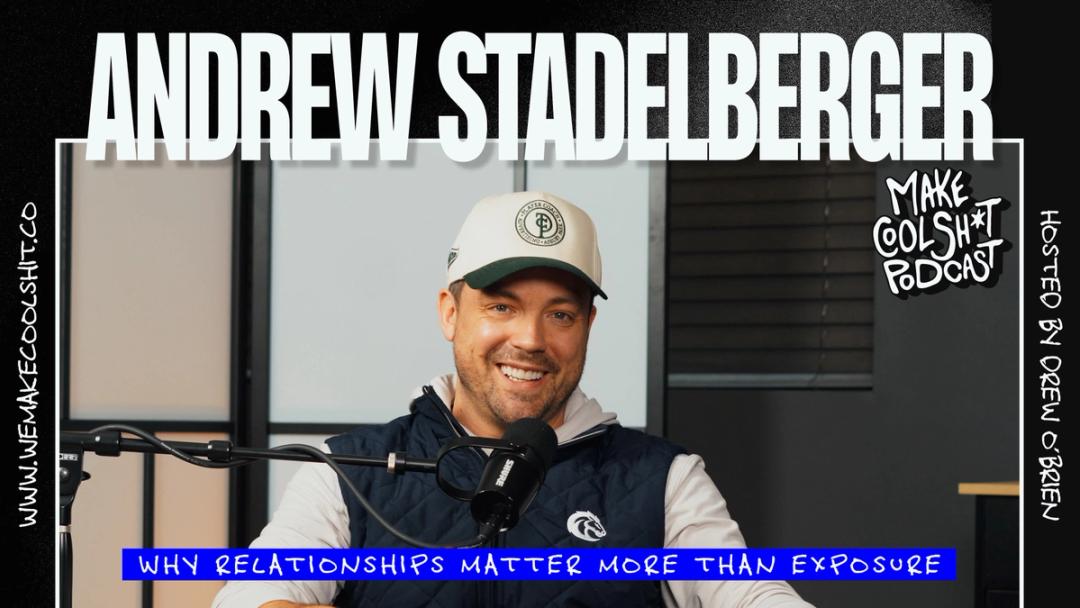
What's up, everybody. Welcome to the "Make Cool Shit" podcast. This week I'm sitting down with Andrew Staedelberger of PlayerCoach. We worked together a bit, agency to agency, and today we're going to kind of chop it up on white labeling, on running a business, on what it's like to be in the advertising space, and why we both quit our jobs to start our own companies. So, Andrew, for all the people that out there that don't necessarily know who you are, or know who PlayerCoach is, give me a little bit of background on yourself, and as well as PlayerCoach as a company. Yeah, thanks for having me. So, I started PlayerCoach, an advertising agency down at the Jersey Shore about 3 years ago. It kind of modulated out of a consultancy, a creative consultancy, that I started. And the idea is basically that we're taking very high-level talent who are fractionally still out in the world: leading Google ad campaigns, people who are running some of the most talked-about and well-known internet shows that are out there, just people that I've been able to network with and be a part of their professional journey over the past 15 years. We've kind of assembled, in your terminology, an Avengers, in a way to help businesses that wouldn't usually have access to those types of resources, that type of experience, in real time. This is, as you know, an industry of advertising creative that trends change, technology changes, the algorithms change, which means do people see and understand and hear about your product or not. To have these types of resources in a geography that previously was unavailable has been
really successful for us. So, my background is I actually came from the— I've been all over media, actually. I started at CNN when I was first getting out of college in 2008, and right after graduation I got basically into the newsroom during the 2008 election, which was an incredible experience. Burned me right out, so I went into advertising after, which is where I've been— So you went into another thing that will burn you out. Exactly. So I figured, let me at least wear jeans while I'm being burnt out, so I moved into advertising. I went into an agency called The Voss. They, if anybody remembers, the Most Interesting Man Doseckies commercials from back in the day, they were running those. The entire agency was, like, writing lines and sending them to the creative team, and the creative team actually would take some of the best ones. You were in the New York office? I was in the New York office, downtown. And they were— they're a global ad agency, their headquarters are out of Paris, but we were the New York arm, and I was on the new business team pitching new brands. So every couple of weeks I'd have to learn about IKEA, you know, wreck it, Ben Kiser brands, Lean Cuisine, whatever it might be, Jaguar, and find a way to best pitch or try to retain that business. Crazy learning experience. Were you a part of the Jaguar rebrand? I was not a part of their Jaguar rebrand. Absolutely not, no. I had nothing to do with that. So you started at CNN. You, as far as I know, you don't have a designer background, and you're not
someone that's in the trenches doing the creative, right? But fast forward, started at an agency, and now you run your own agency. So what is your favorite part about running a creative agency? Because in the background, sometimes it's not that creative. Meaning, like, there's a lot of mundane work, there's a lot of hardships that come with running an agency. So you went from pitching, being a creative idea person, like a copy guy, an idea guy, and now how did you translate that into PlayerCoach of kind of doing it on your own? So, you know, interestingly enough, it's all informed by the journey. My first job in this entire world, funny enough, was being an improv comedian in high school. So it has been ingrained in me to always say yes end to things, to be hyper-focused on listening to people during conversations and learning how to perform. And one of the occupational hazards that kind of came as a byproduct is I'm always copywriting in real time. So maybe I'll tell an inappropriate joke at the wrong time, but it's just these things kind of come up and come out. So, in terms of my role on new business, it actually wasn't necessarily copywriting or anything like that. It was working under the CEOs and the strategists and pulling together their pitches. So I'm watching them pull together the strategies and creative. How do you pitch a Doseckies or a Heineken for a global account? What are the most important pieces from the ground up? And these are all sensibilities that you take with you along the way. So I ended up, real quick story, bouncing to an animation house where I quickly
became an executive producer, again, pretty young, in New York City. And then from there, moved on to a music house called The Music Playground, where they basically put music on TV shows, movies, things like that. If you ever watch a movie or TV show where you're like, "Hmm, this band sounds like they've been around for a while, but I've never really heard of them," and then you might not hear them again, that's the level of bands that we're representing. So that was a great experience. And through all of these different experiences, you get just so much creative experience. And at the end of the day, good ideas can come from anywhere. And as a producer, which is what I became, you're both running the administrative side and making sure the trains run on time, but then you're also making sure those trains look as good as they can or as attractive as they can be. So one of my favorite things— so I do consider myself a creative producer, effectively. And one of my favorite quotes, I think, came from Quincy Jones on a Coldbare Report episode in 2009. I'm sure we all remember this episode. We could fact-check it. Yeah, I'm sure we can. Jamie? It was somewhere around 2000, whatever, the late 2000s. He was asked what a producer does, and he said, "If the music sounds right, and we got the right instrumentals in there, and the crescendo hits at the right time, and the mix is perfect, and then it got distributed everywhere, the artist is a genius. If any of those points mess up along the way, it's the producer's fault." So
that has been kind of a challenge here, because a lot of the agency's ethos is, "We are going to be elevating your brand, and we do that, and we actually can prove sales lifts through targeted advertising and pixels and so on and so forth." Our clients are pretty happy. The one thing that has been a challenge for me is getting myself a little bit out of the administrative side and into the creative side, because that is the most fun, and I do think that's where I do personally thrive. One of the great things about our agencies is we get to know the clients really well, and we call ourselves an agency in your corner. And via that, we're able to be their creative arm almost in-house. So that is something I'm moving towards a little bit more, and trying to replace myself in the administrative side is the biggest challenge I'm facing right now. You've worked as a producer, you've worked on the back end, the front end, the creative side. At PlayerCoach, who would be your ideal client? Our model is the traditional agency model, where we're not picking up competitors. So we do have an Apple brandy brand. We're not going to be looking to pick up other Spirits brands. We have a high school. We're not going to be picking up other high schools, so on and so forth. So I want to cut you off there, because I feel completely the opposite. Okay. And I'll tell you why. Yeah. I have multiple restaurants, multiple apparel brands, multiple— you name it. I have multiple clients in the same sectors.
Yeah. Right? Here's why I disagree, is because— now, it might depend on the service, and I'll explain. Sure. We are building apparel brands, for example. I own two apparel brands. So I am making sure that both of those apparel brands are different. And when I'm building another apparel brand, I'm making sure that that apparel brand is different. So I'm actually controlling and making sure that I'm building something original for all of these people. So if I did have an Apple brandy brand, and then I went and picked up a different person in the same space, I would make sure that it has nothing to do with the other person, and make sure that we're doing something totally different. So the only reason why I cut you off is because I did come from a traditional advertising world as well, where we didn't pick— if we had a Coca-Cola, we're not going to pick up Pepsi. Right. Right? Obviously, that's an absurd example, because you wouldn't actually do that. But you are able to control the creative and make sure that you have something specific for each client. Sure. So the only reason why I'm saying that is you could potentially be taking away new clientele, because what if, one, you work with one restaurant, then the next restaurant's like, "Yo, that's amazing. Like, I want to go work with PlayerCoach." Sorry, I already have a Mexican restaurant in New Jersey. Right? No, you're going to do something totally different with the other Mexican restaurant. Sure, totally. I do think that you make a good point when you're saying— and I do respect that point of view, too, and I've thought a lot about that.
It, to me, depends on the scope of what the relationship is. So for our model, we are a little bit less of a creative agency and a little bit more— let me stop right there. I'm not cutting, I'm just saying, let me stop myself right there. We are both a creative agency, but also a results-driven agency. So a lot of what we're doing is targeted advertising, market research, trying to figure out competitors in the space. And as such, our model has made us kind of like an in-house team. It would be tough for me to spend however many days in a war room with one Apple brandy team and then jump into a war room with another one. On top of that, I think there's kind of like a— from a perception perspective, there's kind of like a conflict of interest there. So my thought is there's so many different categories out there and so many different places that we can play and draw inspiration from. I'm, at the moment, not hard up to be jumping into any competitor. So to go back to your original question, who would our ideal brands be? They would be brands that I feel like I love the mission, love the idea, love what they're trying to do, and have some sort of affinity and knowledge for the space. And that, to me, is just very specific to me. So let's say there were a Savannah Bananas baseball team that were up here. I would kill. And I would white label Make Cool Shit for it. I would probably go in and white label us as Make Cool Shit, you know, for that type of thing. If there is— we've got— I'm not even kidding you,
we were contacted by an independent professional wrestling promotion, and that came very close. I'm a lifelong pro wrestling nerd for absolutely no reason whatsoever. Those types of things are really exciting to me, because these are things I've thought through a million times, and my brain, much like yours, can't help but see a brand, a business idea, and say, "Where in the marketing category, where in the market right now does this make sense? What is not being said about it? What needs to be highlighted that isn't? What if we tried it a different way?" So it's brands that are fun, like to maybe take a little of the piss out of themselves, like to have a sense of humor about things. Those are the brands that we tend to do the best with, where we can be a little bit tongue in cheek. That said, we also play very well with conservative clients, too. We have a Catholic high school. We have a couple of wealth management firms and hedge funds and things like that. I think going along with the whole idea of experience and giving the most professional experience that we can to our clients, we can shift. We can be, you know, a little bit off the wall and help challenge your brand's breakthrough by being funny, and I think by being funny and interesting, and I think that Make Cool Shit does a great job of branding for those brands that want to break doors down, right? And then we can play more conservative, too, and I think that's a credit to the creative teams that we have and some of the producers that we have on
our staff that make sure that every brand has its own voice. Pretty distinctly delineated. You mentioned brand. Yeah. It's a common word, right? It's a word that's so overused now, some people don't even really know what it means, right? So I ask this question every episode. When you hear the word brand, what does that mean to you? Brand is an identity, and I think the fluidity of the term is just kind of what the world is at this point. The internet makes definitions of words and ideas move and change so fast that I think week-to-week brand changes. Right now we're hearing a lot about personal brands, right? We're actually talking about that a lot, right? What is your personal brand? At the end of the day, I think when we're talking about brand, it's, what does the everything about you say about you? Right? What does the way that you dress say about you? The terminology, the vernacular, the way you walk, the music you listen to, those types of things all say something about you. And I think that we've become so hyper-aware. I'm not blaming the internet for this, I'm blaming the real world for this. When reality television started getting popular, I think everybody started seeing themselves as a commodity in one way, shape, or form or another. And we started taking to these archetypes on television, as we always have with, like, movies and TV shows and things like that. But I think that everybody started seeing themselves as a potential star, and then social media probably exacerbated that quite a bit. Branding, I think, is the way that you put yourself out there to the world
and present yourself. I don't think that's a bad thing. I think self-expression is really important, especially in this culture where it's very individualistic, and there's a lot of ways to monetize that and find opportunity in this world through that. When we say, "What is brand in terms of a business?" I think that's just an emodulation of the personal brand or whatever it is you say about yourself. It's basically a business. Mitt Romney said, "Corporations are people, too," and I think that's hilarious to remind people of, but at the same time, you're really doing the same thing. Like, let's take Shorehaven Wealth Partners, one of, you know, our wealth management funds. Well, who are they? Who are they speaking to? What do they want to put out there? Do they want to be a little bit more professional? Like, do they want to be a little bit more off the wall, Gen Z, millennial? The way that they present themselves, the everything of what we put together is going to have to feel like it fits in this space and speaks to a certain demographic of people. But yeah, I think brand is an extension of, you know, just who you are and telling people, letting people know who you are and what you're about. There's personal brands and business brands. Yeah. Right? You kind of just hit on both of those. Why are you here today, right? Why am I here today? There's a point in 2025 and moving forward where personal brands are a thing now. Right. And it wasn't a thing so much in the past, right? So is that something that you deal with your clients, where, okay, the
CEO of company XYZ or client XYZ. Yeah. Is the face of the company, and then now you have to build almost two brands into one. That's what's happening all over the place, actually. So we're finding that one of the more popular trends out there in social media is founder-based stories. People want to watch you build, or people want to see you already behind the scenes working through what you're working through. We build parasocial relationships with people online. I'm following people who I think there's one girl who I'm following from Denver who started a women's pajamas company, not like a sexy one, like a just—she's hilarious. And I barely am aware of the work that she's doing, but every couple of stories she'll put out, she puts out a link to what she's creating. We are now in a world, and I'm fascinated by the independent creator economy and boom in the past 10 years, because it's kind of flipped the way that the economy works, right? Like, so ultimately, back in the day, about 15, 20 years ago, you'd have to buy a CD for $20 if you wanted to hear one good Less Than Jake song and then 10 really bad Less Than Jake songs. Sorry. We're really showing our age here on the podcast. We are. I mean, like, I'm going a little bit gray under this great PlayerCoach hat here. But now we're at the point where any independent creator can get out there, get 100,000 views just on the merit of being interesting or good, and then have something to sell directly to consumers. So one of the things that we're obsessed
with at PlayerCoach is a contemporary theory that's called the 1,000 True Fans. Have you heard of this? The 1,000 True Fans theory is a fascinating approach to putting yourself out there as a personal brand, because if you have 1,000 True Fans, the theory states, 1,000 True Fans who will buy anything that you're putting out there, follow anything, subscribe to anything that you're doing, you will make a living. This is. Which is better than 10 million fans that are just a number and will never purchase anything from you. Exactly. Right? So there's so many people on social media specifically that have 50,000 followers, 100,000 followers, half a million followers, 1 million followers, and they're deadass broke. And it doesn't convert. It doesn't convert. They're just, you know, good-looking models, male, female, doesn't matter, whatever. They just have a lot of people that are interested in what they're doing. Right. And then you'll see a play where they're like, "Oh, try this protein shake," right? "And use my affiliate link," and they still have no money. Right. Right? When in reality, the Lamborghini that they have is rented. The car, the house that they're in is their cousin's. Right. Right? So there's so many people out there, right? Like, even here at Make Cool Shit, I think we have, at the time this podcast is filming, we have, like, 33,000 followers, which is not that much, right? To some people, it's an absurd amount, and to some people, it's nothing, but I make sure that we monetize. Yeah. Our 33,000 followers. That's why we're on this podcast,
right? I need to make sure that we are making sure that the followers equal clients. Yep. It's not a one-for-one. It's not every two followers we get one client, but we need to make sure that the number means something, yes, to outside clients, to show that we're legit, that we have a good amount of following, and that we have good content. That's important because they're obviously going to check, they're going to check us out and make sure that we're great at what we do. But those numbers mean nothing if your bank account has $0. Right. Right. Completely. And I, again, I think it's about the pulling out of the personal brand of the business for a lot of these businesses, because people do want to know and have a relationship with the people that they're buying from, or at least from the other perspective. You just find someone who's interesting or funny online talking about a topic you're interested in, and then you just kind of find your way down that funnel. So with, for instance, Laird & Company, America's first and finest distillers, there are so many different stories to tell about them. Their first Apple brandy drink was probably distilled back in, like, the 1680s, 1600s, but their first record of sale is 1780. George Washington is on record asking them for the recipe. Laird family members are. Which is wild. Which is nuts. Laird family members are in the history books guiding him around Montmartin County to find a way around the British. Like, they keep popping up in history in these different places. Now it's led by a ninth-generation matriarch, Lisa Laird, the CEO, absolutely crushing it.
The family's fantastic. And now we're pulling Lisa out as a personal brand, the first lady of Applejack. And we're getting a lot of love from her because the industry absolutely loves her, and they want to see more of her, and we're finding that out only by putting her out into the market and the market telling us that back. As an extension of that, we've got Crown Point, tax and wealth firm, Nick Agregar, who is, by the time this podcast gets out there, he's probably going to be a TV star. The way that he's been putting out content as a personal brand, talking about how every day is tax day, it doesn't matter what's going on the news, he will find a way to take that news story and make it about taxes. He'll take whatever date it is or holiday it is and make it about taxes. And over time, he's been reached out by, I'm hearing, fraternity brothers and massive M&A clients and things like that, saying, "Hey, I get what you're putting out there." And he's just, we were just talking about this before. I'm pointing at Jamie in the back. No, we were talking about this before, Mike and I, about even iPhone content. There's a place for that. It doesn't need to be so polished. So we're finding that a lot of the business owners that we have are now, to your point, asking us to split the branding between the business itself and then there's this separate personal brand where people are actually, I think, driving business a little bit more efficiently. You've been running PlayerCoach since 2020? Yeah. So PlayerCoach started in 2020 as an LLC.
It started as a creative consultancy. A good friend of mine, Catherine Henderson, who's running Versus Studios up in New York City right now, her and I actually started this as a smaller creative consultancy, and it stayed that way for about two years while I was working with some other clients. And little by little, the consultancy needed an editor for some of the work we're shooting, and then we needed a designer because I can hum a tune in a lot of different ways, but you need an expert, so I ended up working with you. Actually, speaking of targeted advertising, I saw one of your ads online and reached out, and the first thing Drew said to me is, "Good, I'm glad to hear it. It means my marketing's working." I remember that day like it was yesterday, and it's been great ever since. So this thing, one day we woke up and realized we have Make Cool Shit as a creative partner, we've got a great editing team, we've got a development team, and this is now a proper advertising agency. So we actually asked Drew to rebrand us as, rather than PlayerCoach consultancy, PlayerCoach advertising. And this now has turned into a full-fledged ad service where it's not just creative and it's not just design and editing. We do have those high-level senior people over at Google who can tell you or who can teach you how to get to the top of the rankings. We have AI SEO experts who can make sure your name is what pops up when people are freaking out on ChatGPT and looking for a plumber or whatever else it might be. We're basically full service at this point.
We're actually now evolving. This is kind of breaking news for the 200 followers. Dude, dude, dude, dude, dude, dude. That we've got, but no, we are building PlayerCoach Studios now, and it will open in February in Red Bank, New Jersey, at the Galleria. We have a couple of other businesses that are helping us do this, and it's going to be an exciting new chapter in what we're doing. We're going to be bringing in a lot of businesses, making sure we can effectively tell a lot of stories. And hopefully, I mean, pulling the curtain back a little bit, this feels like a top of funnel. Somebody called it a honeypot to hopefully bring clients in, have people feel comfortable. You know, one of the upsides of an ad agency is all the clients love to go hang out at the ad agency because it's fun. Usually, like, it's a little bit upbeat, a little bit more laid back, and at the same time, we're going to double it as a content studio. So great things happening all around. So in the PlayerCoach Studios, what are some of the services you're going to have there? Like, if someone wants to have their own podcast. Yeah. Just like what we're doing here at Goose Media here in North Jersey. Yeah. You want to go down south to Red Bank, Asbury Park area, right? Which is a bustling area in itself for people that aren't from New Jersey that are listening. Yeah. Like, it's a hot town right now, right? A lot of businesses, a lot of small businesses, and even big businesses. And I'm sure you know this, and I'm sure it's not by accident.
Netflix. Yep. And major, major, major, major production studios are all somehow coming to our little state of New Jersey, right? So there's going to be a massive boom in Jersey in the next, like, two to five years. So someone who wants to film content that lives in your general area or who's capable of driving to you, what are some of the things that you're going to offer at PlayerCoach Studio? Yeah. Look, if you are in North Jersey, you go to Goose Media, and that's basically it, right? Clip it. Clip it. But PlayerCoach Studio is, yeah, thank you. It's opening up in Red Bank, New Jersey, which is a very hot town. If people are hearing anything about Monmouth, New Jersey, in my opinion, it is starting to look like the next Hollywood, especially with all the trucks and the traffic. It's insane. But I grew up at the Jersey Shore, I'm Jersey Shore, born and raised and grew up basically a town away from Red Bank. In fact, my first job in life was doing improv comedy in Red Bank through high school and college. So it's kind of like going back home in an interesting way. And we are setting up at the Galleria. So the Galleria is one of the more well-known World War II warehouses that's been reconverted in town. We see a lot of opportunity there, and like you said, it's a very hot spot. Right off the train, so we've got a lot of our New York network easily accessing our spot here, and it's all looking pretty good. That's an investment. It is. Right? Why are you doing this?
Why as a business owner, are you taking a risk and saying, "I'm going to start this fucking studio when I don't have to," right? So why are you and everybody at PlayerCoach taking this gamble? Because in business. Yeah. Most of the things are a gamble, right? They're calculated risks. They're calculated gambles. But why are you creating this studio? The bigger risk is not taking a risk, in my opinion, at this point. Ooh. Say that again. I said the biggest risk, in my opinion, is not taking a risk. There's so many people that are sitting at home that think they could start a business or want to start a business, and they can. They just need to jump off the deep end. It's one of those things where the most painful feeling to me is sitting around and thinking about it and being frustrated that it's not there. I think the actual, in reality, the easiest path forward is through. The only way around is through, right? So for me, when I'm thinking about the evolution of the agency, ultimately, we do want to be highly profitable and a well-known agency. I do not need to compete with BBDO. I do not want to take over the world. I just want to go home, like, surf after I'm done with work and all this kind of stuff. But when you're looking at these, you know, the evolution of a business and an agency and you're growing, I think that we can handle a couple more agency-of-record clients and do really well by them and for them. But is that the best that
we can do? I don't think so. I think that we can control a lot more. I think we can provide a better resource for our clients to come in and be able to create content a lot more easy or a lot easier. Content is king, and I think it will always be king. I don't think that there is a way around this anymore. Now, I do not think that we're going to be in a place where, like, podcasts are always going to be king. I think that just like we're seeing with AI slop and things like that, there will get a, we will get to a tipping point in a critical mass where it's kind of like enough is enough, at which point we'll have different ways of telling stories for our clients in a studio where we can do that. We are going to put up a green screen and just have a bunch of different avenues for our clients to be able to tell their stories. In fact, I was mentioning television. Some of our clients are that good that we're building a little TV studio where I do have some contacts, or we have some contacts in television, in news, as I mentioned before, and we'll actually have, like, a live hit studio too. So if you need to jump up on, like, a 4K live cable stream, we'll be able to do that. You know, the risk is taking no risk, and the reason that we're evolving is because we think and know that we can grow, and more people should know about us. And if we can have more people come in, feel the vibe, understand who
we are, feel comfortable, and feel like they're already a part of the community, that makes the sales effort on our end a lower lift. That gives us the ability to make our own content whenever we want to, experiment, and have a really good time. I mean, at the end of the day, the reason that we are not in accounting right now is because we want to enjoy what we're doing. That's my guess, right? I don't love numbers. I don't love the admin side. It's just one of those critical things you got to do. But the ability to have a space where you can create, experiment, publish unlimited amounts of content, have people come in, do favors for people if you need to, pull together a workshop space, it just seems like an incredibly exciting opportunity for us. On top of that, we actually did poke around a little bit, and we are finding that there are a couple of networking groups and businesses out there that might want to jump in on this project with us, kind of easing the risk a little bit, but also underscoring the need out there that the market has. There's a place in the market for it. There's a market opportunity there, and we're hearing from the market immediately. So we're feeling like we will open with, you know, hopefully a fairly packed schedule, and it feels like the risk will pay off. And if not, I'll come back here to Goose Media and hope somebody will hire me. You started the company, started as a consultancy. Yeah. Then it's now a full-fledged agency, right? Where do you think people don't necessarily understand
how tough it is to run a business? Oh. It doesn't even necessarily need to be the agency, right? Because I think if you aren't a business owner, then it's really hard for you to understand what it's like to do this. And I think just most people don't like to talk about the running of the business side. Yeah. Right? They just like to talk about, you know, "Hey, this is a great social media clip, and we could do this, this, this, and this." But, like, a good example here, Make Cool Shit, I don't talk about it often, but, like, we need to make about $30,000 a month just to keep the lights on. Yeah. And no one really talks about that, right? So how do you go ahead and make that? Well, what do you do? You start a podcast, and you get people, no. So you need to go and get clients. Because yes, it is super fun working on new clients, and it's fun making Cool Shit, and it's fun running it, and it's fun having an office that you wake up and you don't hate going to work every day. I truly love what I do every day. But what we don't talk about is, "Okay, I work 8:00 to 4:00 every day. I pick up my daughter. She goes to sleep, and the second she goes to sleep, my laptop opens again, and I work from 7:00 to 9:00. And last night, I totally revamped our project management tool. I was up till 1:00 a.m. running Trello," right? That's not something I normally talk about because that's not the sexy thing, what it's
like to run a business, right? So you have been running a business technically not that long, neither have I. Sure. Going on nine years, but in retrospect, what has been the most difficult thing for you as an entrepreneur now on running a full-fledged business? I think you just nailed it. One of the things I'm meditating on a lot specifically is pulling myself out of the business and being able to get out of the minutiae of the day-to-day, making the trains run on time, the actual producing of it. You want to be an owner, not an operator. That's it. And I've been operating a little too long if I'm being introspective enough. And we are making changes to do that. I think one of the good things about having a nimble agency is I'm able to make these changes really quickly, see an opportunity or see a challenge, and speak to it pretty quickly. From a broader perspective, in terms of being a business owner, it is not easy. You are doing it alone a lot of the time. You are pulling personal savings out. You are paying people. They don't know where the money is coming from. So if a client's behind one month or two, you're pulling out of personal savings, and it's not like you get an extra award for it. You don't necessarily get a pat on the back. When you are done working at 11:00 or 11:30 at night, and you're really proud of the work that you're doing, and your client appreciates it, that's great. Maybe your significant other doesn't. Maybe it's something where you're taking work home and having
a tough time with the family. You know, maybe your parents are a little stressed out not telling you because they can see that your mind is elsewhere. There are a lot of times where, even on the weekends, the business pulls me out of where I am presently, and where I'm presently is pulled out because of the business and so on and so forth. Well, there's no such thing as weekends. Well, there's no such thing as weekends. As a business owner. That's the thing, right? And so as a business owner, there is no such thing as the weekend, and you have to be able to communicate effectively to the people around you that there is no delineation of my work time and my not-work time. You can't just tell them that you're off. You can't just tell your clients that, you know, you'll be back tomorrow. If there's an emergency, especially with a smaller business, you are the one fixing it. Now, I think that's a double-edged sword, right? A lot of the reason that we say PlayerCoach is in your corner, and people really love working with us and have renewed us time and time again. Every time we have a retainer renewal, we've got a 100% renewal rate at this point. I'm going to knock on wood there. It's because people actually know that we are, you know, very much in their corner. So at the end of the day, we are bending over backwards for our clients. I think customer service is the most important. The challenge with that comes the personal life and being able to keep yourself motivated and healthy every single day. And you also are hit with an influx as
a business owner, especially in the marketing space with marketing gurus, business gurus, people giving advice that is just constantly stressing me out. Like, for every gem, business gem that I get, I get 1,000 reels that are just stressing me right out. Things I've known before, contradictory information, whatever's just popping up as I doom-scroll. So there's a lot of different factors here, and I think ultimately, those who can focus on what is, you know, the 80/20 type of thing, like 80% most effective versus the 20, I personally have some trouble with that. I have a very, I'm not going to diagnose myself with ADD. I don't think I have it. But my mind is always bouncing around to different creative ideas and liabilities and opportunities, and I think it's one of those things where you have to figure out, as an operator, if you are going to be operating your own business, where you are a liability and where you are, you know, an additive. So those are all kind of what I've been dealing with. Very good point. And I think a lot of business owners can really understand where you're coming from. One of the best pieces of advice I've ever gotten on the business/personal side is from my good buddy Mike Steadman, who will be on the podcast, where he's, I'd be working all day, every day, right? And I'm somewhat of a new dad. My daughter's almost two now, and I drop her off at school every day. Then I work hardcore. I don't, the only breaks I take is to go to the bathroom.
Yeah. Right? I eat at my desk, if I eat at all. Got it. And then I go pick her up around 4:30, spend some time with her and my wife, then put her down, and then usually I'm doing some form of work after that. Why am I saying all this is because in the past, I would work myself to the bone so hard that I'd go pick up my daughter and then go home, and then I'm a just, I'm a waste. Yeah. I'm just a piece of shit. Right. As a human being, because I worked so hard. Now, I still work the same amount, but one bar that my buddy Mike told me, he said, "You are giving your family and specifically your daughter your leftovers." And that's something for me. Right. I still work absurdly hard every day, and this goes into work-life balance. There is no balance, right? Meaning everybody has their own balance. I, the other day, Richie, our designer, came into the office. He's like, "It's Friday." He's like, "Thank God it's Friday." I'm like, in my head, I'm like, "Richie, I don't know what that fucking means." You know what I mean? Because I got to do work on Saturday. I got to do work on Sunday. And I want to be clear, that's not a complaint. That's the life I chose. Yeah. Right? That is the life that I chose, and it's something that my wife has to deal with, something that my daughter has to deal with. So the work-life balance aspect, nonexistent. Yeah. Right? Giving your family your leftovers is something that I try every single day.
What I do is literally on my drive home, I'll ant myself up and be like, "Okay." Yeah. Like, "I need to be there for my family." So what is the best piece of advice that you've received as a business owner that you kind of look back on and say, like, what's your mantra? For me, it's never give my family the leftovers. Yeah. And I always say to myself, "Forward always, always forward." Right? Because you could harp on your mistakes, because I make a shit ton of mistakes, right? I literally have an apparel brand that I'm a partner in called Made From Mistakes, right? So you're always going to make the mistakes. The question is just how are you going to actually get up from them? Or more importantly, how are you going to learn from them? Those are just my couple things that I think of literally on a daily basis. No leftovers, always forward, forward always. Yeah. I love that. I think that's outstanding. Feel free to take it. I haven't trademarked it. I will, and I'm going to take your Avengers line too. I have thought long and hard. Pause. Pause. I have been thinking about mantras quite a bit, and the one that keeps popping up for me is the improv principle of yes and, and I think that this can get you in trouble sometimes, but for the most part, yes and philosophy is a really great guiding light and kind of distilled down to, like, the most basics of it.
When you're watching an improv scene, you're really just watching two people have a conversation, right? Your mind is filling in a lot of the gaps. Which is not too dissimilar from a podcast, something as simple as a podcast. Completely. So your mind is filling in the gaps. This is just based off of an audience suggestion. And for these scenes to build and keep the reality, there has to be some sort of structure, as ridiculous as these scenes can get, right? So that means if Drew were saying something to me and said, "Hey, I like your blue shoes," and I said something back to him to the effect of, "I'm wearing pink slippers, you idiot," that is the end of the scene. No, there is no reality in the scene whatsoever. We can't agree on what reality is, and therefore, there's no stakes in this situation. That said, so what you were taught, and, like, maybe we can, with the stuttering and everything, like, we can kind of clean this up. But that said, the principle of yes and is something that's tied into listening and understanding and being open to change. Two people generally will go into an improv scene without having spoken to each other with two different ideas on what the suggestion the audience member gave is. So if someone said, "Chanel, I might think of myself being in a jewelry store, you might think of your name as being Chanel." Now, we've got to figure out how this reality kind of works and mixes in. Yes and is about being open to any possibilities, saying yes to it, and I'm going to add to it.
I think that this is applicable in so many different ways in terms of taking opportunities, seeing opportunities for what they are, maybe saying yes to things a little bit more when you are someone who tends not to. But I think that also extends itself to creative ideas. Why not take another take? Why not throw a creative idea off the wall, especially in the age of trial reels and stories that disappear after 24 hours and things like that? The yes and principle actually basically got me to where I am today in terms of saying, "Do I want to start a business? Yes. Do I want it to be the best business I can make it? Yeah. And how do I carve my own space?" So on and so forth. So the yes and principle, for the most part, has been the guiding light. And then again, I'm going to call back to the 1,000 True Fans theory because we're finding that personal brands are competing as well as established brands in that space. Your entire philosophy is yes and, right? Or one of the core pillars of. One of them. Of how you kind of go about your day. How do you deal with saying no to clients, right? And more importantly, how do you deal with saying no to someone who wants to work with you, right? Because I've found an immense power in saying no. People hit us up all the time, and they might not have the budget or they might not even have a good idea. Where in the past, this is eight years ago, nine years ago, I'm saying yes and taking the money because I didn't
know anything about business, right? Sure. And I didn't know anything about how to build our own brand at the time. But now, saying no is extremely powerful, and I don't say no to clients just to say no, right, because I like saying no. I actually prefer saying yes, and I really like money, and I really like growing my business because I'm not going to lie here and I'm not trying to run a charity, right? But Ryan Mack, who was actually the last guest that we just had, he said something that was pretty profound, and he was like, "I only work with someone if I could trust them with my kids for the weekend." And now, everybody has their own barometer, right? Obviously, they need to hit budgets. The scope of work, all that stuff needs to work out, right? But I'm sure you've taken on clients, and you don't need to name them here, where you said yes, and then day one, one hour in, you're like, "Holy shit. I should have said no." But the money looks really good. The money looks really good when it hits your bank account. Yep. No, I'm calling you out, Maurice, in terms of, I'm just kidding. No, so I agree with that, and the only downside to any philosophy, I think, is that there is, you know, nothing is 100% sacrosanct. So yeah, there's a lot of different times where you need to say no to clients, and maybe that has at times been a challenge. I think especially as a young company, you're looking to build your portfolio.
You want to make a lot of relationships, and at the end of the day, there are those opportunities where it makes sense. There's also those opportunities where I've become pretty adept at finding them where they look good on the surface, but it kind of smells a little bit funky once you get in there. Some startups look this way. A lot of, you know, startup cannabis brands that I've been a part of are this way. A lot of challenger energy drink brands. Anywhere where you feel like there is a little bit of an internal disorganization, you can't get people to lock down on scopes and things like that, I tend to walk away from at this point. Free work for a nonprofit, if we have the ability to and we've got a relationship, we're more than happy to. Whenever possible, we always try to bring the elevator back down whenever we can. But to your point, one bad client experience can shape your month. It can hurt financially. If you have a great client who you like a lot and hasn't paid you in two or three months, that hurts a lot. There's a lot of different things you got to watch out for. And going back to one of your earlier questions, that is one of the hardest things about business. It's the dogs that aren't barking. Once you learn to try to tune into them, you're constantly on alert, and that can get a little bit exhausting. So yeah. The clients that are sometimes a pain in the ass. Yeah. Right? Versus the clients that are great, right? What people don't realize sometimes is
you take on that client that isn't great, but they're paying you a lot of money, right? So that's great. Money is great. We all need it. By the way, the only thing both of our businesses or any business in the history of the world can survive on is sales, right? Yeah. I think that's another thing that people just forget about business. Yeah, brands are important. Make no mistake. We build them. Everything about business is hyper important, but the number one important thing is sales because if you don't have sales, you don't have a business. Yep. True. Right? So you take on that bad client that's paying you, I'm making it up, 25 Gs a month to do 15 different things, right? Where you don't realize is the amount of time that you work on this client that you hate. A, you hate doing it. B, you spend three times the amount of what you should be doing on an hourly basis on this client because they're a pain in the ass. But then more importantly, what you don't realize is the amount of time that you're taking on this client that you shouldn't have taken on in the first place. Right. That amount of time you could have, if you didn't take them on, you could be working on finding that ideal client that pays you the same amount of money that's a joy to work with. It's an opportunity cost thing. I've seen time and time again in massive advertising agencies, a mid-sized level client will only jump on if they can get 80% of the
CCO, the head creative, chief creative officer's time. And that has gutted agencies that have been a part of. I've seen, like, cascading effects months and years down the line, and you see it in small businesses too. So yeah, totally agree. I mean, it's something I struggle with all the time, right? When someone signs up with us, they ask me, they're like, "Hey, are you, Drew, going to work on the design or work on the strategy or work on, are you going to creative direct it?" For everybody out there, I'm always, from a creative direction standpoint, I'm always there. But some clients, I handle every single thing myself. Other clients, Richie or Eden or TJ, someone else from my team are handling it, right? Yeah. Some of my team handles your guy's stuff. Sometimes I handle that, right? I need to pick and choose as Drew O'Brien with my time in the day versus being an owner and an operator. Where am I going to hand draw the logo versus where is Richie going to do it or Eden going to do it, whatever that is, right? But that's something that I'm struggling with as an owner and operator because some people come to me because they want me. Yep. But I'm not May Cool shit. I just own May Cool shit, and I'm a massive part of it, but Drew O'Brien and May Cool shit are two different things. That goes back to what we were talking about before, which is what are clients actually buying? So I have no problem being completely transparent with my clients that I can hum
a tune, like I mentioned before, in kind of almost any category: targeted advertising, creative direction, editing. You know enough to be dangerous. I know enough to be dangerous, and I know enough people to be lethal, I think. So when I speak to my clients, I'll say, "Hey, look, you know, Drew's calling it the Avengers model. I've never seen the Avengers. It's been on my list for, like, five years at this point. My brother will not leave me alone about it. I'm sorry. I just, I can't get off Reddit to watch anything for more than two hours. I apologize. It's just, like, who I am. I'm wired that way. But I will tell everybody, I have a great network. I have a mass, an incredible network of not only highly talented people, but people you'd want to spend time with, like, for two or three hours at a time, people you actually enjoy being around. And I think that's something that's said pretty glibly all the time, like, "Hey, I'm working with my friends. Come work with us." But at the end of the day, we are really pulling together an incredible client experience that makes it hard to not renew with us at the end of the day. Which is very important in a service-based business, right? No matter what you're doing. I know it's cliché, and I know it's all over social media, but I kind of want to throw up before I say this, but it's true. Your network is your net worth. Yeah. Right? So I didn't necessarily believe that. Took me years, years and years, and especially when
I started this business on my own, no partners, no nothing, in my head, I just had this massive ego. I was like, "Oh, people will work with me because I'm dope, and, like, we're really amazing at building brands and creative and all that." And then I realized that all of a sudden, I started getting in the right rooms, right? I started going to entrepreneurship conferences. I went to multiple different areas where creatives aren't necessarily in the room, right? So all of a sudden, I hop in these rooms, and I'm like, "Wow, these are clients," right? And more importantly, the clients that you work with, them become your network, right? So I've made half a million dollars over the years just on my network. Yeah. Right? Whether they're working directly with me, whether I'm sending them to Goose Media, whether I'm sending them to the, you know, the new Player Coach studio that's going to open up. How do you deal with your current network where you were at before? Maybe some of the people that you grew up with, maybe you've surpassed, and not in a negative way, right? But as a business owner, your network is everything. Yeah. You, at a certain time, you're not going to use Lenny from the block is kind of the point here. You know, what people are looking for when they speak to Make Cool Shit is not Drew O'Brien necessarily, unless they're saying it explicitly to create everything. It's Drew's point of view and a sensibility, and they trust that you know what you are going to be putting out there and that everything will filter through your vision and voice. We're very much the same way, right?
It's my taste. That's how I like to put it, right? As a designer, as a creative, as really anybody, it doesn't necessarily need to be a designer, but within the world of AI, I think I've mentioned it every single podcast we've had, right? In the world of AI, in the world where everything's starting to look the same, I need to trust my taste explicitly. Completely. Right? Like, even with my own imposter syndrome sometimes, whatever that is, my taste is Make Cool Shit. Right. Right? That doesn't necessarily mean I need to physically design it, but my taste needs to be curated throughout the whole entire company. It's just like a restaurant, right? Jamie Knott, one of my good friends, business partners, episode one, he's not in all of his restaurants cooking, right? But his taste, in this case, literally, right? His palate, his thought process, his creative direction in all of his kitchens, the multiple businesses that he has, is curated throughout. Right. So how do you handle, as someone who might not be a creative. Yeah. By traditional terms, you are now through years of doing it, right? But how do you handle your taste versus what you're seeing out there in the world of AI? That's it. It really is taste, and to kind of go back to the, you know, my cousin Lenny from the block thing, I think your taste has to be your guide, and you have to be pretty loyal to it. So the people who can get it done can get it done, and they can continue on your professional journey with you, and those who cannot, cannot.
And that's just effectively what business is. That was tough for me to learn as, like, a recovering nice guy in my life too. A recovering nice guy. You know what I mean? So in terms of taste and not having necessarily had the title back in the day of creative director at Havas or something to that effect, I still have run so many creative productions and run so many creative campaigns and been a part of so many of these strategies. And just because your title has something in it doesn't mean that you are necessarily 100% that, or just because I'm a producer doesn't mean that I don't have that creative background. It's just not necessarily been, like, my main thing. At this point with Player Coach, what we're finding is there's a couple of people like that. So for instance, my business partner, Dave Weinstein, I'm pointing at Mike as if he knows who Dave Weinstein is, but he's just here. So Dave Weinstein, one of our business partners, used to run Complex Networks, which oversaw Hot Ones and a whole bunch of different, like, you know, hip-hop content pieces and shows and things like that. They're, like, a really great, you know, culture team. He is known as an incredible executive producer in the world and now has emerged as an incredible creative director. He is writing one of the best commercials I've literally ever seen that we were putting out for Raveli, a hedge fund out in New York City. And what we're finding is in the traditional New York advertising agency model, you are one thing. You've gone to school at Pratt, and now you're a creative
director because you're an intern before that, and then you're eventually going to be CCO, and then eventually you're going to be a consultant making $20,000 a campaign or something to that effect. That is what you do. If you're a producer on our track, it's kind of the same type of track, but in a different way. You're junior, you're senior, you're CMO, you're there's a traditional agency track, which I followed through in New York as well. Yeah. But to your point, I hate titles now. Yeah. Yes, I'm the founder creative director, right? Whatever's in my bio is in my bio, but yeah, Richie's a junior graphic designer, but I don't treat him as so. I don't just because he's junior doesn't mean, like, I think titles, not to cut you off, but I think titles really affect how everyday work is within agencies, right? So your title could be a managing partner, or it could be CMO, it could be partner, it could be owner, founder, whatever, right? So whoever you have working with you, I think in 2025 and moving forward, as a graphic designer, I could just speak on my own. You start as an intern, junior designer, graphic designer, senior designer, senior art director, senior art director, creative director. Like, you have to go through all these levels, which I did at a pretty young age, but that's all gone now, right? If you're a designer, you need to be able to work on video now, right? Take any profession, right? You now need, especially in advertising and marketing and creative, you need to be able to do multiple things, right? So how do you handle this evolving world of almost everything now is an amalgamation
of everything, if that makes sense? Yeah. No, totally. We're in a remix culture in every single way. But no, I think in terms of how do we move forward when we've got a world that we came from, which is just title-based, I think our taste is our guide. I'm hearing this a lot online. First of all, from, like, a technical perspective, we're again coming from a world where you used to have to spend $50,000, $100,000, $300,000 on a commercial to put it out and spray and pray it on local TV and hope that people are seeing it and not have a way to make sure that you understand what the data says. Like, did people like it? Did it convert? Spray and pray is the definition of what that was, yeah. And that's completely what it is. And we're out of that now. And now, through social media and different ways that we can reach people a little bit more specifically, we can hit people in their niches and get a little bit more creative with these ideas. In fact, being a little bit more weird or kind of tailored to a specific person, demographic, personality, archetype, whatever it might be, is actually probably a net benefit at this point because if everybody, as you're saying, is putting out the AI slop, if everybody's putting out the Canva template, then you're not going to stand out. You're just looking like you're part of the pack, right? So. Well, if you talk to everybody, you talk to nobody. And if you talk to everybody, you're not talking to anybody whatsoever.
You are just out there shouting into the void and burning your money, in our opinion. And we don't want to do that. That's not what we want to do to spend our time. So we have found that guys like Dave Weinstein and myself, who have always been in the background, who have always been shepherding along these creative processes, a producer needs, like I was saying before, like the Quincy Jones quote, needs to make sure every part of this process is perfect, including the creative. So we have found that we have pulled ourselves out of this world where it's like, here's our title, and here's our role at Complex Networks, Google, Havas, whatever it might be, and we're saying, we are damn good at XYZ. Let us prove it, and our clients are responding very positively. So, you know, it's one of those things where Make Cool Shit is the company that breaks doors down. We're feeling pretty bold ourselves. Before the podcast, me, you, and Mike, were talking about, you know, a multitude of things, but you're kind of starting your own podcast tour, not literally, but you are starting to get yourself out there. Yeah. And you are currently starting to get Player Coach out there. Why have you decided to kind of come out of the shadows, for lack of a better term, and get your name out there, both personally and as your own business? Personally, I feel like it's a little too late. It's one of those things where I'm hearing a lot of business owners saying they are having a hard time getting themselves out there too.
And I think it's one of those things where you can convince yourself there needs to be a perfect time, a perfect way. I'm not ready, but at the same time, I do think there's a practicality to us being in a service business, and my first priority at the moment and always, by the way, will be my clients. So if my day gets a little bit busy, I don't have the time to put into it, the messaging is something that you can convince yourself that you need to finesse. On the other side of things, fuck that, yes and, and just get yourself out there. So we're at the point now where I'm feeling well-established. Like I mentioned, we have a bunch of clients who are renewing with us. We've got some really nice word of mouth out there. I'm feeling really confident with the team that we've got. Like, we've got something snappy. It is now time to get out there and let people know because I wanted to make sure the foundation was strong. I wanted to make sure that I felt like whatever I was putting out there, representing myself, wearing the hat that you made, that we're representing something that we're proud of. And I think we're at that point, and now that we have something to expand to and we're excited to tell people about, this is the time. What's been your biggest fuck it moment? What's a decision that you made that truly changed everything for you? I had a client. So this is actually my first real long-term client. Their name is Christian Brothers Academy. I'm wearing their logo right now.
And they asked me to join as their alumni director. And when we were discussing, this is actually kind of how I think Player Coach kind of kicked off, and thank you, Christian Brothers Academy. They had looked to hire me as their alumni director, which is a job I eventually took, by the way. We made a kind of a deal where it would be me taking it on as Player Coach. And their idea was a lot of in-person dinners and lunches and emails and things like that, which I think is a really critical, important portion of alumni engagement. But I said that if you are looking to reach people who've graduated after the year 1995, you've got to have a digital play. You've got to be looking at social. You've got to be looking at targeted advertising. I found their online presence in their online store, and it had literally been built in, like, the mid-'90s, and they were just kind of limping along there. We put together a new Shopify store for them. We rebuilt their entire store, like, physical brick-and-mortar on the inside and everything like that. And I basically said, the scope that you're giving me of what you think the job is, I cannot take. But the fuck it moment that you're asking about is I put together a new business model that said, here's how I would do it. And I said, give it to the next guy that you guys are going to hire. And I kind of moved on, thinking, let me see if I can continue Player Coach and find new clients here. And they called back and said, we actually
like your plan. We'd like you to execute on it. There's a moment in there where the imposter syndrome could tell you, take whatever role you can and do it however you need to and kind of figure it out from there. I think the bold leader in me said, the biggest risk is no risk. Put out there what you would do. Bare minimum, you're going to, like, help your alma mater figure out how to get a little bit more digitally kind of connected and find people that they wouldn't find before. And look, when you're talking about a high school and a really damn good one, if you're able to reach one guy, that one guy could be a multimillionaire, billionaire, someone who's going to give endowments to the school. You're talking about Netflix moving in. That's a Christian Brothers Academy graduate who's helping move everybody in. So, you know, through that connection, Player Coach was able to grow and thrive. And I think that all comes from just being bold enough to say, hey, here is how I would do it, and having the courage and the convictions enough to be able to say, I got to I cannot take this role unless this is how we do it. So I think that was the biggest fuck it moment so far. And then I'd say the second biggest fuck it moment was putting down a down payment on a new podcast studio. But hey, dude, why don't we make you the first guest when we have a Player Coach podcast, actually? I'm in. Yeah, you in? All right, nice. Speaking of, how can people find you? How can people find Player Coach?
Stop knocking on my goddamn front door, people. Honestly, I put my address out there. No, I'm just kidding. If you need to find me at Player Coach, you can find us at @PlayerCoach_Advertising on Instagram. And if you're looking for us online, it's PlayerCoach.com. We are mid-rebrand. We are calling this, I'm sorry, a rolling rebrand. That's what we call, yeah, rolling rebrand. Yeah. So we're working with Make Cool Shit and Drew. They have already rebranded us once. It was a 10 out of 10. We are looking to do that again with our website. So keep an eye on us. There's a lot of really fun stuff coming. Well, thank you, Andrew. I appreciate you coming in. I'm looking forward to being the first guest on your Player Coach podcast. Everybody, thank you for tuning in. If you got anything out of this episode, like it, share it, subscribe it. You could hit all the buttons. Hit every single button. All the buttons. See you guys next week. Thank you.