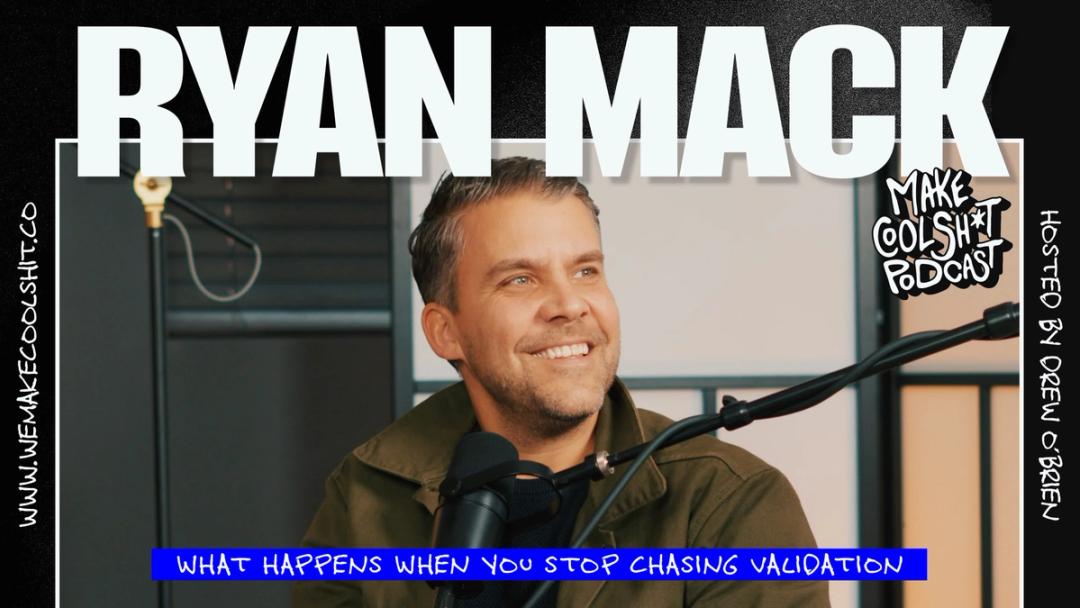
What's up, everybody. Welcome to episode 2 of the Make Cool Shit podcast. I'm sitting down today with Ryan Mack, the founder of Kill the Headlights. We work together a bit at Make Cool Shit, and Ryan also has his own agency with his own clients. So I was actually thinking about this earlier: how did we meet? How did we get connected? Because I have no idea. Ah, shit. How did we meet? I have no idea. Me neither. I even went back to our emails and I couldn't find it. But now we're here. Oh my goodness. It was bothering me all morning. I was truly trying to— on the ride over here, I was thinking about it. Make Cool Shit. Maybe you could have just also just found us on Instagram or something like that. Yeah. I don't know. I thought it was a referral, but I can't remember. It might have been. Some local restaurant muppet. Just— who made that sign? He's like, "Ah, it's this guy." Maybe. That's— that's possible. But we have Make Cool Shit here. You guys have Kill the Headlights. Yeah. So tell me a little bit about Kill the Headlights. It's a great name, by the way. Tell me a bit about the name and what you guys do. It's fairly new. It's kind of been operating in the background a little bit for a while. But the premise behind Kill the Headlights is that brand leaders, company founders, CMOs, they need more seasoned, sharper talent to work directly with them to shape their ideas and strategies. So it was kind of originally
founded as an entity doing ghost work for people in high places. And then that has expanded to be a little bit less of a total shadow operation and more of a— more of a public-facing thing. So you're no longer a ghost writer. You're— you're out in the public. There's still— there's still— there's still people that— that the ghost— the ghost effect is in— is in— is in place. It's actually funny. I was just telling Richie, our new designer here at Make Cool Shit, what that even is, right? I think a lot of people don't realize in our world, in the agency world, studio world, whatever you want to call it, everybody says this line that makes you want to throw up: "Oh, we're a full-service, disciplinary studio, blah, blah, blah." No one's doing everything. Unless you're one of the four major agencies out there. So like, here at Make Cool Shit, we get white-labeled all the time. Every single person on our subscription is white-labeled, right? And we're cool with that because that's what pays the bills. But people don't realize how many times that you white-label people in order to get other work done. Yeah, it's like construction. You got the— you got the GC and then the sub and the sub to the sub and then the sub-sub-subs. And— and then— and then it's— that's the full pyramid of contributors, right? But I think one thing with just to put a bow on the Kill the Headlights bit is people are wildly disenchanted at work today. And so when you are an important decision maker, especially on the marketing and brand-building
side, who are you trusting with your most critical, foundational work? I think it's— right now, it's in a moment where the space, the creative services space, is being exposed because there's so much disengagement, so much disenchantment. I mean, I think the number is something like 4 out of 5 people don't like their work. Don't like their work, don't like their job, don't like— Yeah, it's the gap. It's like the Gallup disengagement metric or something. There was a study from earlier in the year, and it's— I think it's at like a 10 or 15-year high. And so if you— if you're— if you are— if you are on the hook to pull triggers on big ideas and big approaches and new things, who's helping you develop that? And there was a— a— a profound white space in the market where the decision makers felt underserved. Why do you— why do you think that is, the 4 out of 5 people don't like their job? It's actually funny. I was talking to Richie on the ride here about almost like 90% of America hates their jobs, right? Specifically in the creative space. Why do you— why do you think that is? Just to clarify, you can— anybody can go look this up. Fact-check. It's fact-check. I believe it was a Gallup— initially a Gallup research or a Gallup poll that was then followed up with other entities. But there's a— there's a variety of factors. There— there's the— the— and trying to hone in on the creative services space, the onslaught of AI, the proliferation of AI,
that is obvious in there. I think the consolidation of the entire industry, margins therefore are squeezed, and you get people putting pressure on the layers inside of their service orgs to do more. The business that these agencies take on can often be just not terribly inspiring. And then you have like the cultural undercurrents. If you're 30 and you're mid-level, how the hell are you going to buy a home? You know? You're not. What are you doing? Like, what's the future of work look like? Like, how do I find financial stability? And I think all of that kind of compounds and makes people be like, "Yo, fuck this shit." Yeah. I think you— Why do I care? I think you hit the nail on the head, specifically on the AI point, right? You and I were talking about it. Richie now is a new member of the team, but I just put up a junior graphic designer post a couple weeks ago. Yeah. And over 1,000 applications, 100,000 analytics on the social media posts that I put up, like crazy amount of interest, right? Richie, who's a talented designer, and you can correct me if I'm wrong, Richie, after. Great portfolio, great work, great kid. And I asked him, like, "Hey man, how's your, like, interviewing process going?" Like, he was the cream of the crop of the people that applied. Yeah. He's like, "I didn't get a callback." Yeah. Right? It's not that he's not doing good. It's that now people, the agencies are not hiring as many people. Yeah. On the junior level or even the mid-level, right? So that 30-year-old mid-level creative employee that hasn't moved up in his career or her
career is fine, but they're not getting hired because companies think, and wrongly so, that AI can do everything. Yeah. Right? So it's just really interested to see— it's really interesting to see the creative market. Every time you go on LinkedIn, you're like, "Oh, Amazon fired 3,000 people. This company fired 3,000 people. Shopify came out and said that they're not hiring a single employee until they don't— until they could prove that AI can't do their job." Right? So the AI space is only going to get faster, bigger, stronger, better. Right? So how, as a creative employee, whether you're an actual designer, whether you're a business owner, how do you navigate that in— whether it's now and moving forward? So I think right now we're still in this phase of AI as augmenter of our work and maybe an enhancer of our work. It's not original. Or I should say— I should say that was probably up till now, but now the sharpest minds, the best people that were always the best designers, the best strategists, or the best creatives, I think that they now have become significantly more prolific, and therefore you don't need the others. And so those that are the top dogs have really elevated their— their— their position as top dog, and they're more available. And so I think now you're starting to see the replacement effect. The— the— probably over the— over the next coming months and maybe a year, but you'll see that teams don't necessarily need to be as big, and the best people in their respective fields are just going to just— just elevate. Yeah. I say it all the time. I'd rather have a couple savages.
Yeah. I'd rather have three savages working on a project than 10. Yeah. People who are just okay. Yeah. And I think you hear all these big-ass employers saying, "No, it's not about replacement." And you get— you even hear the technology, the— the tech companies. And sure, maybe that's not the intention, but it's the inevitable— it's the inevitable bit. And I don't think it's necessarily just contraction all the time, a big-ass company shrinking. I think it's actually new companies that get founded that simply don't need to expand. So I don't think this is just— just about job loss. I actually think this is also about a slower rate of job creation inside of new entities. I think that's a big part that people don't— they don't necessarily talk about. They all talk about, "Oh, they're going to slice. They're 2,000— they employ 2,000 people. They only need 500." Sure. But the shop— the shops that we have, in theory, I might have needed 50 people to do the work that we've done thus far this year with. Five. 5 to 10? Yeah. Yeah. No, it's the same way. And so— and I'm. It's a tool, right? Yeah. And I'm not contracting. I'm just— I just don't— I just don't need to expand as— as viciously and violently as I— as I would have needed to maybe in prior years, decades, whatever. That's an important piece because we were talking earlier with the junior designers over here where people don't— creatives are horrible at business. Yeah. Right? So I was horrible at business, and I'm still learning to be a better business
person, right? Starting as a designer. Richie, you good at business? Well, you got— he got a crash course before— before the episode. Yeah. But you have a creative background. You might not be a designer by trade. Sure. Right? But how do you marry your creativity with the contracts of your business acumen, right? Because most creative people can't— the left side of their brain can't use the right side of their brain and vice versa, generally speaking. Yeah. Right? But a lot of creatives quote projects wrong or go about selling the process wrong, right? Because you could be the most talented agency designer, creative, videographer, whatever. Yeah. But if you can't sell yourself, if you can't work on the business, then you're just working in your mom's basement. You know what I mean? Yeah. Yeah. So it's a good question. It's just to restate it about how— how do you marry the. Both sides of your world. The creative— the creative ambition with the business acumen. So— so I think a really simple starting point, and this isn't it— this isn't the whole thing, is for— for myself, coming from— coming from full-time employment, coming from running other agencies, running other shops, spending time inside of media companies, I built a lifestyle, and I have a family, and I know what I need to earn. Right? And if I know what I need to earn, then I have a value that I— that I need to generate. You have a floor that you need to hit. A floor. I have a floor. And— and that floor gets basically translated into baseline fees, what I need to— what I need to be compensated to
engage on a project. And those projects range in all sorts of different shapes and sizes. So this is— this is just general. But if you just do the— the— the math, it's cool. This is— this is what the— this is what my personal earnings need to be. Therefore, this is what the target revenue for this entity needs to be. And then that translates to a small number of contained projects at a certain— at a certain cost to the client. And then you start to— you start to figure out the shape of the organization in a baseline scenario that supports the lifestyle and the life you're leading. And this is just speaking from my perspective. But that's the break-even. I want to be clear to all the younger. Continue to live the life you want to live, your setup. And then it's how much bigger and grander do I want to go? Do I want to go take over the world? Do I want to fall somewhere in the middle? Do I just want to be super boutique and high-touch forever and do this because the projects are dope and the clients are good people, and I only work with people that are referred to me with no outbound ambition? Maybe that's a scenario too. And then you just start— you start playing with those levers because then that dictates— that dictates your time, that dictates how much more investment you might need to put into the business. It dictates your positioning. Right? With Kill the Headlights right now, there's a fun energy right now to it. When people come into the world, my world, and want to work together, it's usually
because it's through a referral. They take a look at the projects that we're on that we don't publicly talk about. And it's kind of this— it's this inside— insider kind of energy. And that's cool. But then that arrangement, that position dictates how I can support the life I want to live. Exactly. You're almost now, currently, Kill the Headlights, you're almost like, "If you know, you know," type of vibe. That's right. Because you don't— you could correct me if I'm wrong, but you don't do outbound. No, you do outbound. Right? You're— it's pretty much all inbound, which means all word of mouth, all projects that they've worked on, just referrals. Right? Yeah. Most comp— Ryan and Kill the Headlights are an exception. But I say this to all the time. I say this all the time to younger designers, other company owners. You can't live on referrals forever. That's right. Right? And why do I know that? It's because I found out that the hard way around 2022. Yeah. I went on vacation with my wife, came back, and I realized, okay, no brand new clients. I was gone for like a month. I was gone for like the whole month of May, right, between my honeymoon and going out in other vacations. Yeah. And I realized, I was like, okay, wow, my business can't sustain without me. Yeah. Which is a huge problem. Right? So I found out the hard way. Now, that doesn't mean the company closed, but I realized, okay, I don't have this continuous funnel. Yeah. I can't just live on people talking great about me, no matter how great
we do. Yeah. Right? So that's something that I always harp on with really any business. At the end of the day, if you own a sandwich shop, you could only— you can't do any outbound— you can't do no outbound work and just hope that your sandwiches are so good. You have to have the best fucking sandwiches. Yeah. This side of the Mississippi. Yeah. And there's also different. Deliver and keep your tone and your vibe. And maybe this is a segue into the brand, this brand-specific stuff. It's like you've kind of watched me put this thing together, get started on this. I'm probably going to start something similar where it's a bit of a talk show just because inside of these environments, you can deliver tone, you can add value, you can topically help somebody out there on the internet explore something they haven't thought about yet. You know, your episode with Jamie, maybe you're going to blow somebody's mind about what it takes to build a restaurant brand and, oh, shit. And there's ways to not just go out there and try to whore yourself to fucking new clients. There's a way to— maybe there's some value creation. You have a little bit of a different publishing approach. Maybe it's some really subtle assets that are published and you put some paid behind, but it's like there's some sort of intrigue, there's some sort of simple yet intriguing hook, but it's not overtly a fucking pitch deck. You're reading my mind, FYI, but yes. It's all that stuff. One last bit. It's like on the— I guess this is also maybe on the new how you generate new bids and then how you
build your own agency brand or company brand. But in the marketplace, going back to my first couple points, I think there are more marketers, decision makers, business leaders that are understanding they need to make a decision on whether they want cognitive firepower or they want service labor. Okay. Explain that a bit more because I think the general public or even— even people, experts in our space, might not even know what that means. So there are plenty of companies that need labor. They need to fill holes inside of their organizations to do more marketing, more communications, more audience development. Production. More sales, more production, whatever it is, right? Just labor. They have— they have things that need to get done. They have work that needs to get trafficked. And they— they conflate the creative services with operational support. And then so you have— you have, I need labor. I have holes that need to be filled inside of my— my marketing organization. Or do I need real fucking cognitive firepower, real creative strategy that is defining the things I need to do? Because right now, point about AI, point about everything, AI is basically allowing everybody to do everything. So if everybody can do everything. The poison field has been well. Isn't the only thing of value to add is to help them decide what to do in the first place. And that conversation is so far upstream, but you got to get there. Like if I— if I— if I want to shape that work, you got to get upstream. And so— and so again, if everybody can do— if everybody can increasingly
do everything, isn't the most important piece of that is deciding what to do in the first place. It's the high-level decision making. It's— it's the high-level creativity. Yeah. It's separating yourself from someone who could put a prompt into. Yeah. ChatGPT versus somebody who's curating an entire campaign. That's right. And— and the tool set, the new tool set, the emerging tool set of AI is not— is not— is not not part of the— the big strategic and creative thinking. It's certainly present, but whether you're developing a new— a new— a new positioning for your company and brand or you're— you want to roll out a sweeping new content platform or you want to open up new lines of commerce, whatever they might be, solicit the interest of new audiences, those are heady, fundamental, dangerous fucking topics. And those are not meant to be shaped by disengaged, disenchanted service layers. Just not. Yeah. In maybe in the simplest form, right? I think I spoke on it earlier, but specifically in AI, it's the tool, right? So if you are a high-level thinker and you're putting in a prompt into whatever AI platform you're using, you're going to get better results if you are a high-level thinker and you're thinking on a different plane than everyone else is. Totally. If you're a disenchanted employee. You bang— you just, hey, what are the— what are the five things you put in the fucking prompt? It's a shitty prompt. It's a hollow prompt. It's— it's not— you're not riff— it's not a riffing partner at that point. You're looking to cut corners, form out the
dock. Yeah. At the end of the day, it's— you get out what you put in. That's it. Right? All right. I own brands. You own brands. We both work with brands within our companies. When you hear the word brand, what does that mean to you? Because it means a lot of different things to a lot of other people. The word brand itself, I get all the time I make cool shit, oh, it's your logos. Yeah, of course. It's the visual aspect of what you do, which is a massive part of it. But what does the word brand mean to you? I think the common, common way to frame it up, to be as expansive as possible, is it's the totality of your expressions, right? It's the totality of your expressions. And that— and every single expression is a demonstration or a component of the brand, right? If I were to say it to fucking high school kids, if I'm going to— I'm like, yo, who are you? What do you say? And how do you look? Richie, who are you? What do you say? What do you say? What do you talk about? How do you talk about it? Loud-ass creative Richie. And how do you look? He's about eight feet tall. But those essential— I'm just playing around with Richie, but those essential questions are just how I think would be like, who are you? It's like, okay, cool. I'm this. And then what's your immediate descriptor? Cool. Got it. And then it's like, how do I— what do— what do I say? And in that instance, what do I mean? I'm like, yo, you're a brand.
You're like— you and I can go make belt buckles, right? It's like, what are you? Okay, we're— we're a belt buckle company that, you know, this, that, what otherwise, whatever we frame it up. And it's like, cool. How do we— how do we talk? What do we say? Not even how, what. You got for years, it was always about social media. It's like, how do we sound? And it's the tone. Sure, that's part of it, but what do you say? What are you talking about? What are the topics that are like so close to you that you can't help have a point of view on? Right? And then how do you look? What's your sigil? What's your symbol? What's your fucking— what's your vibe? What's your color palette? What are your textures? Like Richie, I don't know, he looks like he might go play some hoops right now. I think it's like just who are you? What do you say? And then those are my questions. Those are the fundamental questions. You sit down with somebody, you're launching a new restaurant. Yeah. What— what is this place? Okay, cool. What do you say? What do you talk about? Are we— we talk— we actually talk about the fusion of this cuisine and that cuisine? Or do we actually talk about the future of seafood? Or do we actually talk about sustainable farming and the rise of solar farms as a way to offset electricity contributions to the grid and simultaneously a regenerative approach
to fucking farming? Oh, that's what you talk about. That sounds cool. That sounds like the building blocks of a brand. And then it's like, how do you look? Oh, well, we're— we have a— we're kind of warning you for 1920s America. I like the great Gatsby vibe. Or it's like, I'm a— I'm a— I'm a futurist or I'm a whatever the hell it is. It's like, all right, cool. Then you— then you're like, oh, shit, I'm starting to— I'm starting to get a vibe for this dude. I— I think you hit on something important. I'm reading through the tea leaves. It's not an exact one-for-one comp, but I tell our clients all the time, the owner of the company needs to have a little bit of their sauce, their flavor into the branding. It doesn't have to be 100% them, but you can't build the brand based on the sous chef that doesn't speak to anybody for this fake seafood restaurant that we're creating. It needs to be guided by the CEO, the owner, the founder, whatever you want to say. It doesn't mean that their branding or their logo is a picture of their face or whatever it is. But if you and I in our respective companies, if we walked, talked, acted a certain way, and then our brand was the exact opposite, then the audio wouldn't match the visual. Yeah. And everyone knows my story in— in the past and how I— our company was called the Design Company. And I would wear blazers and I would gel my hair and I would talk how I thought the clients wanted me to talk.
And then I woke up one day I'm like, yo, I'm a fucking fraud. Like, I'm telling my clients to be authentic. I'm telling them to be real. I'm telling them to put their heart into it. But then I'm not talking about the work we did. I'm talking about our internal brand. Yeah. And then I realized, okay, that's not working for me. So I need to rebrand my own company. Now, I say all that to say is now for other brands, why do you think that when you see a rebrand that fails epically or when you see a company out there and you're— you're an expert, so you could tell just like me where I'm like, uh, yeah, that doesn't— that doesn't match up. Where do you think brands fail in building their own internal brand within their company? Oh, man. I think there's— there's context is everything. I— I think you— you see a lot of failures on— on the rebrand front. They actually entirely eliminate a signature attribute instead of building. Like Jaguar, for example. Instead of building on it. Yeah. And I'm not saying that you need to stick to— and then there— there are the decisions where you're like, you want to abandon everything and you want to start from scratch. But like— but like most— most of the stuff that I've seen, you know, over recent years is where like there's some sort of signature defining attribute that isn't— isn't necessarily the whole thing, but it's— it's— it's like the— it's like a— it's the core piece of it that they abandon too abruptly that— that usually creates
revolt. And I— And that's usually the thing that built their business to get to where they're at now. Yeah. And I think it also goes to this like philosophical thing where like people often go into rebrand to try to make it more expansive and cater to more audiences. But there is another— there is a contrarian point of view to that, the— where the more niche you go, the more expansive your brand gets. Mm-hmm. The more you can go own a singular window into an attention, then that— then— then— then their engagement with you expands the presence of your— of— of your— of your company and brand. Like there's a— there's a— there is a distaste for the— the blatant attempt to become generic to attract more people 'cause it's very AI. Yeah. And it's like— and they've since changed it, but a good example is like Burberry had this beautiful royal logo. Yeah. And then they turn it into something that looks similar to Helvetica, right? Because then now— and by the way, it's not just Burberry, it's all the fashion houses. That's a good example. You just saw a Cracker Barrel go through the rebrand. You saw a Jaguar completely. Yeah. Disengaged from anything that they've ever done in the past. It was like a signature re— and like even in the Jaguar example. With their— with their doing, they're trying to push it forward, push the boundaries, whatever. And it's got like that kind of like futurist take of it. And you could— you could do that. That's not— that's not in a territory unworthy of exploration. That— it's just— it's just how do you— how do you take some
of those— those signature components or features with you so it doesn't feel so disassociated from what your base— your— your core fans like. There was recently a comedian, I forget his name. You guys— you guys can go look it up. It's a comedian and it roughly was the quote was like this. He refound his groove when he started writing material for his first 100 fans. Mm. And then that— that— that recalibration that he went through unlocked growth. So by— by just explicitly trying to like, yo, let's return to the shit that got me my— my first 100 people to follow— to— to not even to follow, just to— to be engaged with me. Like what was I doing then? And then— and then that unlocked like incremental growth, you know, fast forward however long he was doing— doing comedy. But I thought that was— I thought that was a pretty potent thing, you know, especially now. Speaking of brands, we get this question a lot at Make Cool Shit is, well, I'm making it up. Let's just say we're charging a client 50 to 100 grand for a rebrand. So it's an existing company. Sure. That's doing well, has the budget to work with us. And then sometimes a client will say, "Okay, how can you explain my return on investment on this project?" Right? Because creativity is not like a vending machine. I think it was Jeff Staple, I think his name is, who owns the Staple clothing brand. I saw this Instagram reel one day and I saved it. He's like, he broke it all down. He's like, "In a vending machine, you put
in a dollar, you get a candy bar. Creativity and rebranding and creative in general, it's a spectrum, right? It's— it's a longer play. It's years of consistency and building the brand." So when someone says, whether it's us here at Make Cool Shit or Kelly, it's like, "Hey, how— how do you provide ROI on creativity?" Yeah. If you're launching a new company. That's even harder because there's nothing to compare it to. That's— that's right. So if you're injecting your operations with like a new wave of creativity to combat stagnation or just underperformance, I think it's pretty straightforward to say, "Hey, when this rolled out, we saw the increase in the standard stuff. We saw more demonstrated interest from fans. We saw more time spent with our audience. We saw a higher click-through rate on assets now created inside of this new— this new brand world." Which is important because these metrics weren't a thing 15 years ago. Yeah. Yeah. Yeah. Yeah. Yeah. Yeah. Per se. Or if they were. Yeah. If they were, they were just— they were much more rudimentary. You know, when you start to go back to what are you talking about as a— as a— what— what do you say? What is your point of view? What are you talking about? And then the— the aesthetic, you know, I would make the argument that inside of brand— branding, that you know, there's a case to be made that whoever's leading that charge should be leading— should be leading the ideation on— on— on— on content and publishing itself as well. Because there's one metric right now I know that a— that— that I've used inside of my world, I know creators
are using to optimize their own channels that are, you know, doing hundreds of millions of views a month is wat— is just watch time, which essentially is time spent with an audience. Just time spent with an audience. Does— does this new creative approach help us spend more time? Does it make a target human spend more time with us? Because think about it, the more somebody spends time with you, logically, the likely— the more likely they are to— to buy something. And if you keep spending time with them, they're more likely to buy again. So does this creative expression of us help us spend more time with our target audience? Will it— do we believe it'll more effectively spend time? There's still a belief. It's still a fucking bet. We're still gambling here. It's— it's creativity. Correct. And so— but— but you can— you can start quantifying, damn, now when we make stuff inside of this new— this new— this new world, people are sticking around a lot longer and they're— and— and the stuff is more engaging and they're coming back more frequently and, you know, those types of metrics. You made a— you made a good point. It— it is a gamble, right? I know we were talking earlier about the Jaguar and its rebrand has got a lot of backlash towards it, right? Which I don't love all the time because there's so many people that worked on that that were— now they just get shit on online or by me on this podcast. But— but the point is that was a gamble, right? Any— whether starting from scratch, hell, a business starting from scratch in itself, forget the
brand, that's a gamble in itself, right? So a lot of people misinterpret how much of a gamble it is, right? But you really just need to align with your authenticity of what you're believing. Yeah. And then if you are a lock-in step in whether you're building the brand yourself or working with another company, if everybody's locking step and walking towards the same direction and everyone is ready to run through a brick wall for this. Yeah. Then it makes it, in my opinion, significantly less of a gamble. But I want to be very clear, it is still a gamble anytime you start something from scratch or you start something or you rebrand a company because you can't get 100% of the audience liking what you're doing, right? But you— you hit the nail on the head earlier where it's like, I'd rather have 100% of the 1% than have 1% of the 100%. Yeah. Yeah. You mean in regards to getting— getting talent on my projects? Yes. As well as niching down, right? Like. Oh, yes. Yes. Like, do you want to be— do you want to be a— what's the term? Big fish in a small pond or a— a fish in the vast ocean? Yeah. Yeah. And the thing. I want to be clear, that was not the correct metaphor to be using. I'm tracking. I'm tracking. But the niche thing I— I think is— is you— you go into a specific space and you pick— you pick performance as your hook and you're an apparel company. Cool. You go— you go into the space and you might be super niche catering to a very specific audience as a
performance-oriented product. But then— but then once you build that, then— then there's— then there's these adjacent expansions. And that's where I think we get— we get twisted up is like we think it's like we just got to cater to more people in— in tone and message where it's like. Your— your— your— your arrow is sharp. You got in there and then how do you just— how do you stay on track? How do you penetrate within there? And you— and yeah, exactly. And it's going in and then it's on the other side of the prism, right? You're coming in with a super tight point of view and then it's like, "Oh, shit." You get on the other side of it and it becomes expansive. It becomes very expansive. I've worked in a lot of food programming, a lot of culinary programming. You're like, "Hey, damn, food is pretty niche. Sure, new food is niche." But then when you say, "Hey, we're— we're fucking killers in making food content," it's like, "Great. You go in food. Okay, cool. You build an audience of tens of millions of foodies. Great." But inside, once you're in, then you start putting food in the backdrop and then you're like, "Yo, we're going to make a travel show and food is going to be in the backdrop." And then you're like, "Oh, and then we're going to make an interview show and food is in the backdrop." And then, "Oh, we're going to make a home design show, but food is in the backdrop 'cause we're focusing on kitchens." And then all of a sudden you're— you're dabbling in interior design, you're
dabbling in travel design. It's lifestyle at that point. It's lifestyle at that point, but food is still the fucking thing. Food. It's like that's the hook. And then it just becomes more expansive 'cause you're starting to play in like adjacent spaces. Do you think the way you look at things, like that strategic way you just broke down the prism example. Yeah. Is your creative superpower? And if not, what is your creative superpower? Oh my God. Also. Objectivity. What is your flaw as well? Yeah. What's your biggest flaw? So I think often in creative development and strategic development exercises, objectivity and creative conviction are seen as opposites. I think that right now having a clean, totally pure, blank slate approach to problem solving for clients is where you need to start. So you're not coming in with baggage. You're— you're walking in there with a— with a blank canvas. It's being very, very, very specifically about a problem inside of our industry is that you have a shitload of creative directors and strategists that have a certain thing that they want to do. It's a passion project. It's a certain type of outcome. They have an agenda. It's a— yes. And— and they're just looking for places to park it. So when they go get a brief from a client, they're like, "Ooh, yeah. Fuck yeah. Like I can go take this stupid fucking idea and put it on this dude's or this woman's business and— and— and watch it tank. But I'll get it in market and it's going to look really pretty." And then
I'm going to. It's ego-based too. Exactly. And— and you have this poor behavior of— of— of answering or trying to fill the needs of people that need creativity with their own personal preferences rather than objectively developing something that helps them stand out in a— in a compelling, profound, on— on business manner. And I think that's a big problem. So I think objectivity and— and— and not being bound to any specific type of output or entity is— is— is— is an asset that I definitely dial up in— in, you know, in the market. Yeah. And what I'm also hearing is one of my biggest flaws I talked about in the episode with Jamie is— is I used to have a huge ego as a designer, right? So when— when you're going into a meeting and you have a blank canvas, what that really means is that Ryan killed the headlights, et cetera. You guys don't have an ego. You're looking at it, "Okay, let's actually collaborate." Yeah. Rather than— 'cause that's what everyone wants to say, right? People hit me up on— on Instagram all the time, "Oh, let's collab." Do you want to collaborate to use our following or do you want to collaborate to actually collaborate? Yeah. Right? And even when you say, "Okay, I want to collaborate just to collaborate," are you coming in with your own agenda to collaborate or are you really just looking at this as, "Hey, let's have some fun and let's build something— build something cool"? Yeah. Yeah. That's— that's— that's— that's right. You got to be like— you got to be agendaless. Your agenda has to be like, "Yo, I want to— I
want to create some fucking awesome shit." The best shit possible. That gets them excited and full buy-in. So going full circle back to the— the opening point about CMOs and leaders, there's a trade-off too here. Is it more beneficial to have a pretty good idea being— being put full throttle by executive leadership, right? Evangelizing it, fully behind it, executing it, and maximizing it to its greatest capacity, or is it to have like some crazy, very high-quality idea that they're not— that they're like, "Okay, cool. Let's roll with it." And it's a byproduct of some process that they did not feel like they were leading. So the idea might be a bit better, a bit stronger, but it does— is not being driven home with the same conviction by the internal stakeholders. I think that is equally a kiss of death, if not more, for great ideas. So my premise is like, get— get them extract their ambitions, extract their preliminary thinking, extract the strategies and ideas that they've thought about and might want to pursue and help them package them and make them rad and help them bring them to life. Make them better because— because buy-in and drive on the client side can— can— can— can make a campaign unto it. Yeah. And— and especially depending on how— whether either of our companies are working with a client, sometimes we set them up and then they're on their own. Yeah. Right? And sometimes we also work with them throughout the year or what have you. But you hit the nail on the head where like if you don't make them want to run through a brick wall of this collective
idea that we all made. Yeah. Once kill the headlights, leaves, and the full scope of work is done, if they are not all invested and all on board, then you see the. Totally. You see the idea just slowly. Totally. Slowly crash and burn because. Yeah. Not everybody is fully vested in the process of where it can go and where it could take you. But they also can't even— they don't even have the words in their mouth to explain the— the shit themselves. So when you— when you're— when you are intimately engaged with those drivers, like almost as a tight riffing team rather than layers of labor, right? And this is sometimes you need talent, you don't need teams. Oftentimes you need that increasingly more today than ever. You need individuals that are going to just help catalyze your initial instincts and ideas. You do not need layers and layers of operations to think through that shit with you. I think big shops are always going to have a place. The alignment machines, it's like, "Cool, now we got on our tracks and we need labor." Totally. Which is okay. Totally. Totally. Totally. But you have the mega shops pitching that their excellence and creativity and in these award shows, which were exposed numerous times over the past couple years. They bought that shit. Yeah. Yeah. It's the effectiveness of the actual stuff that's winning awards is just not there. It just looks pretty. It's just not there. It looks pretty and sometimes it doesn't even look fucking pretty. Yeah. Yeah. It's just a politicated way to fucking a gold
or a bronze or whatever the hell it is. Nothing against awards. It's good industry stuff, but it's just the alternative motive. When I talk to other shops and their agenda is to win awards, I'm like, "Yo, no. Nah. Sorry, I don't trust you." Yeah. 'Cause once again, that is the definition of ego. I just don't trust you. Don't trust you. And I think maybe I've said this to you, but one of the filters that I put on people that I work with is like, "Yeah, of course you got to be talented. Of course you got to have some ambition and integrity, but would I trust you with my children for a weekend?" Ooh. If I don't trust— if I wouldn't trust you with my kids for a weekend, I typically don't— I won't work with you. See, that is interesting because that goes back to the business aspect that we talked about earlier, right? In the past, I've said yes to clients that were willing to pay me X amount of money because at that time I valued money. I still very much value money. Yeah. Of course. But I didn't value values. Yeah. Right? So. And— and to be fair— to be fair, let me caveat that. I'm not even saying you need to be some virtuous or righteous person, but if I can trust you to take care of my children for a weekend, then I can do business with you. Yeah. Right? Of course. Of course. I think you're a good person and all that, but that's— are you talented?
Are you ambitious? Do you— are you a person of integrity as it pertains to your work? And— and if you took my two girls for a weekend, are they going to come back feeling great? I think that's a metric that everybody— assuming that you have a family or children— that. 'Cause there are so many fucking cunts in this business right now. Yeah. And there are so many people pedaling shit. Yeah. And there are so many people that don't even— that don't have empathy or don't see big picture, don't understand life for what it is. And— and yeah, I don't— I don't want to work with them. I— I think that's— that's very important. And they don't teach you that in school. No. They don't teach you that in business school. They don't— they don't teach you that anywhere. Yeah. Other than real— real-world experience. On that note, talking about going into something with a blank slate, right? Yeah. Something that all creative people, regardless of your title, I think we all deal with is imposter syndrome. How do you deal with imposter syndrome? By acknowledging it as not a syndrome, as an inherent truth across humanity. Everybody— how is it a syndrome if it's ingrained in everybody? I don't want to— it's there. It's a trait, right? Am I for real? Very good point. Am I for real? Am I for real? Should I be— it's— it's natural. So I'm okay at the moment. The moment everybody else sitting there, big conversations with a CMO of whatever company, it's like, "This motherfucker, yeah, yeah, he's doubting himself." Yeah.
Look at him. Every single one at that table that you're at is. Look at— look at her. She don't know what the fuck— she doesn't— she doesn't think she knows what the fuck she's doing. But she's saying it confidently though. She's up there and she's preaching the preach. But then, yeah, I don't think she does. And then— and then— and then— and then you see moments and it's like everybody has it. Everybody has it. It's the entire idea of progression. It's like, "Yeah, I'm doing this for— I'm doing this for the first time." So if you have a job that is bigger, grander, better in whatever capacity because you're on your own or because you're now running Unilever, right? Like you didn't do it before. Yeah. Imposter? Faker? Yeah. Of course. I said last— every single person has it. Yes. Whether you're in the creative business or not, right? Yeah. It doesn't matter what you do. And then you get— and then you get the— the— the— the— the— the lifers in— in a role. I don't even mean at a company where they— they're like, "Yeah, they just— they are— they are— they're doing the job in numerous different places." And sure, like they— they— they don't— they— they wouldn't fall into the category of the people that I'm talking about that are, "Hey, I want— I want to do something new. I want to— I want to move up or I want to try over here. I want to splinter cell and go over here or whatever." Like in all those
scenarios, excluding the people that are just staying— staying in their— in their lane, like those are all— everybody's— there's imposters. I think— I think the people that are staying in their lane might have it even more so because they're too scared to— To take the job. To take the job or whatever. I'm sitting here on a podcast talking about owning my own shop and like, "Yeah, it's kind of new." So I'm like. So even deep down inside of you like, "Oh, shit." I'm— I'm a fake. I'm a fake. Yeah. But I— I— I— I think it's healthy for you to say that. I think everybody is healthy to— to acknowledge it, right? Because it doesn't matter whether you're a 22-year-old Nigel video editor, right? Yeah. Or— or someone who's our age who's running a shop for X amount of years. It's like, "Yeah, like own it, accept it." Yeah. Everybody has their own ways of maybe getting out of it. Yeah. Right? We all have. Like Richie, there's videos that you're helping with that are published to a really important channel. Which I didn't even explain to you. That— that get watched by really important people. Are you— are you— are— are you equipped to do those? Okay, cool. Super confident. Okay. To— to be fair, he's only worked here for a couple weeks. The last question I like to ask everybody is, what's been your biggest "fuck it, let's do it" moment? A moment in your career that maybe changed the trajectory or positive, negative, whatever that is. What's been the one almost defining moment? Just a lighthearted question to end it.
Pro— probably. I mean, maybe not professionally, but. It could be personally too. Yeah. It was probably my— my— my wife and I, we lived in the city for a while. We lived— we were in New York City. And then we had a point in time because of the COVID dynamics and having kids where it just became time to pull the trigger and leave. And— and just the— the— we spent time in West Village and Brooklyn and Upper West Side, all over the city. And I'm sure at the time you loved it, right? We still did. Yeah. Up— up until the day where we broke the lease. But I think that that was probably just "fuck it" is that it was such a material rearrangement of— of life. Or not even rearrangement, just a— just a— a shift in— in trajectory and. It's monumental. Yeah. And so the— the— that— that premise after living— after living in the city for whatever— whatever it ended up being, 12 years or more or whatever, it just was— it was a big— a big— a big moment. Especially because there's that cliché where. Yeah. I did something somewhere. I lived in Hoboken, then I moved to Montclair. You lived in New York City, you happened to move to Montclair, right? We just happened to pick the same town, but everyone was, "Oh, are you moving to the burbs?" Yeah, yeah, yeah. Exactly. You know what I mean? There's that negative. Well, let's be fair. I— I was kind of eyeing them out. I was flirting. I was burb curious. For— I— I want to be clear.
I was never burb curious. I was burb curious. But then professionally, a big— a big thing that I definitely took a while to think about was back in 2019, leaving Vice Media just because. Cushy job. I had spent numerous years there putting— putting a lot of effort into building new lines of business and— and all that kind of stuff. But then that was a big one. And then— and then right now, right now just— just identifying this space, identifying this need in the market and trying to lean into it. And so far— so far so good. You get the handful of people that you're working with, big-ass publicly traded companies all the way to startup coffee companies. And so the range is there. I fuck it, let's just do it because I'm going to get— I'm going to be— it's going to be super stimulating. It'll be engaging. We can make the numbers that we need to make. And— and yeah, and it's kind of the ultimate fuck it all. But as I think somebody had to have said this, that in every disaster there's a tutorial. So. Mm. That's a bar right there. And so if it all fucking falls apart, I'll have at least a draft of tutorial on what next to do— not next to do next time. Yeah. And you'll sell a class. I'll sell a class. Yeah. Yeah. In every disaster there's a tutorial. So for anybody out there who maybe wants to find you, where can they go? Instagram, email? Yeah. How would people reach out to you?
You can email me at Mac, M-A-C-K, my last name, killtheheadlights.co. And tell me— tell me what's up. All right, that's a wrap. Episode two, Ryan Mac. This is the Make Cool Shit podcast. If you guys got anything powerful out of this episode, like it, share it, post it. You can find us on IG, website, and OnlyFans. Talk to you guys next week.