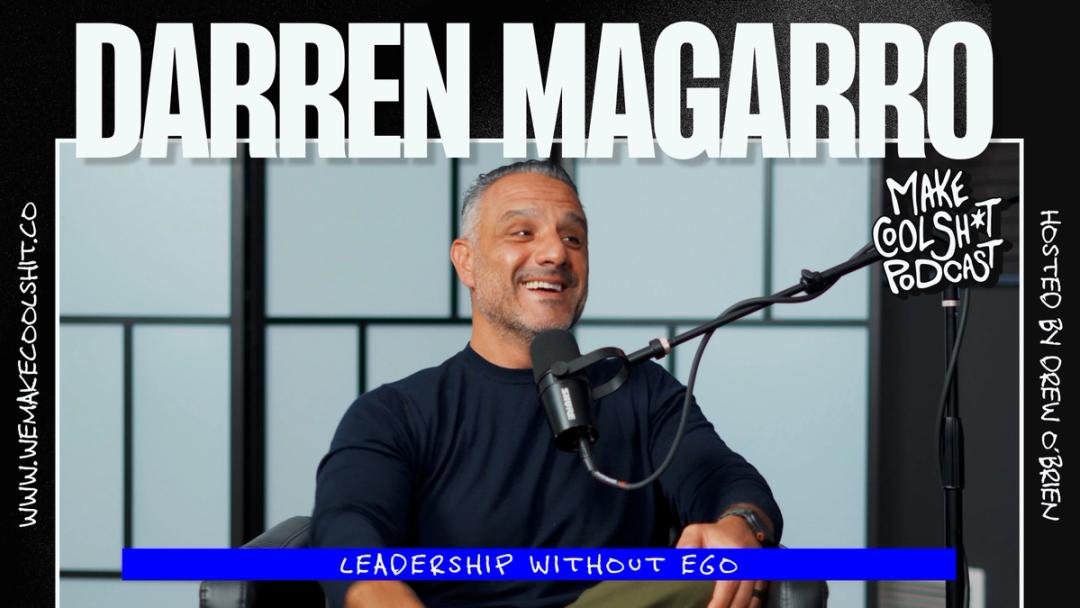
Alright, everybody, welcome to another episode of the Make Cool Shit podcast. Today I'm sitting down with Darren Magaro. He is the founder of the DSM Group, or is it just DSM Group? You can call it whatever you want. As long as— As long as I'm paying the invoices. It's— right, it's iterate. It's been iterated through time. It's DSM. I'm sure people have called me way worse things, so you can call me whatever you want. What does DSM stand for? Darren Sebastian Magaro. Full name. There you go. Beautiful middle name. Thank you. It's my dad's. So for the people that don't know you directly, you are an agency owner yourself. Yep. Right? We have some crossover on services, if you will. But tell us a little bit about the DSM Group, and a little bit about how you started, and about today, what separates you from other agencies. How we started? I mean, I've gone through this with you. We— Wait, wait, hold on. Let me see if I can remember. Truthfully, you started on a porch. Yes. With a laptop. Yes. And a beer. Not a beer. It was rotisserie chicken and beers. Rot— sorry, both. I had the rotisserie chicken. It was a Boston market, basically. It was a Boston market and a— and a package store in my— in my house, with a laptop and zero clue how to do it. What— what year did you start? It'll actually be 19 years on February 7th.
So we're coming up on 19 years. We had 9 years yesterday. Wow. Wow. And I'm going to— later, I'm going to tie it back to you because we might not have had 9 years. You know what? We'll just go there. Do you remember this? Real quick, before we get into you. Yeah. Really bad Chinese food. In my basement. We hung out. I remember that. Yes. And then I went to the office. So— so— without— and we could cut this if you don't want to put it in. Without putting your dirty laundry out there, you were in a void at 2019? 2019, yeah. 2019-ish. You had a creative void in the business. We'll just call it that. Mm-hmm. And I was burnt the fuck out. Yeah. With running a business. Because at that time, I was only running the business for 2 years. This is before I had business partners. Yep. This is before I was called Make Cool Shit. At the time, I think I was the O'Brien Creative Group. O'Brien Creative Group. So I went to you, another New Jersey-based ad agency, and I was like, "Fuck this, dude. I'm done. I'm going to bring all my clients to you. You need a creative director," essentially, at that time. "Fuck it. Like, let's make it happen." Do you remember that conversation? Absolutely. I was ready to do it. And then, to Darren's credit, at least from what I remember, you were like, "I am interested, and I'm willing to move forward,
but I want you to stop and go home and truly think about this before you say yes." And thank you, God, that you said that, because I would have fucking hated you. Not because of you. I would have hated anybody who would have been my boss. You weren't burnt out. You— you— you didn't— you were too young to be burnt out. Yes. I thought I was burnt out. You weren't burnt out. I've had a ton of great people in my life who have been mentors, who have been— I mean, you know my story. Like, losing your dad when you're 18 and being the product of a second marriage is something that— and having to grow up really quickly. Like, I relish that role. I had a lot of good men in my life that helped me along the way, that told me, like, every time that I thought— you were in the place that I was at when I was 19. I was like, "Fuck it. I don't know what I'm doing. I don't know what I want to do. I just want to buy a car, buy skis, have fun, you know, hang out with my girlfriend who's now my wife." And, you know, we were in college. Like, I was making a ton of money working a construction job. So you weren't burnt out. It's a matter of having perspective. First of all, congratulations to you guys for 9 years. Thank you. Because that's— that's amazing. It doesn't feel like 9 years. Just wait until you hit 19. It's going to feel like 87.
There's different speeds that come to life. And we were just talking about this before we got on camera. So your daughter, she's 2 years old. You're— you're in a high-speed phase right now. I'm in it right now. There— there— you are— you are knee-deep in the shit. Yeah. Literally. Right? Disgusting diaper this morning. There you go. I don't have any diapers anymore. But with different ages with your kids— so now my daughter— we— Samantha and I were just talking about this. My wife's name is Samantha, so we were just talking about this this morning. We're going to Mexico to celebrate our anniversary. We had 20 years last year. We never got to go on a trip. Congratulations. Thank you very much. So we're going back for a long weekend, and it dawned on us that Olivia, my oldest daughter, is turning 17 April 23rd. We're going to Mexico on, like, Memorial Day weekend. Guess what? She could drink legally in Mexico. No. She's not coming with us. Oh. Oh, okay. She can drive legally in New Jersey when we're not here. This is all, like, new territory. It's a big deal. So she's getting her license April 23rd, God willing, and we're going to be gone a month and a half later, and she's driving now. Like, we don't have to coordinate rides for Luca and Tessa to get to school. And, like, there's all these things that are happening. But it's— it's also, like, a different time of life where the problems— and I think we could— you could apply
it: bigger kids, bigger problems. Bigger agency as you grow, bigger problems. There's more, you know, not just monetary issues, but, you know, you're kind of built like me in— in a sense that, like, you care about your people. You care about what you're doing. You care about the product. Like, those things become amplified as you get bigger. So, you know, to— to me, like, I'm in a different place in my life, personally, professionally. I want to credit a lot of it, like, the conversations we used to have with, like, Bill and— and you. We'd sit down and, like, I thought I was— like, that was my transitionary period. It was taking me from the young jerk-off that I used to be, you know? Like, that's— I mean, that's what it was. Like, my mouth was way ahead of my head. I know the feeling well. So, you know, and you— you tend to slow down. And different things happen in your life. You know, 2019, I love how you put it, a creative void. It was— I didn't want to put your business out there. It was— no. It was— it was, you know, you're— you— you have a split with your— your business partner. And it— and it happens. I mean, these are all things. You know, now we're like, what is it, 2026? So you're like 7 years on, almost. And you're like, all these things happen. Like, that happened for a reason. Meeting you happened for a reason. You know? Like, things happen. And when they happen, there's good, there's bad, there's indifferent.
But you learn to, like, navigate the course a little bit. And that's kind of where I am in my life, I guess. Yeah. But back in 2019, when I did think I was burnt out and I just wanted to, I guess— I guess looking back at it, I wanted to take away some of the stresses of what it was like to run a business. Mm-hmm. And I said, "Hey, fuck this. Let me just give it to Darren." Right? I was going to bring all my clientele. Now, at the time, it wasn't that much revenue, but I was like, "Okay, let me bring it into the— into your business, into DSM." But the thing that really struck me, now that I'm looking back at it with hindsight, even at the time, I— it— it was interesting to me, but you had an actual creative void. Like, your creative director partner left. Mm-hmm. Now, I didn't come into you and say, "Hey, make me a partner in your business," because at that time, I didn't deserve to. But most people would have, quote-unquote, "signed me in the room." Right? Most people would have just said, "Yes, let's go. Let's not let this guy go home and think about it. Let's fully flush this out." Because you gave me that space and ability to be like, "Okay." I sat down and talked with— with my wife, Gabby, again, and I was like, "I don't know. Like, Darren is cool. Like, if I was to have a boss, maybe I wouldn't try to kill him." You know what I mean? Yeah.
Like, you— you'd maybe be one of the bosses that I would respect. Right? And then after talking about it with my wife and my family one more time, I was like, "I got to keep doing it myself." But the point is, Make Cool Shit wouldn't be here today. The podcast wouldn't— nothing would be here today if you just said, "Yeah, let's do it." Yeah. Because I— having the conversation, I had a little bit— a little bit more perspective at that point, a little bit more experience. And things were moving fast in my life too. You know? There was a lot of things happening. There was a lot of moving parts. Obviously, everything's worked out great for everybody, you know, in the end. But, you know, like I said, I remember you coming over. We sat in my basement, had Chinese food, had a few beers. And you talk. And, like, I guess at that point in my life, I needed to learn everything up until that point in my life was easy. It was simple. Well, you were going through personal issues, some health issues. Yeah. Right? You had— your business was, at the time, maybe in your mind, was not crumbling, but you had a massive issue to deal with. It felt like it was— it felt like it was crumbling. Because, like I said, when you have the first— what was that? 19— so it was— the business at that time was like 12 years old. So you're humming along. You're sonic— like. Not even humming along.
Like, it was just up and to the right. Like, it was going with the economy during the 2010s. Gotcha. So it was like every year, no joke, every year from '07, when I say, like, I was in a front porch, like, I was in a front porch. It was. Yeah. Me, the front porch. It was Jerry Maguire, Sands the Goldfish. Yeah. Like, it was— it was like my wife was like, "What are you— what are you doing? Like, if we're going to— if you're going to do this, like, like it was like Kunu and forgetting Sarah Marshall, like, you got to— well, now you got to do something." Yeah. Like, you have to have some sort of plan. And so having that time in my life to be able to, like, deal with all those things was something that you went through. I saw what you were going through. It was different. You know, it was a different scale, whatever. But, like, the way you've always been— and it's a credit to you and your character— having restraints is not going to be good. And so it's the same with me. Now I have some restraints because I have— you know, you have a big team of people. You got to make sure you're doing the right thing. That— that's why we have Charlene. Charlene is the ultimate, you know, protector. Char. You're the ultimate protector of the realm. But, like, having those experiences, I could see a lot of myself in you. It was just a few years behind me. So— and I've learned, although I don't— I don't— I still am learning this every
day. I try not to react. I try to think more before I react. And it doesn't always work, and I'm not always great at it. I still have my moments. But it's been this way in my personal life. I joke that I'm Sicilian. That's where the temper comes from. It's an excuse. You know? Like, you. Because I'm Irish, and I also have a temper. Well, but— but you learn as you go. Like, as a parent, as a dad with your daughter, you're tested with patience. There are things— I'm sure you're sitting there, you're like, "What are you doing? This is what used to drive me crazy." And now, especially with Olivia, like, you've seen— you've followed my socials. Like, Luca and I are, like, bo— we've been boys since, like. Yeah. You know, Luca's my son. I still remember that. He's old as hell now. Dude, I said to him today. He's like, "Tell Mr. Drew." Yeah, yeah. He goes, "Tell Mr. Drew." He's like, "He— he drew me— he created my Air Jordans." Yeah, yeah, yeah. I remember that. That's funny. And then he— he sent— you sent me that nice video. Yeah. I still have— I have it favorited— favorited in my phone. Bro, he's now 6 foot, like 170 pounds. He's— he's big— he's as tall as— he's bigger than me. I'll— I have a picture I'll show you from the trip. I— between my brother-in-law, my nephew, and my son, I'm the shortest in the— in the picture. Good. If he's playing football, he needs to— he needs— he needs to
put on a little muscle though. He does. He definitely does. You got to— you got to hit the weight room, my guy. Luca, you got to hit the weight room. I've been saying this forever. But having those experiences, like, tying it back to being a parent, you know? They test you. Everything tests you. And I had this, like, relationship like this with my daughter Olivia that now I said it to her. I'm like, "She's going to be in college in a year and a half." And I said to her the other day on the way to— I take her to school every morning, and I said, "I'm really going to miss you. I'm really going to miss, like, now she's into music. She loves, like, All Nation and John Mayer, like, the Life Channel." And, like. She's an adult. She is. You know? And she's. Which is crazy. Yeah. But it happens like that. Yeah. I— I could— I could already— obviously, my daughter's only 2, but even at this small scale. And it's interesting because, like, you mentioned tying in family or— or being a father and— and being a business owner. I always looked at Make Cool Shit as my baby. Right? And, yes, now I have multiple companies and— and whatever, and things are going great, but the concept is still the same. Right? I have more patience now as a father than I ever did as— as a non-father. And now that patience, albeit maybe I have, like, 5% more patience than I had
before, but it does truly translate into the business now. But what happened with me— and you had kids younger than I did. I had my first kid at 36. So I was a late— an— an old dad. Right? But. Yeah. At the end of the day, it's like, "Okay. How I'm hungrier now than I've ever been because now I see this little human, and now I'm like, 'Okay, since 2017, I have been eating what I kill.'" Right? And you've been the same way. Since you opened up your company, you are getting paid by sales that you've made yourself. Mm-hmm. Obviously, yes, we all have teams and what have you, but you are eating what you kill. And not everybody really fully comprehends that. Right? If you're a 9 to 5 employee at a company, which is cool, I'm not judging it, but, like. It's not the same. Yeah. We know what it's like to make payroll by Friday. Mm-hmm. Right? And how many times have you not paid yourself? Right? How many times have I not paid myself? Right? More than we'd like to admit publicly. Yeah. I'm sure. But it's made me so much hungrier. So do you still have that hunger even though you have 3 kids and they're older? You have 3 kids at 3 different age levels. You might not be in the diaper era like I'm in, but you're still in the thick of it in terms of raising kids. They're still in the house. It's— yeah. It's— what's the best way to say this?
It's different— it's a different age, but it's a different set of problems. So now you're dealing with the problems that your daughter— like, it— it's just. Different scale. It's different scale. You know? It's— it's the emotional part of it, especially with girls. It's going to— you're going to see, like, the emotional part of it. Getting to high school. You know, I have 2 high schoolers. It's a different— I— I think what I try to do, and there are moments where I still have these, like, epiphanies or, like, aha moments where you're sitting there and you're like, "I didn't go through this shit." Yeah. It was a different time. Yeah. You know? Like, high school. You'll see today when your daughter— and I don't even know what it'll be in another 12, 13 years. God only knows. But, like, these are the things that you're sitting there. One of the biggest things today that you see, you know, Luca just started freshman year, and— and Olivia is in her junior year. Kids don't, like, back other kids up like they used to. You know? Like, I had my crew. Yeah. We all do. Like, you have a group of 5, 6 friends that, like, you're super close with. And— and I had a conversation with Luca about this, and he— he went to private school from, like, second to seventh grade and then went back to public school for eighth grade, and then he wanted to play football, so he had to go to a public high school. And he's just like, "It's overwhelming sometimes." Like, kids now,
all they do is, like, they're out all the time. And it's like social media, keeping up with— and I'm like, "Bro, just do you." Yeah. We— we went out, just had to be home when the streetlights came on. Right. Or you didn't go out every night. Like, I don't remember in high school, I— I didn't go out every night. No. Like, during the week, I was. So Friday, Saturday, that's it. Well, yeah. Like, or, like, you played sports. Like, whatever. That's it. You had sports, you had a game. There's no going out. Right. You go home. But you— but, like, now, it's, like, just ongoing. And I'm like, "Luca, you don't have to do all that. Like, just do you. Find your—" I told him, "Buddy, find your tribe." Yeah. Find your tribe. That's a good point, though. But, you know, because when you're 16, 15, 16, 17, you're not thinking like that. You're just trying to keep up with the Joneses. You're just trying to fit in. It's overwhelming. You know? You— you know, you're not focusing on being your authentic self. Yeah. You're trying to be the person that you probably think that the rest of the school wants you to be. Well, think about what you just said. Right? Finding your authentic self. How long did it take you to find that authentic self? Right? You started. In business? Well, 7 years. Right. It started out as O'Brien Creative Group, and now you're here. But I remember you going through that creative process and having it be like.
But you— you matured over that time. Yeah. I had to take my name off the door. Right. I still haven't taken my name off the door. But you have the— you— you made it an acronym, so it's different. But to the point, having that maturity to be able to— and having the comfort in your own skin to put that out there. I remember as you were going through it, you're like, "Well, what do you think? Like, this is what the brand's going to be, and here's what it— and here's why." And I was like, "Go with it." Yeah. There's a lot of people who wouldn't do that. I was scared shitless. And truthfully, pun intended, I— I was scared shitless to do it. And I didn't ask that many people their opinion. I really only went to the people whose opinion that I would take seriously. Now, at the end of the day, if you still told me, "No, don't do that. I think it would be wrong," I probably still would have done it. But I maybe asked, like, I— like, maybe 5 people what they think about it because you're right. And I say this to my clients all the time. Right? When you're building a brand, when you're— especially from scratch. Right? Like, sometimes we're helping them with the name. Right? So it's like, I either say, "It's got to be a fuck yeah or a fuck no." Right? Or, "Hell yeah, hell no." Yes. No— no gray area. Mm-hmm. Right? So Make Cool Shit— and it's funny, I was— I've probably talked about
this on a million episodes, but even when I started Make Cool Shit, I just lightly changed it and, like, slowly— like, I didn't dive in 100%. Now we're— we're dove in. We're— like, now every single day, I try to make sure, "How much can we differentiate ourselves every single day?" Right? Because as a business owner, that's the only way we're going to get more clients. Right? Is by separating ourselves from the pack. But I asked you, and you're like, "Yeah, like, no one's doing this." And I don't remember exactly, but you were like, "Yo, how do you feel about it?" I was like, "I think it's something I need to do." And then you're like, "Then." Then do it. Then forget what I say, forget what my— really, what it was, I was worried about the current clients that were paying us. Right? We went from, to your point, Drew O'Brien Creative LLC, because I didn't know what the fuck I was doing. You were on a porch. I was in a 1-bedroom apartment in Montclair. Mm-hmm. Right? Then I went O'Brien Creative Group because I was like, "Oh, we're bigger now." Or— or, you know, it's not just Drew. It was. Right? And then I went to the design company when Dave and Phil came along. Right? And now we're Make Cool Shit. But the point is, not— not to make it about me, is, like, I was a fucking fraud as a business owner for 5, 6, 7 years. But you and— you and me both. Yeah. The DSM Group, when I was sitting in the front porch, was the DSM
Group. So going back to the beginning of what you're saying, when you get to a point, right, it was me. I had to be a fraud, fake it till you make it. Yeah. To get— to be one person in a front porch and be the DSM Group. Right? That was '07. You were smart, though. You added the group. I added the group because the group was my wife at the time and our dog. Yeah. Okay? Like. And the rotisserie chicken that you were in. And the rotisserie chicken and the Miller Highlifes. Now the company, our logo is just DSM. I think corporately we're still the DSM Group, Inc., or whatever it is. That's what's on the invoices. Right. Clients, make sure you pay the invoices. Okay? Pay the invoices. But, like, you had to go to your point about going through a process of, like, you were nervous about what your— what your paying clients would think and whatever. Over the course of the last 9 years, especially in this business, and this is something when we first started, I, like, this was my badge of honor. Like, we don't lose clients. Everybody loses clients. It's— it's inevitable. It's inevitable. Yeah. And, like, that's the whole point. We've lost clients now that I'm still friends with. Yeah. Same here. But, like, things happen, you know, in their lives. Catastrophes happen. We had one client that, like, they had 2 domain. They had their website. The website got locked up. They were getting held for, like, 100,000, you know, Bitcoin or something. Like, what are you going to do?
You know? Like, your— what you have is your authentic, like, responsibility to those people. And, you know, you find as you get— I don't know, man. You find as you get older, like, it doesn't work with everybody. And that's okay. And that is, like, I am so— I'm going to be 49 in 2 months or a month and a half, whenever it— not even a month and a half. February 16th. And no joke, like, I'm just getting to a place over, like, the last year and a half where it's like, I'm not for everybody. And that's cool. And as a team, we're not for everybody. So to your point about, like, differentiating yourselves, whatever, that's a part of, like, the process. And that's, like, refining and— and being okay with it. And the ones you're sticking with, you know, like— like Ralph, you know, he came with me from when I left the old agency. We started, still have our first client. And we've— he's my best friend, you know, or one of my best friends. You know, I have best friends from, like, growing up, but, like, there's nobody closer other than my family. When I have a problem, like a personal thing, I go to him. And as a dad or as a husband or whatever, and that's, like, that was built from just my old agency owner putting us together in a room and being like, "You don't pay a lot of money. Here's our youngest AE. You guys work together." Yeah. Yeah. It became something that was. Something significant in your life started with a random ass
meeting. That's— that's— that's what I was trying to. Yeah. Get at. Right? So it's funny. You mentioned earlier, literally on our website, I think it says, "We're not for everybody," and that's the point. Mm-hmm. Right? I looked at your website before coming here. I've seen creatively, visually, right, multiple iterations of the DSM Group. Not necessarily changing your logo, but I went on your website. You're front and center now. Mm-hmm. Right? You— you weren't before. Right? I never wanted to be. So I neither did I. I never want— but look, now we're on a podcast. I can't— I can't believe you didn't even put the best part of the why I was front and center. Your mustache. My mustache. Yeah. Zinka— Zinka. It's beautiful. See? Drew loves it too. Drew loves it. I'm bringing the mustache back. Mustaches are back in, people, just for. I'm bringing it back. It was very Tom Selick, Magnum PI. It's— it's a powerful mustache. I would even argue that that should have just been, like, your Instagram icon. Just. Remember the little icon thing you made me? Yeah. I remember. Like. That— that was in COVID. So I— I did a designer day in COVID. There you go. Just because I— I. I still have that. It was like— and it's just the eyebrows. I was like, "Wow, my eyebrows are really bushy." Yeah.
You know? It's like a caricature, though. You have to— you have to make it— you have to make it more— more exaggerated than— than it normally is. But so it's funny because Make Cool Shit were obviously a— a specific flavor. Right? Now, we could build corporate brands, we could build crazier brands, but our— our brand as a company is a specific flavor. And this is why I love this podcast, because to the general public, maybe a year ago or 2 years ago, right before you had this conscious thought, is it seemed like DSM might have been for everybody if they had the proper budget. Mm-hmm. Is that fair enough to say? Sure. So who is your ideal client now? Right? One of my first questions before we popped into everything, because I just said, "Fuck it, let's go into the monumental decision that you helped me with in my life." DSM, you're an agency. That word, agency, means a lot of different things. I actually fucking despise the word agency. I refer to us as a studio. I also hate that word too. But everybody, like, puts this word agency— it has a different meaning for different people. Mm-hmm. What is your core product and who is your ideal customer? Our core product now is strategy and, like, executing and reporting. It's funny you mention this because I was on a call earlier today with a prospective new client, and one of the things that Dan and I— Dan's our— Dan, word up, dude. Shout out, Enrico. Shout out, Enrico. One of the things we were saying was going into, like, creative about digital strategy. Right?
You put out ABC tests, whatever it may be. So for the layman talking about ads. Right? Running a piece of content, content A, content B, content C. Right. It's. Totally different designs. It's— it's 3 different ad sets with similar creative to see what is going to work the best. And then, you know, obviously call it ABC because. It sounds boring, but it's very, very important. It's very important to what we do. But we said there's some times where in our agency especially, where we have a strategy, execution, and reporting team like Dan's, and then we have our creative team that's run by Jess, the creatives are always going to fight for the best creative. Oh, yeah. Right? But sometimes the best ads are creatively bullshit. Well, not only— Sometimes. Not only creatively bullshit, but it's not even about creatively bullshit. Sometimes we run an ad set and the most beautiful ad gets the worst results. A lot of the times that happens because you're not strategizing the creative. You're just trying to make the coolest thing visually, but it doesn't actually attract the buyer. Correct. And so that's where we get into sometimes, you know, you have to have— especially with us where now, like, at whatever it is, 16, 17 people with 3 departments, you have 3 different voices. You have the creative department where, you know, Jess has been there now going on 4 or 5 months. She's starting to mold the team. You know, Matt and Sarah have been there like 5 years each. And then you have Dan's team with, you know, Clayton and Isabelle who's on maternity leave and— and Kalina and Jeremy and, like, you're bringing all these
voices together. And the voices are— everybody's fighting for their own thing. You know? And that's— it's an interesting dynamic. And, like, now where I sit, like, for me, it's all about the relationships and, like, new biz. To your point, that's where I need to focus. Like, I don't— and I used to struggle with this a lot. That's your expertise, though. Well, and I used to struggle with this a lot because you— you have something to fall back on. You're a creative by trade. I'm not. I'm a media buyer by trade. So I'm not negotiating Altice deals or, you know, radio deals or TV deals, like, every day. So for me, to get back to the point about what you were saying about we kill what we eat, that is— and that goes through ebbs and flows. Oh, I know. Yeah. So there's times where one of my— I think one of my biggest weaknesses, in my opinion, is imposter syndrome. And it's tied directly to the ebb and flow of, like, new deals. And that's really where I've turned my attention to, like, starting in the beginning of 2025. We set a hard goal. We said, "This is what I'm going to do. Here's how I'm going to do it." And that's, I think, at this point in my career because I don't get involved in the strategy or the execution. You know, like, I— I hope if you asked everybody at DSM, I'm a pretty, like, hands-off leader. Like, Zinka and Shar and— and Dan and Mer and— and Jess run the day-to-day
of the agency. But if I don't do what I do. Then there's no running of the day-to-day. Then there's no— Yeah. DSM. Yeah, for sure. So. Imposter syndrome. I'm glad you brought that up because when I first started this pod, I think this is only episode 7 or 8 that you're going to be on. Right? So this is still a brand-new thing for us. And when I first started, I had cards and I had questions and I had a little bit more of prep where I prefer, especially you, I've known you for years, I don't need prep. Right? We've— we already know each other. But our first guest was a co-friend of ours, Jamie Nott. And the only reason why Jamie Nott is now a partner with me in Sunday Sauce is because we met him— I met him at your event. Mm-hmm. With Ralph. So, like, you see how all this is coming back together. But the point is, one of the questions I used to ask everybody on the podcast was, "How do you deal with imposter syndrome?" So Jamie is a creative. He's not a designer, but he's a chef. Right? So he has that creative background. Everybody in the design space, if you are a designer, whatever that means to you, I believe that you have imposter syndrome no matter what because you don't know, "Hey, is this brand that I just built look exactly like Nike in the back of your mind?" Or, "Is this original?" Or whatever it is. Right? You said yourself you aren't a creative, whatever that means.
You are a creative person with how you run your business, but you don't know how to draw, like, I might, or you don't know how to use the program. I don't know how to draw shit. Or you don't know what a creative director might do. Right? So I do have a skill that I could fall back on. Great. But I love hearing that you have imposter syndrome because I do believe everybody does. But what does that really mean to you? Because you're not looking at it from a— from a creative standpoint in terms of, like, "Oh, does that logo look good?" Or, "Does that website look great?" Or, you know, it's not as black and white. You might be a little bit in the gray area because you might be like, "Oh, we didn't hit our goal for this year. Does that make me a fraud?" Is that a little bit of, like, how— how you look at imposter syndrome? Because you have a different background than— than we do. Yeah. As designers. No, I think imposter syndrome, to your point, I think everybody has a little bit of it. And if they say they don't, they're just lying to you. Or they're a sociopath. Or a narcissist. Or a narcissist. Probably a little bit of both. Probably. No, I— I think that that's what makes us good at what we do. I think that's what makes everybody good at what they do. If you don't have a little bit of imposter syndrome, like. A little bit of humility, maybe. You know what I mean? Well, as you go through it, I think— I think humility and the fact that
you have imposter syndrome, let me tie it back to, like, the first. Right? So 2007 to 2018, the company's running, everything's smooth. We're— we're doing shit. Like, fucking shit up in the world. The FSUITW. You're on. 2019 comes and it comes to a screeching halt. In the process of doing that, tying all these things back, now that I'm, like, thinking about it, tying all these things back together, finding your tribe, finding who you need to, what got you here from here to here is not going to get you from here to here. And so finding your tribe, aligning with the Zinkas and Charlenes, like, people who really, really care about you and care about, like, every decision that's made. And Zinka just said it because we got into a little tiff earlier this week. Zinka. Well, she's right. And I'll say it. Zinka. She— she— she probably was right. She was right. She absolutely was right. But no joke, like, we still get into it, but I know deep down in my heart, the decisions, this is going to be the next phase of what happens with me. This is now the transition as I approach— I'll be 50 in a year and a half, I'll be 49 next month. Making decisions has always been something that's been important to me because I feel very responsible about the team. Right? So that imposter syndrome is tied in with making enough money, bringing enough new clients in, all the things that you need in order to grow a business. I mean, at the end of the day, if we're not growing
a business, what are we doing? Right? Yeah. Sales is the only thing that can allow all of the other things to happen in the business. Correct. Now, having 2 people at your side, one on the financial side and one on the operations side, which neither I'm very good at. You know, like, my claim to fame before Charlene came in was buying a 12-horsepower igloo cooler with running boards that I could ride around the parking lot of the office in Franklin Lakes. Yeah, but it's a dope cooler, though. It was— it was— it was a very dope cooler. But that's very important. Mm-hmm. To understand your weaknesses. Mm-hmm. It took me so long. I had the biggest ego about from the design standpoint, and then I realized I was like, "I don't know what the fuck I'm doing." But if you don't have that. I think you do. Well, in terms of running the— in the beginning, I didn't know what I was doing in terms of running a business because I was just a designer, but so did you. But you found your tribe. You found your people that you're ready to go to battle with. Correct. If you don't find those people, and it doesn't have to be in design or agency, it could be in anything. It could be your partner in life. Mm-hmm. Right? If you don't find that person that you're willing to, you know, run through a brick wall for, then you're just going through life alone. Right? Big businesses, great lives aren't built solo.
They're built with other people involved. 100%. And you made an amazing point. Right? The same people that are get you— that are going to get you from A to B aren't going to get you from B to C and C to D and so on and so forth. And without the experience of 2019, I wouldn't be where I am today with, you know, Zinka and I joke that she's like my younger sister and Charlene's my older sister. Charlene, I'm not disclosing your age. You're— she's just older. She doesn't look a day past 38. Right. Shar, 38. But one of the things that, like, continually plays in my mind, especially as I approach 50, and you're going to— like, you've known me long enough. Well, I— so I do know you long enough. You've mentioned it like 4 or 5. Is this something you're worried about? No. Is this like a number that, like, you're, like. No, no. Scared to say out loud or? No, but as I approach 50, what I'm now understanding is, for me, my imposter syndrome was built around those decisions and making sure that taking care of everybody, like, at— at the company and whatever iteration of the company it was, it went from 1 to 2 to 3 to 5 to 7 to 22, now back to 16. Like, whatever iteration that was, that, yeah, the ebb and flow, that was paramount to me. And that's what drove my ego of, like, if I don't do this and I fail people, then I'm a failure. I'm not a— I can't control everything. Yeah. I've— I've— I struggle with that as well. I— I think all business owners
should. So because, like, to your point, right, if you don't, you're kind of a sociopath, like, like you said. Cool. Or— or you just don't give a fuck, which is even worse. But that's what makes you successful. That's what drives— that's what drives good business people, but that's also what drives good human beings. Like, I read— I— I posted a thing that I saw on LinkedIn the other day about Gary Vaynerchuk, and he's like, "I don't care if they're your best." And, like, I'm not a GaryV, like, like, I— there's some things I— I really appreciate, and there's other things that I'm like, "Bro, like, relax. Slow down." But he said it. He goes, "I don't care if it's your highest performing salesperson. If— if there's a person in your company who is a shitty human being, cancer spreads." That's a good point. And that's— that's what it's about. And I— like, it's not like saying that X person is— is cancer or this or whatever. Like, the experiences happened. And as you go through them, as I'm now approaching my 19th year of doing this, I see why Zinka and Charlene were so important. Not only to put bumpers on me from, like, the financial side of things, but also the point I'm trying to make with this is it's gotten me to the point where they're better than me at making decisions some days. That is an amazing thing to hear because you couldn't have made that— No. You— you couldn't have said that sentence 5 years ago. I couldn't have said that sentence 3 years ago. 3 years ago.
Yeah. I mean, that's a— that's a powerful thing. Right? And that's— that's why the best leaders in— in any business, the best leaders of anybody in any category, right, not just business, if you don't have the humility to say a statement like that. Right? Like, I want to get to a point at Make Cool Shit where I am not the most talented designer at Make Cool Shit. I'm not there yet because we're not there financially to bring in someone better than me yet, but I can't fucking wait for that day. That's Drew's way of saying he's humble enough. He's humble enough. It's a— dude, you'll get to a point, I think, if you're doing business well, you'll get to a point where you become comfortable enough. The good— the good days and the bad days, you're going to have both. You know it. Yeah. There's good days, there's bad days, everything in between. But if you can get to the point where you can say, "I don't have to make every decision," you're better at the— and not just from an operations or a financial, like, the— the where the rubber meets the road. I'm saying when you can, like, in another conscious state, and I'm not— like, I'm not floating above the room. Yeah. But if you can get to a place where you can say to your COO and CFO of 8 and 9 years, "Hey, guys, you think with more clarity on this than I do?" I trust you. I trust that you have the best interests of me and the business in mind.
That gets you to a place. It's not lazy, but it's saying all those— all those million paper cuts that you had over the years and all the scars that formed over them, some decisions, it gets you thinking, like, you think about it the wrong way. And those hurts and all. Because you're too close to it? Well, you're too close to it. You're— there's stored-up anger about it. There— like, it just— you're not thinking clearly. Like, somebody's coming at it with a— with a cleaner perspective than you are. Yeah. I say that all the time. I literally just had a call 5 minutes before this pod started with Jacqueline. Second shout-out for Jacqueline Davies on the podcast. I don't— I— I don't— I don't want to put her business out there because things aren't finalized, but she's looking to do something on her own. She was one of my first employees in the business, and she's looking to start her own business. I— I think I could say that. And she's talking about it, and she's talking about it, and she's like, "Wow, you're making really good points." And what I said to her was, "It's so much easier for me to talk about my clients and talk about my clients' businesses than it is your own because you're in your own business 24/7 and you're so close to it. When you're working on a client, you are able to look at it from an outside perspective. You're able to go at it with that clean slate." Right? Mm-hmm. So that's kind of what your C-level team's able to do. Like, "Hey, I'm not the D, the S, or the M in DSM.
That's Darren. I know what his tendencies are. I know what he wants." But more importantly, I think what made— what the best part about your team's setup is they have their own sweat equity in the game too. Right? Meaning, like, they've been there. Yeah. They've seen you nearly collapse physically and emotionally, mentally, all— all the ways you could do it. And we've all been there as business owners. Right? Yeah. I've had panic attacks. I've had full-blown breakdowns before. Yeah. That's not the stuff that people want to talk about on social media. That's not— you know, that's not the fun things about running a business. But yeah, it's fucking hard. Right? So if you do have those people, that right-hand man or right-hand woman on your side, it alleviates it to a level that I don't even fully comprehend yet because I'm not there. But I can't wait until that happens for me one day. One of the things is actually funny because one of the things, like, the cul— like, we've stayed around 16, 17, 18 people, you know, for the last 5 years, whatever it's been, 3, 5 years. Which is a lot of people. It's a lot of people. Right? Like, if you put 18 people in this room, this room's almost filled. I just didn't want the listener to just— just one, just my mom, just one listener. I didn't want— I didn't want to shout out. What's up? My mom's going to listen too. 2— 2 moms. 2 moms. 2 moms and maybe 2 wives. Maybe my wife probably won't listen.
My wife definitely won't. No, no shot. No shot. But if you put 18 people in a room, like, 18 employees is a lot of fucking people. People don't even realize that because they're always like, "Oh, Amazon has thousands of people or whatever." Right? Like, that is 18 families. But it's 18 people that you— and I know family is like a dirty word in business, but it's 18 people that one of the things we joke about at DSM, they don't leave. You don't— you don't have a high turnover rate, which is true. Yeah. Which is— which is true. I— I know that for a fact. We don't have a high turnover rate. There— like I said, there's ebbs and flows in the businesses— in the business that we've had to let people go, but we've stayed close. You know, we— we've helped people find other jobs at, like, other friends' companies and things like that. The responsibility, whether you're dealing with, you know, 2 people or 10 people or 20 people or 50 people, if you're thinking about— and I'll say this to anybody watching that's thinking about starting a business, Jacqueline, whatever it is, invest in those people. Investing in the relationships, and it sounds like really, like, Zen and whatever, and I could say it to you. Like, investing in the relationship, going all the way back to when we met, like, the reason I told you to go, it wasn't just because of the constraints. It was like, you need to find your own way. I had to find my own way. If you're going to do this, you need to find your own way.
And you had it in you. We all get tired. We're there for one another. That's the beauty of this community in New Jersey. I think it's one of the best things. I have friends that just through the ad club or whatever it is that are just friends. You know, like, we used to talk a lot more. It's— life is now— I have 3 kids. You have a kid. Like, you're running your business almost. My— my life's changed a bit. Yeah. Like. But— but— but to your point. But if you called me or I called you and said. 100%. "I— I need— I need this." Yeah. Or you said, "I need this," you're going to do whatever you can to help. Yeah. I wouldn't even think about it. Right. But it's— it's funny. Now that I am getting older, now that I am a father, now that I have run the business for close to a decade now, which is crazy, I still have my core friends that I went to high school with. Right? Yeah. Still to this day. Right? But when you get older, you really start to realize, like, who your ecosystem is. Right? And me, I have an ecosystem along with my business partner, Phil. And how it gets smaller and smaller. And— and smaller. Smaller. Exactly. Tighter. And who we want to let in. Yeah. Right? And— and who we want to move forward with. There's only— there's only 10 to 20 people that I could think of if I
called. I could trust that whatever the fuck I said on that phone call, someone's going to try to help me out and actually make it happen. Yeah. You are one of those people. Now, do we talk every day? No. But even when I was starting this podcast, I was like, "I got to get Darren on." Right? Part of this podcast is because obviously it's for, you know, it's to build our audience, it's to build social media clips, it's to do all these things, but it's really it's to sit down with people like you that I, you know, maybe— like, I didn't know half of the shit that you already said about DSM, like, where you're going. You finally realize that you're not for everybody because I stupidly looked at DSM. I was like, "Okay, yeah, they're doing better than us financially, but they're like the corporate people." Right? By the way, this is wrong, Drew. This is the wrong thought process. This is ego-driven, Drew. I was like, "DSM, fuck them. They're for, like, banks. We're not banks. We're Make Cool Shit, dude. Like, we're like the coolest." Like, and I started realizing, not just with DSM, that's how I looked at a lot of my competition. And even though we're not in direct competition, but I looked at other people as enemies rather than, "Oh, how could we work together?" Mm-hmm. Right? Yeah. And I— and I think maybe that's not how you started, but that's how when I met you, that's how you came looking at me. And now you've also sent us clients. Mm-hmm. Right? People that weren't fit for you,
but might have been a fit for us. You could have just told them to fuck off in a nicer way than how I'm saying it, but you're like, "No, I know Drew over at Make Cool Shit." Like, yeah, maybe that's okay. There's just a few I'd like to tell fuck off. Yeah. Trust me. I— I understand. But I— I think that's also very important to— to make clear and kind of give you your flowers. Not only did you literally prevent me from making a huge mistake, easy to look back at it in hindsight, right, from myself, you have been a mentor to me. I don't know other agency owners, or I— I do now through networking, but before, I really— like, business owners in 2019, I really just— 2017, I really just, like, knew you. Like, I— I didn't grow up in, like, an entrepreneurial, like, mindset. Right? Like, and now to this day, you're one of those people that I could look back at and/or at least call, and no matter what, like, as grown men, you don't have those— you don't— you don't have that many relationships in your life that are like that. Mm-hmm. My work here's done. I've— I've literally. Honestly, that— that is— that is a bit of a mic drop moment. Now that I am finally having a little bit more perspective on life itself, business owner, fatherhood, all that stuff, what's the biggest piece of advice that you would give someone that works as a leader of men, women, leader of people? Right? You have almost 20 employees. You're supporting families. You are— because outside of all
this, you're also a good fucking person. Right? Like, you— you have— you have a good heart. I'm sure there's a lot of people who would probably say otherwise, but I— I appreciate that. The people that really know you know that you have a good heart. Right? All the other stuff, that's all they could say whatever they want. But I don't think anybody could say, "Darren's an asshole." Right? Yeah. They might say you have a bad taste in English football clubs. You— they might say you have a bad taste in NFL teams. That's whatever. Okay. But the point is you are a good person. Yeah. And I think that's very important to the core of how your business has— has grown over the years. That's a— that's a really good question. I'll tie this back to an earlier part of the conversation that we were having with what I said to Luca. I think it's about my son. I— I think it's about being true to yourself, I guess, is the best way to say it. I don't think anybody's perfect. I don't think anybody has all their shit together. I sure don't. Well, as you— as you get older, you get perspective. And I— it's a little cliché, but I think you get a little bit more comfortable in your skin about who you are, what your preferences are in EPL teams and things like that. But it allows you— and I— and I— and I'll tie it back to having kids, and— and you're going to see this as your daughter grows up. Those lessons you learn, you get to impart them.
I— this is the biggest part, I think. Having good people, having good male role models. I— I've had, you know, since college, since my dad passed away. Right? So I had Kenny Sullivan, and I had Gary Caytan, and I had, you know, I have Tom Greco now. Like, in every part of my life, since I lost my dad, I've had a male figure that's older than me, more experienced, that can rein me in. I think I'm a lot calmer than I used to be, but, like, I used to be, like, an unchained junkyard dog. To— to— to the point about. I know the feeling. Well, to the point about what you were saying about everybody in my mind, like, when we first start— when I first started DSM, everybody was the competitor. Everybody was the enemy. Every— like. I'm going to steamroll them or get the fuck out of my way. Yeah. Like, what's the next? And now, as I've built up relationships and you get a little bit more experience, you see, like, how can we help each other? I— I think that's, like, the light switch moment. Like. Yeah. How can we help each other? How can we make the— and— and in certain cases, there isn't. Like, and I think the other thing that's really important, what you see on the outside and what you see on social media and all this, like, I've really kind of, like— and I'll give flowers to my wife on this one because she's not a real, like, social media person. Shout out, Samantha. Samantha, shout out. I— I've really toned it down because, like, you
get, like, I actually took the month of December off. I— like, I didn't go on. I— I wasn't, you know, I— I posted a birthday thing for— for Luca, but, like, I wasn't on Reels. Like, people were sending me messages. They're like, "Are you alive? Are you all right?" And it was, like, the best month of my life because being a kid now, right, in high school or whatever, this is where the pressure builds up because you're seeing everybody else doing all these things. And why don't I get invited to, you know, this ski trip? Or why don't— why don't I get invited here or this, that, and the other thing? And— and it's like, this is life. Like, find your people. Find the people you're going to be happy with. Yeah, you didn't get invited to the ski trip or you didn't get invited to this party or whatever. Like, we didn't have to deal with that. Maybe you a little bit because, like, with cell phones and stuff like that. Like, I didn't even have a cell phone. I didn't have a cell phone until I went to work. I didn't have a cell phone until I— until I hit high school. Yeah. I— I didn't— I definitively did. I had. Yeah. 2000 was my— like, my BlackBerry, my Nokia and BlackBerry when I started working in 2000 because I worked in the city. Like, that was my first foray into cell phones. Now they see everything. It's like, who likes what, the— like, who cares?
You know? And. It goes back to being your authentic self. Like, just like. Being your authentic self, but having that— like, and I literally just lived it by not going on social media for a month and no joke. I— like, it was amazing. Yeah. I didn't pay attention to anything. You know, I had some personal stuff going on in my life with, like, you know, my sister got sick and, like, things like that, but that I had to attend to. But people— people got, like, worried. They're like, "You all right?" I was like, "Yeah, I'm just living my life." Now that— now that I do think about it, I have less memes coming from— coming from your DMs. Right. But yeah. And people didn't even know. Like, and— and the stuff you sent, like, my wife, it drives her nuts. Like, Samantha, I'm sorry, but, like, it drives her nuts. She's like, "These are the stupidest things." It's like, you know, chubby Chinese kids dancing and, like, dude, that kid's amazing. Yeah. I've— I've— I've— I've seen— I've seen you. Yeah. On— on, like, my stories or whatever. Like, I got into, like, in Nov— in mid to late November, I— You were posting that, like, every day. It was amazing. I— I was. It's funny because I— I do remember saying to myself, like, "Yo, what— what the fuck is this guy doing?" It was great. I— I got really into that kid, and then I went off the bridge and. He's good, though. He's talented. He's talented. He's very talented. But playing into your authentic self, I think,
is really important. Giving a shit— like, if you're going to start a business, giving a shit about the people that are actually helping you create and do all the things that you want to do in order to achieve success. Getting back to the point about Gary Vee, like, if somebody's not rowing the boat in the same direction, this was the biggest lesson I took from 2019. If somebody's not rowing the boat in the same direction, like, life goes on. Drop, kick them off the boat. Drop, kick them off the boat. But everybody— all the turmoil that I had in my life, I think everybody's doing great. Like, I'm doing fine. They're doing fine. Everybody's fine. And, like, people moved on with their lives. This is, like, really deep stuff, but, like, having the— having the foresight and the experience and the maturity, I think, to be able to, like, process things differently that you're doing now, like, everybody's not an enemy or, like, business stuff or as a dad, like, I have to be a little bit more patient. I have to be more patient with my wife, like, because women come at it from a different perspective than men. You know, moms are moms, dads are dads. And I used to be— I used to go at it and be like, "I'm not their parent. I'm not their friend. I'm— I'm their friend. I'm not their parent." I'm their best friend. Yeah, yeah, yeah. You know what I'm saying? Like, she's like, "No, you have to be friends with them too. That's a part of the job.
You don't get to not be one and the other." And so. You have to be all of them. You have to be all of them. That's what this— like, certain days you're going to be their best friend. Other days you're going to be their parent. And so having— having that, having being a good person, having a good partner, you know, I mean, I'm sure for you, you know, with your wife, now you guys have been married what, like, five, six years, seven years? Got married in 2019. Been together for, like, 11 or 12 years. Yeah. But, like, having. So she's not going to watch it, so it doesn't matter. She'll watch it. She'll watch it. I'm glad I did this today because it's just— it's one of those things where it's like, you get emotional about things now and you just see things in a different perspective, you know? And having the outlet to be able to do this is— is cool. Like, it's— it's a— we're not the same people that we were. No. And— and that for the people that work for us, for the people that live with us, for the people that are in our sphere of influence, I think that is paramount. Like, that's the advice I'd give. Well, if we were the same people we were when we met in 2017, we'd probably be dead. Through. I would definitely be dead. Through a panic attack, a heart attack. I would definitely be dead. Yeah. And once again, without putting your— your stuff on, you know, out on the internet, like, yeah, you were having a physical reaction to.
Yes. The emotional aspect of the business. Right? So you hit the nail on the head on, you know, when the only other piece of advice I wish someone told me if I got to go back in time, outside of not everyone's your enemy, which is what I thought it was in the past, is ask questions. Right? Like, find someone— and this is what I kind of did with you— find someone that's ahead in your space, that's ahead of you, and ask as many questions as you possibly can. Yeah. And find somebody who's not in your space who could be a good— all right, so to put a bow on this, find somebody in your space that has been through more experiences that you can ask questions to. Absolutely. But find somebody outside your space that has been successful in life and. Find a good mentor. Ask them the hard questions because the stuff that I talk about with my— with my mentor, Tom, now, 10% of the stuff is about business. It's about being a— you know, Tom's kids are grown up, married, have kids. He was wildly successful in, like, what he did, retired really early. Now sits on the board at Brain, helps them. Like. Tom, give me a call. Tom— Tom Greco. He's the man. But find somebody like that because 90% of the questions that I have now are about life, are about parenting, are about being a good husband, about not losing my temper. And, you know, he's from where my family was from. Like, our— our families kind of, I guess, knew each other back in, like, the
Garfield and Lodi days. And he knows people that I know. And it— it just— he's been through a lot of the same experiences. And that's where I think the transition happens. Finding that place where you're ready to, like, die to yourself a little bit. Die to yourself. Die to yourself. What do you mean by that? Die to yourself in that, like, lose— drop the ego. I'll use my daughter Olivia as an example. I had to always be, like, strong-willed. And now that she's a junior in high school and she's going to be 17 and driving. Dude, that's crazy. Bro, like, we were the same person, and that's what made us clash all the time. And that's what ruined our relationship for such a long time. Not ruined it, but, like, it made it hard. Put a strain on it when it— when it didn't need to be there. Right. Now we've— we connect over the things that we love, like music and— and— and other things. One of the best things that I did last year was took her to a Lord Show at MSG and, like, took her out to dinner and hung out. And, like, she's going to be gone in a year and a half. And it— and it took me this long to, like— or at least it took me 15 years to get to that place where I had to die to myself to be like, "Your needs and your what you love and why we fight all the time, like, I don't need to be right. I don't need to be right
all the time with you, Olivia." I struggle with that. Well, now— now it's— now it's kind of becoming a joke in the house because she's still tight with Samantha. But on the flip side of it, like, now we have our moments where her and I, like, we'll see eye to eye. And I'll just give her, like, the look like my dad used to do. Just be like. Break the fourth wall, like the office. Like we were talking about earlier. Break the fourth wall, you know? And, like, she knows that I have her back. And that's really what I want her to have when she goes to school, when she— wherever she goes. You know, she's looking at Villanova and she's looking at Charleston and she's looking at Palm Beach Atlantic or wherever. Mom and dad aren't going to be there. So the foundations that we build, like, you can always call me. Like, that's— and that's something to apply to— to the people at work. But the people I've worked with, we've gone through medical issues. We've gone through, you know, marriages. Yeah. Buying houses. You want your intern to still be able to call you. Even the lowest person on the totem pole, you want to be able to have that relationship where, "Hey, you might not be on in the C-suite, but you are a part of the team." Yeah. We just had— we hired an ex-client of ours down in California, probably in September, to help me with sales. Like, I couldn't do it all on my own anymore.
And her daughter is now helping with, like, the cold calling side of things with, like, Apollo IO and things like that. And we met with Marley on— what day is it? On Tuesday for the first time ever. And Cor— and Corby was like, "Listen, let me— I want to talk to my daughter. I think she'd be really good at it. She's, you know, really a good communicator." And we talked to— to Marley about it the other day. And I was just like, "I want you to feel— I— your mom knows this already because she's worked with us as a client for a year and a half and then— and then, you know, on the other side of it now working with us. I want you to ask questions. I want you to break things. I want you to be curious. We know what we know." And this is all, frankly, new because the selling that we did for the first 17 years of the company was just my relationships. Eating what you could. Right. And now I said to her, "I want you to go out and if you have an idea, even though you're the— you've only been here a day, bring it to us. Bring it to Corby. Bring it to us." I don't know how the dynamic is going to work between them two and, you know, working together, but bring it to us. If we can do it and we can make it better, let's do it. That's a good mindset to have, though, because you could be— if it ain't broke, don't fix it. Right? That could be your mindset.
That's what a lot of people might have, right? Success in all of these years that you had. Now in year '19, you're like, "Yo, like, we need to be able to do things differently." Right? We need to have that mindset of we don't know it all. Right? And I think that's something that you— we all get with age. Right? You're— We realize we don't know it all. You're a little bit— and I'm seeing it with my kids more. You're not seeing it yet because, I mean, you're a little— you're younger than me, but, like, generationally, the shit that kids have now and, like, what they think and how they think is totally different from the way I thought. Yeah. I mean, that's every generation. But yeah, even today, I can't understand what kids in high school— like, my family, kids in high school, what they're saying. They're using, like, fucking words I've never even heard of before. It's— it's— yes, it's the words and it's, like, the language. But it goes— one of the things that I am most proud of about Luca is that he— his nickname is Unk. They call him Unk because, like, he's an old soul. And he knows every parent that we— like, every parent that we know loves him goes up. He shakes her hand. He looks them in the eye. All the things that we were taught, kids aren't taught today. Like, kids that he hangs around with or some of his buddies, like, they don't say hello. Like, he— every mom. No matters. Yeah, yeah.
He— every mom he sees, he gives a hug. Like, that's what it was. Yeah. But that's the way we were taught. Like, you respected your elders. There's not that same. Yes, sir. No, sir. Yeah. Yeah. There's not that same vibe today. No, no. You said earlier, "I'm really happy that we sat down and did this podcast." Yeah. I— I am very thankful on many, many levels to be able to do this, to be able to have a conversation, to see you where you're at now, you know, where— where it all started. Don't make me cry. Don't— don't make me cry. I'm not going to make you cry. But I'm telling you from where— when we both met and where we were mentally— mentally, physically, emotionally to where we are today, like, we might not be Jeff Bezos, but, like, we're doing things right. You're doing things right. You're creating something that— and you still have the hunger to do it. You're creating something that means something to you. Like, here. Yeah. Yeah. I— I was talking to somebody about this, I think, last week, and they were like, "If you have 20 people or you have 10 people or you have five people, if it's authentically yours and, like, you're doing it successfully, like, why do you need it to be something else? Your success, your success, what you've done and how you've done it, you're doing it the right way and you're successful." And to the people that matter in your life that you hold accountable and that hold you accountable, you can lay your head down on a pillow and you can, you
know, I'm probably not going to have ever have, like, $50 billion in the bank. And, like, that's cool. I'm good. That's— that ship sailed. But the people that are in— in my house, the people that are in the business, I think they know that they care about me and/or that I care about them and vice versa. And, like, that's what it is. At the end of the day, you have your reputation. I know it sounds so stupid and cliché, and I know it's been used since, like, the dawn of time, but that's the freaking truth. That is the truth, Drew. That is the God's to honest truth. I have no arguments. That's actually a mic drop moment. So you're not on Instagram that much anymore, but if people want to reach out to you, how can they get in touch with you? They should call you. Should call me? I'll be your secretary. You can go on. You can go on. I think I had to change my name, too. I think it's DS Magaro now. It used to be Dare Bear, and then everybody started calling me Dare Bear. And then my kids were. They also realized you were a fully grown man. Yeah. And then my kids were like, "Can you change your name to not be Dare Bear?" So DS Magaro on Instagram. I'm on Facebook, LinkedIn. We try to put a lot of, like, when I do— do content on LinkedIn,
I try to do a lot about, like, the leadership of things and. Well, don't worry. We'll clip up some posts for you. Cool. Thank you. Yeah. And— and that's— that's really the best way to find me. We have, you know, our website, the DSM Group. Check it out. My mustache is awesome. He does have a beautiful mustache. Yeah. And on that note, if you guys liked anything here in this episode, like it, smash all the buttons you could find Darren on OnlyFans. I appreciate you. And we'll see you guys next week.