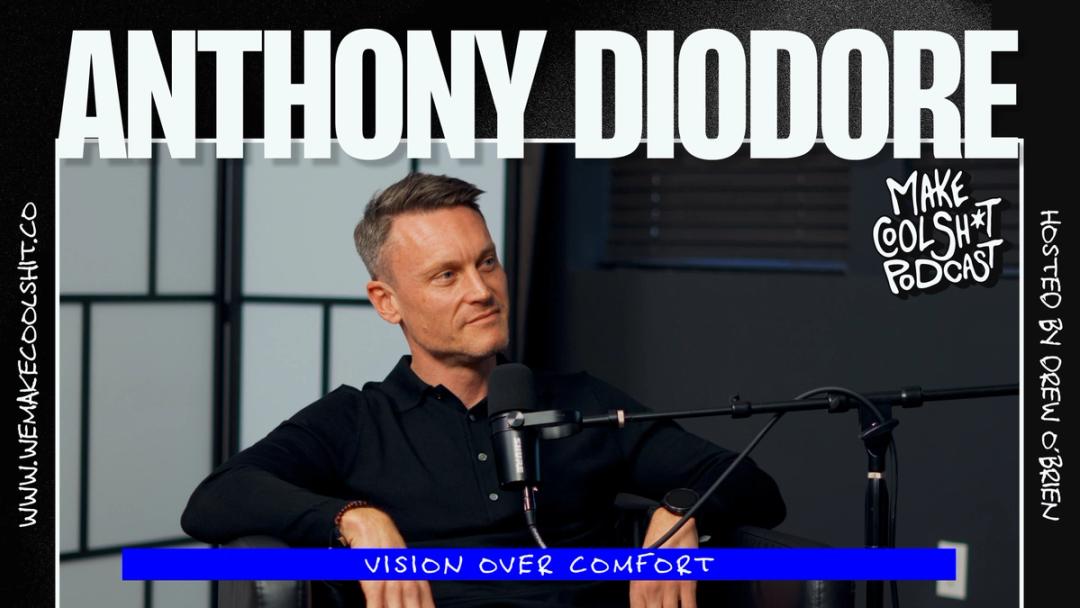
Alright, everybody, welcome to another episode of the Make Cool Shit podcast. Today I'm sitting down with Tony Diodor, the founder of Oak Bishop, the dopest men's skincare line out there, and I'm not just saying that because he's a part of the Make Cool Shit ecosystem. I was thinking on the drive here, how the hell did we meet? Yeah, so I— I was looking for somebody to help me with some web development. My fear was that I was going to have to go into New York City because I'm from the city, you know, I lived there 20 years. And I felt like, well, I'm going to have to probably go there to find an agency that's going to be able to help me create this commercial idea that I have. And proximity became sort of like a big issue for me, and I was like, there's got to be somebody around me. And I was just searching around, just proximity-wise, you know, and I saw Make Cool Shit close to my house. And I was like, let's— let's talk to these guys. Let's see what they're doing. Let's see what it's all about. And we clicked. We clicked really well. And we were supposed to have like a 30-minute meeting. It was like an hour and a half. Yeah, it was long. We were just riffing for a while because we come from a similar kind of design background, similar. And we had a lot to talk about, and I felt really good, positive about what you could do. And I saw some of the things that you'd been working on, and they were
really up the stream from what I'm working on too. So it was cool. It was easy. It was very easy. It made so much things— so many things easier, man. When you're putting together a business, like, oh gosh, the people that you have to work with, the people that you're going to find to work with, the interview process, gosh, it's— it's long. And that was a— that was an easy find. Well, that's great. That means our Google Ads are working. It's working. But you mentioned we come from, like, a similar background, right? Both business owners, both graphic designers by trade. Yeah. Right? I obviously went to the creative agency, I have the apparel companies, but the core of what all my companies are still come from, like, a graphic design foundation, right? You didn't start a graphic design company. No. You started a company that is not even really out there so much. Obviously, there's men's skincare lines out there, but none that I've heard of, right? Why? Because men, myself included, we don't give a shit about our skin. And we don't give a shit about the routines. And we should. It's wrongly so. Yeah. And by the way, this beautiful product here, which we did not design, we designed the website, but seeing this on the website, seeing this beautiful orange packaging, right? Yes, that goes into the brand, that goes into selling, and that's all great. But I have also used these products, and it's incredible, right? So going back to you, yes, you have the graphic design degree, you have
the pedigree, all of that. Why this company? Because this is a— Yeah. This is a rare— there's maybe 30 men's skincare brands out there. Listen, don't stop checking. Yeah, there's a lot. There's a— there's a lot. I'm learning that— I'm learning that there's a lot more. There's a— there's a big bottleneck in this industry. There's 1% compared to women. Yeah, oh my God. The women's marketplace in general is 80%. And I would say, I think that we make up 10% of the skincare market. It's just not a big— it's not a big one. And if you buy skincare from larger companies, you can feel it. You buy something from— I used to use a Shiseido product prior to my own company. They discontinued it, you know? If you're going to a store to purchase something, man, it can be clothing, it can be anything. The men's stuff is on the second floor. It's in the basement. Yeah, it's an afterthought. You feel it. You feel the afterthought of it. I don't think there's enough brands out there that are really focusing on men's needs and the things that make us look better. You know, social media is making us more self-conscious about the way we— the way we look. You know, everybody wants to go to the gym. It's funny because, like, your New Year's resolution will be like, I'm going to the gym. I'm going to sign up for that marathon. I'm going to do that. But it's never like, I'm just going to do a skincare routine that takes like
two minutes. And that really pays dividends. So having been in the business, see, we did the— and I, you know, I did it for many years working on the graphic design side of cosmetics, working on a lot of brands, huge brands, global brands that have mostly women's stuff, but also the men's stuff too. And the problem with all of the men's skincare products, and I'm not putting any brands down, I'm influenced by many brands that still do this. But the graphic design and the packaging is just black and white. It's all the same. It's all grays, and it's all kind of boring to me, you know? It's blah. It's, yeah, and it doesn't say anything interesting, you know? It's not like trying to tell you about itself. It's not trying to kind of stand out. Like, you put these products on the— I always fantasized, like, you know, I go to the gym, I work out, and you have your gym bag when you take a shower, and it's like, these just pop, man. It's like you're— every statement you make about yourself, it's like all these little things. And that kind of matters. And that's how I designed the logo. That's how I chose this orange. That's how I chose every aspect of it, you know? Because I'd seen it for years and years, and nothing pops, you know? You saw what wasn't working. Now I'm not talking about from sales because you have designed with billion-dollar brands before. I have. Right? But that doesn't mean that they're doing the design the right way, right? They're getting the sales because they already have the
clout, they already have the market share. Right, but the men's side of it, you know, you take a very large brand, and they're going to have like a few men's products. They will discontinue those when they feel like it, you know? Like, maybe an ingredient becomes a little too expensive. They're not relying upon that product. No. So they'll just discontinue it. That's an afterthought for them. They don't care, right? So that means the products aren't that good to begin with, I think. And so that's something that I set out to change. And having watched it for all these years, because the graphic design aspect of this was my day job. I'm a musician. I was a rock and roll musician. And I luckily got— I didn't go to school for this at all. I got a gig doing graphic design, and it just so happened I started working on skincare and cosmetics and that kind of stuff. And it was a day job, but during the years, I saw this opening. It's time for this kind of thing, you know? And I think men are becoming more aware that you can— like, as we started working on these products, and I don't know if I'm jumping ahead here, but I started thinking like, which products am I going to do? What am I going to work on here? I see a lot of brands starting, and they start with one thing. We even talked about this when we first started. I was like, should I do one thing or should I do multiple things? How am I going to set this business up? But I decided that I would
do three. One of the bottlenecks is, one of them is a serum, this middle product here, the Completus serum. Most guys don't know what a serum is. I don't. Right. Or I didn't before I met you. Exactly. But I— I had been using it and finding results with it, and it really helps. But I have oily skin, and if you have oily skin, a serum is going to save your ass. And it really makes a difference. Learning about the ingredients in them, iteration after iteration after iteration, finally getting the right thing. I thought that it was the smartest approach to do three products instead of one. Well, you hit on something that's important because you didn't just— and I'm not saying all companies do this, but you didn't just take brand X, that's a competitor in the space. Yeah. Look at their ingredients, copy it, and maybe change one thing so that you are slightly different, right? You went in and formulated because for the listener out there, you know, like just my parents, those are the only people that listen to this podcast. For the listener out there, when Tony first signed on with us, we didn't build the site for another like six months. It was longer. So you actually paid us fully upfront. You were the best client we ever had. Yeah. Because you paid us fully upfront, which is what we do anyway. But the point is, you paid us, and then like six months you were like, okay, I'm ready now. Yeah. Right? And listen, we checked in, we talked a bunch, but we didn't— it
wasn't like contract signed, deposit paid, website built. Yeah. Right? Because you were out there formulating and building the business and building the strategy of everything. That is Oak Bishop, but it's wildly important that you didn't go graphic design first, brand first. Wildly important, don't get me wrong, obviously to what we do, but if your product blows and you have a great brand, you can still have a company, but it's not going to be a long play, right? You need to have the product first, and the product needs to be dope. And then if the brand is dope, that's where it elevates, and that's how you create a billion-dollar brand. Because if you have a shitty brand and a great product, it's only— the same thing happens. It's not going to be a longevity play, right? Because the product is only going to take you so far. Yeah. Yeah. So that's the craziest part, man. You know, when I first started and I had this idea, I was like, how am I going to get this moving? I don't know what to do. I need to start talking to some labs and some people that can help me create the products that we're talking about here. Luckily, in New Jersey, there's some of the best in the world. I started this process. I'll never— it was like, you know, it's a really cold day today, right? It's, yeah, it's freezing. It's brutal cold. So it was like today. My wife was gone. She was out of town doing something. I had to get the kids to school, but I had set up a
meeting with a factory, like a lab, that I randomly found. And I had no— I didn't have business cards. I had only my Gmail. I can't believe they even were interested in meeting with me. They even accepted the invite. Yeah, because I didn't even know what I wanted to do. Yeah. You know? And I dropped my kids off at my neighbor's who they also have kids at our same school, so they were going to— they were going to walk my kids to school. Get in my car, freezing, freezing. God, it was cold. And drove to this place and met with these people. I remember one woman, she even was supposed to be on leave because she was going to— she was pregnant. She was going to have her kid. She stayed so that she could meet with me. And I felt so guilty because I didn't really know what I wanted to do. You're like this poor woman, you're walking in the meeting with someone. I know. And they gave me these— they gave me these business cards. I didn't have a business card. I had my— I had the name, and I was like, but no idea which products I even wanted to create. There was no way for me to get going without putting myself in this ridiculous position. I was walking around, like looking at brands that I'd seen. Oh, you work with this brand? You work with this brand? That's so cool. Wow. No idea what I'm even going to say when we sit down. Four people sit down and meet. And I'm like, okay, I just got to
spitball this thing. I just have to kind of figure out what it is. What do I have to do to get this moving? And of course, it worked. They were like, okay, here's what we can offer, here's what we can do. This is what we do. I had no idea whether or not they came up with the packaging. I had no idea what to do. How do I submit artwork? Like, who does all the parts? The only way you can figure that out is to go ask the people that actually do it. Put yourself in that position. That was the first interview I'd done with a lab. I didn't end up using them. They weren't— they weren't the best lab. I found the absolute best lab. The absolute best lab. But after interviewing just so many of them. So to what you were saying, at the beginning, I just knew I was doing it, but I didn't know how to put the pieces together. There are a lot of moving parts. Yeah, but most business owners don't, right? Really. I would imagine. I think the most important thing of what you just said is that you didn't know what the fuck you were doing. You were scared shitless. You're like, I literally don't even know what to say to these people. But the scariest part, man, the scariest part of all of it is being stuck. So like when people start businesses, a lot of times you're like, I want to be an entrepreneur. I want to start a business. I think the scariest thing is
being stuck in a position where you're like, I've hit the ceiling in my life. I don't know what to do next. I'm the kind of person that has to wake up and have a gigantic challenge. That used to be rock and roll. That was music. And I got pretty far with it, and I did well. But then that completely went away. I need a challenge. I need something to build. And so I knew this was what I had to do, but I had no idea how to go about it. And I'd imagine that's what you're saying too with other businessmen where they're like, I have no idea what I'm going to do here. We're going to make this happen, and every single day we'll just move a little bit forward. And that's what it's been since then. That's how I have to look at everything. That's how I wake up every day. Yeah, yeah. Right? Like to your point, right? I own two clothing companies. I've worked on a million clothing brands before. I've worked at clothing brands before. I never started my own. Yeah. Now my situation is a little different because I knew a lot about the industry. So I wasn't like, oh, I don't know where to start. I knew exactly what to build. But the point is, I still had the balls to say, okay, I have one business. Now I have two. Now I have three. Yeah. Right? It's hard to run one. Now I have to run two and three and four and five and maybe ten
one day. Yeah. Right? Because similar to you, I'm a builder, right? I never really looked at it like that, right? Sometimes you have to like kind of step back, look at your own situation. But you're— it's all about the mindset, right? And I know there's like guru bullshit stuff out there. Yeah. But if you have a mindset of like, okay, I'm going to figure this out, then you could be selling bananas on the side of the road. Yeah. Right? Yes. You obviously chose this men's skincare line as a vessel for your creativity and for your passion. But that's another thing too. You're passionate about this. I never met a guy who was passionate about skincare before, right? But if— also, if you're not passionate about the businesses that you're building, then that will show up. Yeah. I am passionate about it. It's amazing too. So look, marketing-wise, I saw some— I'm not a marketer, and I'm having to learn how to do that. That's a whole other discussion which we can get into. But one of the great things about building this business, I saw with my own eyes, there's a problem in the business, and it's not serving men the way I think that it could be. So I'm going to go out there and change it. And there's a lot of other brands that are trying to do the same thing. I think their marketing approach is awkward and weird, and I'm trying to not do that. But everybody starts off a little bit awkward. One thing that's really cool about this brand is that it's helping people.
Like people email me, they text me, and they're like, hey, you know, this is really helping clear up my skin. Like this is true. Like this stuff happens. You have a true proof of concept already in such a short time. Yeah. I mean, a friend of mine, this is actually real-life stuff. You know, like now COVID is way old now, and everybody's having to go back to the office. If you got a job, the office is calling you back. Yeah. It's up. Rent's due, baby. Time's up. Yeah. So this friend of mine, he has to wear a CPAP machine because he can't sleep. So he wears it, but now he has to go back into the office of a very large company, and he has this big line around his mouth. And he was like, dude, ever since I started using your products, that line has gone away. So now, and he was telling me this. He was like, now I don't feel so self-conscious when I go into the office. That's a huge win. Man, I was like, you just made my day. You know, because I'm scrambling trying to figure out how marketing, you know, I'm really at the beginning, man. I just launched this in October. So there's so much to learn. And I've made some really cool things happen, but there's— it's a long road ahead of me, and I'm going to do it. But hearing that story, man, it made such a huge difference. To know, man, these products can help you. They can help you feel better, look
better, and have confidence. And that's no joke, man. That's real-life stuff. Yeah. I mean, I think any business owner, once you see your work in the wild, like as a designer, right? My biggest thing is seeing the signage go up or seeing a little tip or trick that I gave them that made them an extra 100 grand or something like— Yeah. Seeing that, seeing your hard work come to fruition, right? It's one thing to make the packaging, make it a real thing. That's an accomplishment in itself. But then hearing that what you formulated starting from that day in that meeting when you didn't know what the fuck you were doing, now you are helping a true friend or helping a stranger, right? Also, how great is it that you're getting orders from people you never met before? It's awesome. Right? So like, I'm sure the first— I'm sure whenever you see that little Shopify ding on your phone, you're like, let's go. Yeah. Man, it's amazing. It's such a cool feeling to know that somebody is connecting with the idea. You're up against, like we were talking about, the lauders of the world. You're up against like these massive, massive companies, you know? But we have an advantage. We can pivot quickly. We can change our message. We can see who's listening, and we can directly market to them and speak to them directly, you know? Because you don't really know. You put something out there, who knows? Who knows who's going to like it? You have an idea, you know, but really you don't know. It's like, it's crazy. We put out a men's skincare product.
I ran a promotion over the holidays, Black Friday promotion, where you get a free one of these scrubs. It was a short time because I was like, I have to have a loss leader here. I have to figure out a way to get the message out. I can't afford to pay. I can't be— see, I've spoke to some of these guys, and they're spending 100 grand a month on Meta. Yep. They get it back. Common. But I can't do that right now. I'm nowhere near. So I can put out stuff on Meta. My advertisements are effective, but nobody knows who I am. So that's an issue. How am I going to get you interested in what I'm doing? My products are better than ever. My products are great. I'm not going to say they're better than ever. They really are. They're good. They're really, really good. They're also expensive. So to get you to trust me, how do I do that? Well, this loss leader was really effective for me. I got a lot of emails. I got a lot of interest, and we did some business. But it was a lot of women. Lots of women signing up for the email and everything. Were the women buying it for the husband, or were the women using the products? Couldn't tell you. I have no idea. But either way, it was an interesting aspect, something I did not think was going to happen because we advertised to men on Meta. Because you thought 100% of your audience was going to be men. I would think that's who is finding what we're
doing appealing. But it's not. It's not. It's going both ways. And it just goes to show you why 90% of the market is women, because they really are trying to find new skincare products. Everybody's trying to find that new thing, you know? Guys aren't. You know, when was the last time you're like, I got to find the newest, coolest skincare brand out there? It's like. Never. Never. But you have in the back of your head, maybe you're thinking, like you do a Google search. This is all stuff I've had to learn. You do a Google search, and you're like, what's the best thing for like wrinkles, you know? Like eye wrinkles. I'm feeling a little like. Yeah. You know, what's. I'm 37. They're starting for me now. Dude, yeah. I mean, I just turned 50. I'm feeling it too. So like. Yeah, but with your product, you don't get day over 40. That's what I feel it, you know? I use this stuff every day, and I really think that it works. But like if you're looking for like what's going to help me look younger so that the wrinkles and the lines aren't showing up, and it's like, man, this is coming on really fast. I feel uncomfortable. That signal will go into Meta too from the pixel. And the pixel is going to pick that up. And everybody's auctioning that information off. I can't win that auction. I just don't have. You can't. I can't. But I can win it. You're not a billion-dollar brand yet.
But I can win it sometimes. And those sometimes, you know, those sometimes that retargeting that you do is how you can alert people of your presence. You have, as you know, on Meta, three seconds or less to get people's attention. Maybe. Maybe three seconds. You can watch the graph drop off, you know? You're like, oh, man. I made this reel. You saw when I first started the reels that I was making. I was doing stuff I thought was funny, you know? We did the video where I had a friend come by, and I set up behind my house is a whole— it's just the woods back there, you know? So I put a tent up, and I got some fishing poles, and I had my friend come by, and I was like, here's the deal, man. I'm going to walk by you and say, oh, you smell good. What is that? Just like, you know, whatever. Something a guy probably would never say. Yeah, yeah, yeah. But I need an opening line. So I was like. But that's a good opening line because most men aren't going to say that to other men. Dude, you smell good. What is that? But I know. Like maybe, maybe if you were like, what is that? That kind of smells good, you know? If you want like an edge, you're looking for something new. And he was like, oh, that's this new skincare, Oak Bishop. And I was like, I'm going to start making fun of you. And then I'm going to sit down, but I'm not going to be looking.
I'm going to be messing around with a bottle of water. You come up and just slap the shit out of me. I was trying not to laugh because I know where this was— I know where it was going. It was a good piece of content. So it was okay content. We got a lot of views on that. Sold zero products. And the hard lesson I'm learning is nobody's looking for that. You know what I mean? Like nobody has time to like see you put skits on because they're really interested in, can you help me or not? And you get. What's your value? No time to do it. And I'm brand new. So like I'm up against the lauders of the world and people like that. So that kind of content, like it makes me laugh and my friends laugh. And like it's a blast to do, you know? But it's just, it's not focused. And that's my goal now is to figure out how do I focus the message? How do I get better at these marketing, you know? I got this book by Alex Hormozi, you know? You know that like everybody, he's. $100 million offers? Leads. $100 million leads. $100 million leads, yeah. So he was talking about the four different kinds of outreach, you know? Warm outreach, cold outreach, free content, and paid ads. And that's what you have to work with, you know? And the free content, I was like, oh, we'll just make some skits.
We'll get hope, maybe something will go viral, maybe something will work for us. But I don't think it would even matter if it went viral. It wouldn't matter. It wouldn't because you're not telling them the point of your product. Yeah. It gets you views, not dollars. Exactly. And we need dollars because there's a business. And, you know, we're at the very beginning, and we have to make sales, and we have to position ourselves now in better places and be strategic. And it's hard, you know? It's really hard. So I get up every morning at 3:50 in the morning so that I can journal, meditate, and then get to work, you know? Because I have my other job too. Okay, so I'm really glad you brought that up. Yeah. First of all, that's psychotic, but I love it. I have to. 3:50. Yeah. Now, I was telling Tony off camera, I make cool shit, for better or worse, we don't accept clients that have a day job. Yeah, I didn't know that. Right? It's not necessarily something that I put on the website, but if I'm talking to a client that booked on our calendar or meeting with somebody, right? I would say out of every 100 people that have a full-time day job, we accept two or three of those. Why was that? It was like because we clicked, like. You clicked, and I could see that you were serious. Yeah. Right? It also helped that you were local and you came to the office and we had a rapport, right? If you were a stranger from the UK that we never met before, you know, I don't really know you.
I'm not going to see you around town, whatever, whatever. But the point is, you know, why do we not accept people that aren't fully running their businesses yet? It's because side hustles is a side hustle. And revenue-wise, a company rarely makes a shit ton of money that is a side hustle because you don't have the time dedicated to it. Yeah. Right? So the fact that you wake up that early, the fact that you put in the time before work, the fact that you are working on it, I know that you're working on it whenever you have a spare moment outside of having your job, outside of being a father, being a husband. And for everyone out there, he runs like 75 marathons like a year. So he's like a crazy Ironman guy. That's why he's 50, but also straight up only guy that came suited and booted to the pot. He's 50. He looks like he's 35, but that's the product, right? Thank you. But all joking aside, most side hustles don't turn into real hustles unless the business owner has the mindset, right? And I don't care who you are and where you're from or what the product is, right? We get all the time apparel here at Make Whole Shit. Hey, I'm starting a clothing line. Why? Because everyone and their mother, brother, sister, cousin has a line, myself included, right? So do like most clothing brands, you need like 30, 40 grand to start it, right? If you want to do it the right way, right?
You got to build your brand. You got to build your, assuming you have to pay a company, you have to build your brand, you have to build your website, and you have to source your product. You have to get samples, 10 rounds of samples, 20 rounds of samples, whatever, whatever. You have to invest. Also, it's a very expensive business. The same concept for you. Now, why I'm giving you your propses too is because you are spending a lot of money, as business owners do. People don't admit it, but you're spending a shit ton of money. You're iterating on your product, right? And you're taking the gamble on yourself. Now, and we can cut this if you want, there's going to be a day where you're going to quit your job, right? That day, I hope for you, comes. Yeah. Because that means your side hustle turned into a real hustle. Now, I also understand you live in Montclair. You have bills. You have kids. You have a wife. You have a mortgage. All that, right? Like that's no joke. So yes, you need to make money. But you are correct in like terms of your marketing. Yeah, you need to be more guerrilla. You need to be totally different. You need to be out there. But going back to the side hustle thing and not bringing on people that are full-time, it's just like, hey, if I'm going to put our effort into working with you and helping build the brand or build the website, in whatever case it is, whatever service it is, it's like, are you really
taking this that seriously? Yeah. And that was a big, that was a, there's so many Rubicans you have to cross when you're doing this. And that was the scariest. There were really scary moments. And the thing is, is when you're doing it, like I'm a solo founder, you're alone. You have. I know the feeling. You have to make these decisions where they can destroy your life. Like for real, like this is real talk. Like this is crazy stuff that you can be like, okay, I have to have such self-belief in this that I'm willing to completely obliterate my life for it. Sorry. I'm laughing because you're right. It's not funny if your life gets obliterated. No, no. Yeah, but that's. It kind of is. But that's true, right? Like. Yeah, yeah. It's incredible. I told my wife the other day, a couple of years ago, I was like, we had like two bad months or whatever. I think I told her on the last podcast. I was like, yo, like, she's like, we'll sell the house. Yeah. But the point is, I've never met your wife. You talk a lot about her, right? Another super important thing is whoever your partner is, whoever in life, if you have a partner, obviously you could be a single business owner, right? But if you are not single and you're married in a relationship, whatever, you need to have a partner that supports you, right? Because I'm sure your wife wasn't that fucking happy when you're like, hey, babe, I'm going to go put 30 grand into this business, kill our savings.
If only. Right? 30, 50, whatever the number is, right? You don't have to put your dirty laundry out there. But the point is, right? Like most people are going to say, yo, Tony, what the fuck are you doing? We got three kids. We got this. We got that. Fuck that. Everybody said that shit to me when I was talking about being a rock and roller too. Like, don't listen to that shit. Because now I look back, I have everything because of that. I have everything because I was like. That started your mindset. I don't want to, dude, I don't know, man. I mean, it just was with me all the time. I was born in a very small town in Indiana. There was no way what I wanted to do was going to be there. I had to get, I had to get out of there. And I had to have a vision and a dream all the time, which drove me and drove me and drove me. Every single thing I have in my life now is because I work my ass off to be a good musician. And I was made to be a violinist when I was a kid, but I didn't like being in orchestras. So I love rock and roll. I love, dude, I'll be honest, I love partying. I love being out all night. I loved rock. You liked the lifestyle. I loved the lifestyle. I loved the lifestyle too much. And that, I got lost in it too.
And that was bad. The age-old story. Yeah, man. It's the same old story, but the thing is, it's like you can survive anything if you have a vision and a dream. Anything. If that dream is pulling you out of bed in the morning, you're going to be good. Just keep going. Just keep going. Now, I got to the end when I was doing music. I got like, I got the gig of a lifetime, my band at the time, that was doing well. We had a radio hit. Like we were doing well. But we just stopped kind of gelling. Like there's a cycle that you get into when you're a rock and roll band where you're doing CMJ, South by Southwest, CMJ, South by Southwest. You get some stuff on the radio. You're like, it's not really happening. We could just continue to do it. It just started falling apart. And then I got a gig. A friend of mine hooked me up with an audition for Lou Reed. And I got that gig. I don't know how. Like I look back at that whole audition process and like they were having famous guys audition for this. So excuse my ignorance. What's Lou Reed? Lou Reed was a member of the. Or who is Lou Reed? He was a member of the Velvet Underground. He had, he worked with David Bowie. He was Iggy Pop. Like he was a rock and roll legend. And then so I got to play with Lou and tour the world with him. That's how I met my wife on
tour when we were in Italy. He was crazy big in Italy for some reason. And we went there. And then my wife moved here to be with me. And, you know, we left Brooklyn when we had a family. It was very clear that we needed to be out of the city, you know? Like people shit on the suburbs. You're all crazy. The suburbs is awesome. I'm going to pause you. Okay. Montclair is not typical suburbs. It's not typical suburbs, but look, dude, I lived in New York City for 20 years, and all people do is shit on New Jersey. Like that's like a pastime. Yeah. People don't really understand. And just to be clear, this is someone who lived in Queens, grew up in Queens, then moved to Jersey, right? And I've lived in Jersey significantly longer now than I've lived in New York. But Jersey has everything. It does. And the person I was in New York City, the going out, smoking cigarettes, smoke a pack a day forever, you know? Living that just destructive, self-loathing, nihilistic lifestyle. And then I came out here. I mean, I was still smoking when I came out here. And no one smokes here. And it goes to show you how important culture is because it was just weird. Like I just stopped. Like I don't smoke now. It's been years. And then, you know, then COVID hit. And like I hit that thing where I was like, dude, I don't have that major thing anymore. I'm not doing music. Like I was touring the world.
You know, it was my entire life. There was a void. I was that. That you were missing. I started having like this is real shit. Like I had, I started having panic attacks. I even went to the hospital because I thought I was dying. Like, dude. I've been there. I thought I was dying, man. Yeah. I've been there straight up. My kid was putting on a performance at a Christmas thing when we first moved out here. And I, some guy was talking to me. And I was like, I'm going to die. That sounds stupid now. But I went to the bathroom and I was like, I'm not okay. And so we went and they're like, you're fine. And then I started just like every time I get on the train, I was too nauseous to get on the train. I have to take pills just to commute. Just to commute, just to handle the commute. And then I was like, this isn't okay. So like. Yeah, something's got to give here. There was a boxing gym nearby, Mendez Boxing Gym. And I was like, all right, I'm going to go there. I'd always wanted to try. And I needed something I was terrified of. Now, I didn't subconsciously know that, but I needed something to do. And so I went there. I walked by it like 10 times because I was like, they're going to laugh at me. They're going to beat the shit out of me and just laugh at me. And I'm going to look like such a fool.
I don't have any business in this place. And then I was just like, dude, just go. So I went, I signed up. I started going every day. Was that true? Did anyone make fun of you? Did anyone beat you up? Yeah. Yeah. Like the trainers, man. Because they're like, look at these white-collar fools coming here trying to be tough. But it became my goal to like show them I was not that. Yeah. And I started sparring. I started, like I really started giving it my absolute best. I started really trying. And all of that negativity, all of that nausea and fear and pain and all that shit just went away because I had this thing that I believed in. It didn't have to be the thing that made me me. It just had to be like a new adventure, a new challenge in my life, a new thing I wasn't good at that I wanted to try to get good at. And dude, you don't have time to like be all up in your head when you have to go spar a guy that's way better than you. Yeah. You're not thinking about what your boss told you last week. No. You're thinking about how not to get killed. You're just thinking about like, man, an uppercut at 6:00 in the morning. Nothing feels like that, you know? Yeah, yeah, yeah. So then. I can't pretend like I know how that feels, but I get it. It's a crazy feeling, man. You know, like you learn a lot about yourself. You learn a lot about when you're doing that. You learn a lot. But then during COVID, everything closed.
I remember I was talking to the guys. I made some good friends in that place. And I was talking to the guys in the gym. I was like, yeah, I think I'm going to take a week off. Now looking back, it's funny. Like I'll see you guys in a couple of weeks. This lockdown's not going to last. It looks a little crazy, man. You know, I'm just going to kind of, and then world shuts down for a year. The owner of the gym dies from COVID. Oh my God. I know. Then that everything just goes away. Is this in Montclair? No, no, no. It's in New York City. It was right in Flatiron. It was Mendez Boxing Gym. It was a real place, like a real fighter's gym where like guys fight. Trained guys, competitive guys. So white-collar dudes coming in, that's. Oh, yeah, yeah. They're like. Whatever. But say in Montclair, that makes a little bit more sense. Yeah, no. If it was in Montclair, which is not. No, no. But then that's why I got into doing Ironman and marathons and stuff. Because I was like, I need, now I need that. I didn't have an entrepreneurial vision at that time. But I was like, I need something to do with myself or I'm going to go totally crazy. Like I need to have a thing to focus on that's me. I want to be the best dad, the best husband, the most supportive person I can possibly be. But I need my thing. I have to do that.
And so I signed up for a triathlon. I didn't have a bike and I didn't really know how to swim. Like I could swim like. You didn't know how to swim? Like I can swim. I can jump in the water and swim around. Yeah, yeah, yeah. But competitive swimming, until you've done that. I mean, you're not doggy paddling, but you're not Michael Phelps out there. No, no, no, no, no, no. But like also, you don't realize, like you can't see when you jump into a lake, there's 20, 100 people around you clawing at you, hitting you. It's the wildest. I've seen the videos. It's just the craziest. It was horrendous. It's the craziest thing ever. It was, I almost drowned. I mean, it was totally nuts. But again, it provided this insane challenge and I needed to live up to it. Driving home, I was like, no, man, no. Fuck driving home. Jumping in the water, swimming out, heart rate fucking at red line. Panicking in the water, start panicking. Because I'm getting hit left and right. You're just getting hit. People are clawing at you. You're like, whoa, like these people were just cool back on the shore. Now they're insane. Yeah. Clawing at you. Trying to get their time. Yeah, just trying to get past you. Or they're panicking just as much and they're just trying to get by. It felt like I was the only one. And I swam up to a buoy, held onto it for dear life. I had just started.
This just started. Holding onto it, I'm panicking. I'm like breathing like crazy. People were stopping. I remember a woman stopping. She was like, are you okay? Swimming. How long is the swim? It's a mile. Like 1.2 miles. No, no, no, no, no. That was an Olympic. So it's a 0.9 miles. So it's basically a mile. Okay. Dude, a mile swimming is like. It's a lot. You don't visually realize it when you're training in a pool. And then when you go out to a lake and you can't see anything. Now I'm used to it. Back then, man, that was a crazy experience. A guy came up to me in a boat and he was like, are you going to be able to do this? And I was like, I will. Just give me a minute. I'm sure that's given you more confidence as you're going through this. I've never wanted to quit more in my life than that moment. I was like, I was presented with two options in my life. Like this was a big crossroads for me where I was like, because I hadn't shut up about it to my family forever. I was like, triathlon, man. I'm going to do this. Yeah, I know the feeling. I fucked up on my marathon trip, but I want to hear about it. Yeah, yeah, yeah. So like I could see the shore because I had just left it. It was right there. Easy out. Or the mile buoys. You couldn't even see the end of them. Turn around and then come back.
And I was like, if I leave and go home, a failure to my kids and my wife, they'll let me off the hook. But you won't let yourself off the hook. I would never be able to live with myself if I quit right now. I know that feeling. Never, man. Yeah. So like you're like, there's only one way. You think that's an option? That is not an option. So you're going to figure this out. You can't see, you can't breathe, and you suck at this. But you're going to fucking go from this buoy to the next one. Every buoy is 100 yards. Going to keep going 100 yards and just hold onto it and get your breath. Until finally, you get warmed up enough and I was able to kind of get my way through getting out of the water and realizing now I was just at the beginning of this thing. Now you have to run a marathon, right? No, no, no, no. This wasn't Olympic. This was not an Ironman. This was an Olympic triathlon. So that means you're going to have to ride your bikes 36 miles and then run a 10K. Okay. 10K, not bad. So that's manageable, but it didn't feel like it when I got out of the water. Just, oh, I was wrecked, man. Sorry. I say not bad before running. Yeah. Without swimming for a mile. Yeah, yeah, yeah. And biking 30 miles. Yeah, yeah. So then that was a period where I was like, okay, but how much can I dedicate myself to this? You know, like I went, I started thinking about doing this business.
And then I told myself, okay, see how far you can take this just a moment. Do the Ironman in Lake Placid. If you can commit to that for a year and you don't quit, there's no quitting. You can do the nine-hour bike rides on the weekends. You know, you can give up hanging out with your family. You can give up comfort. You can train swimming, hire a coach. You know, I did a training camp up in Lake Placid. I gave it everything I had. If you can do that, then you can do this. And that gave me, now that's not really true. No, it's true. But like in my mind, I equated the two things where like if you can not quit when shit gets hard and you want to quit more than anything, you know, I'm not a natural athlete. You know, it's not, I'm a musician. You know what I mean? That's what I am naturally. That told me everything I needed to know that when I crossed that finish line, I was like, all right, you're good. I believed in myself. See, I would argue the second you finished that swim. That's when you had, because once again, not to be a guru here, but it's just the ability to not quit. Yes. Right? Yes, exactly. Do you know how many times I wanted to quit running these businesses? Yeah. All the time. Yeah, every day. But it comes in a split second and then it's like, nope, got to move forward. Yeah. Right?
Then on the flip side, it's really hard to give yourself wins. Mm-hmm. Right? It's really, really hard to be like, like the other day, I signed a huge branding project, like a really big deal. Congrats. And I did it in the room and they sent the deposit like a couple hours later. Mm-hmm. And I should have been like, holy fucking shit, that was amazing. Yeah. Because it was. I basically made $20,000 in like two hours. Mm-hmm. Just the deposit. And I was like, but then I went to, okay, let's go attack it. And then I stopped myself. I was like, yeah, that's pretty fucking dope. Now I only gave myself like 30 seconds of enjoyment. Mm-hmm. But I think business owners, we're usually so attack, attack, attack, attack, attack, because we don't really have a choice, right? Because we're putting out fires all day, right? But I try to at least once a month look back and be like, all right, like we're doing something pretty cool here, right? Yeah. Like how do we make it better? How do we grow, right? And you're not here yet, but down the line when you have employees, when you have other people and you're a leader of other people, that's when you really need to have that mindset of like, okay. Because if you're stressed, if you're a dick, if you're tired because you just ran nine miles and then you go into work one day and now you have 10 employees, right? Now you're putting in, you're giving that energy to your employees. Yeah, 1000%. Yeah. Yeah. I think being around people that
are leaders, it's so it's hard. The entrepreneurship journey, as you know, is a very lonely one in a sense. And I'm good with that. Like I like running alone really early in the morning. I like doing this work. I like, I get a lot done. I'm an introverted personality type, so I get a lot done alone. And it takes energy. Are you an only child? No. I have a brother. And so it takes energy for me to be out among people. But I've gotten better at it. I'm pretty good at it. I can do it. And I can actually enjoy that. But being around other entrepreneurs, you know, that's tricky. Tricky to find that kind of thing. I know there are places, I don't know if you've come across any places that some organizations or clubs, like I was looking for places. Dude, this is crazy, man. This is just like, it goes to show you. It's like you never know. I was looking for some organizations in the city and there are a lot of them, but they have a high bar to entry. Most of them are, your company must be making a million or more a year. You know, I just started. We're not anywhere near anything like that. I found one and shout out to these guys. Shout out to EO. You guys are amazing. And I'm going to talk about it now. I had found something called EO. It's an entrepreneurial organization and they have EO House
in all over the world. I think there's probably one in Rome. There's one in New York. Like it's a, I don't know if you've heard of it. I haven't. But so it's like a thing for entrepreneurs where you have access to their house in any city and they have workstations, they have meetings, they have a bar, they have anything that you need. It's like a Soho House for entrepreneurs. It's exactly that. You know, so I was like, well. By the way, that's your answer right there. Go to Soho House. Everyone there's a business owner. Oh, yeah, I know. But like, yeah, yeah, that's true. But this is like that. It's more super. So like Soho House, there's going to be a lot of like posers in there. You know what I mean? Like you're going to have to fucking sift through the bullshit. Yeah, yeah, yeah. When you're there. And I've been there. It's nice, man. It's a cool spot. But this is just for entrepreneurs who are crushing it. And the whole purpose of this organization is to help each other. And so I was like, well, I'm not at this level yet. You know, I don't have access to this place yet. And then I was looking through the website and the New York chapter. I was like the chapter president. I was like, I know that dude. He's a guitar player from back in the music days. I know his band. We used to hang out. So I emailed him and I
was like, hey, man, are you the chapter president of New York City, EO House? He was like, yeah, Tony, what's up? You got to come down and check it out, man. And I was like, yeah, I do. So I went into the city. I went to one of their meetings, met all these people that I'm still in contact with. Huge, huge entrepreneurs. And one of the guys did a speech that day, that evening. His name is Barrett Ersik. And he started off his entrepreneurial journey mowing lawns. He turned his lawn mowing business into a $30 million business, mowing lawns. And I was like, okay. Okay. So that's the guy he is. You know, that's the kind of dude he is. Like because everybody's like, when you're young and you're a teenager and you're mowing lawns, he's the guy that turned that into a $30 million business. For everyone, it's just a summer job or a side quest. Yeah. The way he was and what he was speaking about, he actually, there's a worksheet that he made accessible via his webpage was like the bottlenecks in your industry and how he was able to overcome bottlenecks in mowing lawns and turn it into this crazy industry. And then he's since gone even further and started into this kind of all-natural good for the environment fertilizer. And he had to go meet Al Gore like later that day for something. And that was all from starting mowing lawns. And I was like, that is incredible. And you would never know. Dude, you walk in, you go to a marathon, you can see the guys or women, you can see the people that are going to win.
You can see them. Correct. Oh, yeah. They're clearly. And guess what? It ain't me. Yeah, no, me. It ain't me. Me either. It's more you than, it's more you than me. No, like, but you can see or you go to, you go anywhere and you can kind of tell the people that are like the main people or whatever. You go into an entrepreneurial place or like, and you're in a restaurant or something, you can't tell who's like got a $10 billion business. You can't tell. I disagree. You think? Yeah. Okay. But like, so. No, tell me why. Tell me why. Because the thing that struck me about this dude was he was like the most regular guy ever. Yeah. I mean, don't get me wrong. There's the Mark Cubans of the world that are billionaires and wear a hoodie, right? Yeah, yeah, yeah. Now, this is what I'm about to say does come off as cliché sometimes, right? But yeah, the person driving the Porsche, the person with the Rolex or the AP, the person with the $9,000 jacket on, it might be family money, it might be finance, bro, in New York City or whatever. But generally speaking, when someone has that level of, and by the way, I'm talking purely superficial, like walk into a bar and talk to somebody, right? If I see someone with a rare Rolex and it's a $200,000 watch, that woman or that man needed to do something incredible in their life to be able to afford that. That's true. Right? So like, so you were mentioning like, oh, okay, I
have trouble like finding entrepreneurs. Like a good example is me, my business partner, and now our last dinner was like, it was like probably 20 people, 25 people, two different business partners of mine. We go out to dinner like once a quarter. Okay. We go out to a 1:30 club in 10:05. I'll invite you. Yeah, definitely. I'd love to go. But the point is, especially where we live, right? In the Montclair area, there's millionaires, billionaires, some of the crazy. So some guy I play basketball with like is worth more money than God. And he's the nicest guy ever. Yeah, yeah. To your point, it's, you might not know that this specific guy, he was like that. But the point is, I think, and this is what I had to learn. I was never an introvert. I was always an extrovert. Yeah. But I was never openly comfortable talking about business. Mm-hmm. Because I didn't know shit about it back then. Yeah. Right? Now, as soon as I talk to somebody and they're like, oh, I run a business, boom, we're immediately clicking, oh, what do you do? How do you do it? Blah, blah, blah, blah, blah. Yeah, yeah. It's more about like, hey, like now our dinners, yeah, we go out and we have dinner and we fuck around because we're all friends. But it's like, okay, after that dinner, one guy might be like, one guy's a realtor. He's like, all right, I'll go sell your house. Or one, or me, I'll help someone else in this little group with two or
three things to help make their brand better. Or I'll build their entire brand. Like five people at the dinner, you know, I built their entire companies with them digitally, right? So the mindset switches to like, okay, where and when can you provide value to this group? Because at the end of the day, business owners, all they care about is, hey, aside from being a good person, right? Like, hey, it might not be today, but six months from now, one of the guys at the dinner, one of the guys that you meet at EO might invest into your company, right? It's not a one-for-one quick transactional thing, but that's how, you know, it's cliché, but your network is your net worth. And I found that out quick, right? Because I always hung out with the same dudes I hung out with, you know, my whole life. I never expanded, right? Next week, I spent 1,500 bucks just to go to a dinner. Mm-hmm. Yeah, yeah. Just to go to a dinner. It's like two hours. But I know that people at this dinner at the David Meltzer event, it's going to be worth 50 grand. Yeah. Yeah, absolutely. No, at this particular event, it made me think of that because the dude, first of all, this guy, this guy Barrett Ersik, like I'd never been around somebody that was that successful. I'd never heard them talk. And success, what does that mean? You know, like whatever. Like maybe it means a $200,000 Rolex. Maybe it means.
Freedom. Yeah, maybe it means like what I was seeing, the point I was trying to make was what I was seeing in that guy is that he would walk down the street and no one would know that he was this huge. His company has made $30 million. But it's not, it's not, oh, hundreds of millions, but it's not that. It's that he has this ability to push forward industry and be confident in that environment and not let the day-to-day stuff get him down, destroy his focus. And my impression, and I could be wrong, but I didn't think that he was doing it so that he could buy a nice car. It seemed to be that he was doing it for something more poignant. He had a purpose. Something that I couldn't, like he wanted to build something, you know? And I found that extraordinarily fascinating. And I understand there's a money aspect in entrepreneurship because you need it to run, you need it almost as a tool so you can run this thing. Sales are the only thing that's going to keep your business going. As a CEO, you know, like it's going to be, I'm going to be paying other people before I pay myself. Correct. And so what does that mean? That means there's something more than money. This means there's something driving you more than money where you're like, I need to create a thing. I need to connect with people on this level. And when I was seeing that guy talk, I was like, that's amazing. I'd never seen anybody do anything quite like that before. And I kind of left the place feeling like, wow, man, the dude
was such a regular, nice, approachable person. Well, it's like the four-minute mile going back to your running. Yeah. Right? What's the outage? I think like, what's his name? Wa Fontaine. Yeah, yeah, yeah. No one ever ran a four-minute mile before. He ran it. And then like six, in the history of the world, no one ever ran a four-minute mile. He ran like a 4:59 mile, whatever the hell it was, right? Like two months later, like 10 people ran a four-minute mile. He just broke that. He broke the stigma. Right to your point. I'm, dude, in 2017, when I started my company, whatever you think you knew, I knew 5% of even what you think you knew, right? I was also 26. I didn't know what the fuck I was doing, right? But the point is, it didn't take me until like the last three, four years to really understand, okay, it's more than just running the business. It's networking. It's getting out there. It's finding those dinners. It's finding those EO events, right? It's finding the next time you're at the bar and you're talking to the woman next to you just in casual conversation because you're traveling. Maybe she's the head buyer at Nordstrom's. You know what I mean? So it's just more so like you have to, as an introvert, now, selfishly, I don't have this problem. Yeah, yeah. Like my wife is the opposite, right? My wife is more so your speed where like she's going to be more reserved. Me, I'm at the bar and I'm bored and I'm alone.
Yeah, I'm talking to the person next to me, right? So it's just more so you don't realize that now as a business owner, you're open to so many more opportunities. Oh my God. Versus just working your current nine to five and okay, now you're just like, yeah, I design packaging. I know that's not all you do, but yeah, I'm a package designer for big brands. Yeah, it's a career. And it's a, I'm extraordinarily, I'm extraordinarily lucky to have it, you know? I mean. Because you wouldn't have your business if you didn't have that career. Yeah, man. And it's a, like everything is a chain of events. And the longer you go on in life, the more grateful you are, the more you realize how gratitude pays this huge part. Like there was a time when I lost, okay, I lived in Brooklyn, lost my job. I was working at an ad agency at the time, and that went away. I couldn't get another one. And so I had nowhere to live. So I took all my shit. And a friend of mine had a candle business. He had a warehouse down on Fulton Street. Took all my shit, put it in the candle warehouse, and I lived in that warehouse for like a year, nine months or something. And I tell people this story, but the thing is, is it gave me context to understand like I can't do this, man. You know, I really went down to about as ground level as I could possibly get. That was rock bottom. It wasn't rock bottom in the sense of like an alcoholic hits rock bottom.
It wasn't like, it was like a shameful position. It was just, I lost my ability to pay for my life. I had no money. I had nothing. I couldn't afford food, you know, finding cigarettes to smoke. Just like, just, you know, DJing. I used to DJ at this little place on Ludlow Street, you know, just like wild life, man. It was really wild. And it was weird. Like it was such a big warehouse and I had a couch set up in the corner. And at night, I'd wrap this blanket all around myself and I could feel the mice running over my legs. No. It's like that, dude. It was ground zero Manhattan, like right down there on Fulton Street. Yeah, yeah, yeah. I know. And it was a warehouse. And like I used to hear this nightclub below me, this boom, boom, boom, boom. That was my life. And I was like. I meant for something more than this. This can't continue. No. It's like a moment of clarity where you're like, I can't allow this to happen to me. I'm very grateful that I get to live this very interesting life right now because I grew up in a farm town and now I'm in New York City sleeping in a warehouse. Like I know a lot of interesting people. I'm DJing, I'm performing, I'm doing music. It's an interesting life I'm living, but this is not tenable. I can't continue to do this. And that gave me a foundation for, you have to work your way out of this, man, you know? And that's when I got, that's when I started.
No one's going to save you. Dude, no way. That moment, that moment, that amazing moment in your life when you're like, no one's coming. No one's coming. You're going to use that, you're going to use that forever, you know? Like that's the thing that's going to get you out of everything. That's going to be your firepower. Like no one's coming. You're doing it. Yeah, but you don't get that feeling until you've been put in that position, right? Now, I never got put in that. I'm grateful enough where I haven't been in that situation in my life. Yeah. Right? But in terms of the business, there's a lot of times where I haven't paid myself or felt unsuccessful or I was like, am I going to lose this business? Yeah. Right? And then if I was just, if I went like this, my trajectory was just like straight up, 90-degree angle, right? I think so. I went to art school. I don't know. Just all the way up and no ups and downs, right? I wouldn't know what to do when there was some adversity, right? Yeah. And I want to make it very clear, like my adversity is like 5% of what people really go through in their life. But if you don't have that feeling of your back against the wall, right? There was a point where I literally had no money. I was like, yeah, I have a mortgage. Yeah, yeah. Yeah. Right? What am I going to do?
I'm going to sell my house. Now, granted, I wouldn't be homeless. I'm going to move back in with my parents at 30. Yeah. Or whatever age I was at the time. But if you don't have that quote-unquote rock bottom or adversity, whatever term you want to use, also, it could go the other way. Fuck it. I'm here now. I'm a homeless person in New York City now. Bro. Now, I don't say that lightly because I know a lot of the homeless people are challenged, but you could have went the complete opposite way and you could be like, okay, I'm the guy on the couch now. But it's, you know, what I was saying earlier about vision. Vision is everything. Vision is how you put yourself into the world, how you see yourself. And it really has to do with your tolerance. How you see yourself is what you're willing to tolerate in life. And at that time, I was willing to tolerate it because it was fucking rock and roll, dude. It was fucking kind of cool. I had my turntable set up in the corner. Yeah. And you're from Indiana. Like. Yeah, but like everybody I was hanging out with was fucking weird and awesome. And it was a wild life, you know? So my tolerance for that kind of thing was like, no, I'm not a mentally ill person who has an alcohol problem or a drug problem and is on the street, you know? Because that's typically what the problem is. That wasn't me at all. It was, I lost my job and I couldn't find
another one. And then I just lost my apartment because I had zero savings and I was living paycheck to paycheck, but I was just rocking out, living rock and roll, playing shows. My friends were all characters and it was a cool life, you know? And then it just wasn't. And it was a glimpse. It was a really useful, powerful glimpse of like. What your life could be if you kept it going. It can go sideways so fast, dude. Like you are not, so, and you know, during that time, I never reached out to my mom. I was never like, you need to help me. Because she couldn't, you know? It's like, you're alone, bro. Like you're going to, you know, get through this or die trying. And I was lucky enough to find a job. And then through that job, I was able to kind of pull everything together. And then the job that I currently have now was like my lifesaver. Like it's a career. Like it provided me with an ability to live in Montclair is the way to put it. Montclair, for people who don't know, it's an expensive town. And my kids have a great life and we have a good life, you know? And the gratitude I have for that is beyond measure. Doing the business is because, like we spoke about earlier, and like you have, it's like, I need that giant project. I am not, it's either I do this or I go back to the hospital and I'm nauseous and I can't fucking move.
You know what I mean? So once again, it's not funny. I'm laughing because I understand what you're saying. It's that way. It's that way. You have to do it. I have to have a rock band. And I'm aged out, man. Last time I, I remember a show I had in LA and this was forever ago. This was so long ago. Flew to LA. Label put us up in like the most shitty hotel. We had a gig back then. What was it called? What was the area called? Silver Lake. And there was this, it was like the hipster area. And this place we'd played a couple of times. And it was a terrible show. And like it sucked and whatever that happened sometimes. And nobody really went. And the bands that were local bands that played didn't bring anybody either. So the place was empty. And I was like, we ran all this shit and it was all this expense. And the kid that was on the band next, I'll never forget this. This was such a moment, the turning moment in my life when I was like, all right, you got to figure this out. Was I was putting my equipment away and I have this pedal. It's called a big muff. It's big muff pie. It's like it's a soft tech. It's just Russian. It's this military-looking thing. And it's a distortion pedal for the guitar. I was putting it away and I hear someone say, oh, I had that same pedal. And I looked up and it was like, kid.
He's like 18. He's so young. And I was like, dude, this might not be for you. And like you have to really, I think you need to realize that. You have to have some self-awareness about it. Definitely, you know? And like that, I could feel that part of my life slipping away. And there was no way to hold onto it. Now, I was still going to get my Lou Reed experience after that. But. That big, giant, massive experience, that big, giant thing that's waking you up in the morning or keeping you up at night where you're thinking about it, you're obsessing about it. You want to get every detail right, you know? Like you can't wait. Dude, I wake up at 3:50. I can't wait to wake up in the morning and have my coffee and do my thing in the morning. Like it's my favorite thing in the world. Like every day is Christmas. Like we just had Christmas and it's fucking great for my kids. They're stoked. Santa Claus came. The elf came. Like everything came, you know? But for me, it's like every day getting up and getting to work on my thing and make it as good as possible and connect with people is, it's everything to me. And that's why distinguishing that feeling between having a career, they're two very separate things. I'm not like, I hate it, so I have to find a new thing. It's just this. Which is the big difference. Must be done. Yeah. So what I'd like to wrap it up with is you are a rare occurrence in terms of a make-cool-shit client.
Like we said earlier, full-time job, full-time business. So if you had to give a piece of advice to somebody who currently has a nine to five, a career or a job, whichever one, and they want to start their own business, you are in it right now. It's still a short period of time in terms of your whole entire business life, right? You're still a fetus of a business. But what piece of advice would you give somebody who, whether they love or they hate their current job, that doesn't matter, but most of their time is taken up by their career, but they know that they have something more to give. They know that they have that purpose. They know that they want to start that business. What's one key piece of advice that you would give? Because you are currently living it. Yeah. The key piece of advice, that's a good question. Like the one thing I wish I knew before I got going on it, it's really hard to tell. I mean, the key piece of advice would be, there's so many of them. One of them would be, be sure, be sure you're in an industry that has growth. Don't pick some random thing that you want to sink everything into that doesn't have potential. Do a little research. Make sure the thing that you're really passionate about has a lot of potential. And you know, I think in Hamlet, they said, know thyself. Know if you're the kind of person that can handle this shit. Because it's. It's important. It's really, really, it's defeat after defeat after crushing, crushing defeat
every minute with breathtaking moments of amazingness. If you're the kind of person that just has to do this, then you're going to find a way. Get very disciplined. Come up with schedules. Schedule everything. Make sure you hit those schedules. Hit those targets. Don't chase money. Don't chase it. Chase the vision. Make sure that vision happens. Always learn. Be willing to learn. Be open. Don't know everything. Don't know anything. Be willing to try. Be willing to pivot and be willing to make a fool of yourself because you have to. You have to embarrass yourself. You have to put yourself into difficult positions. And there's no guarantee you'll make it. And I'm there right now. Yeah, sorry. I just got lost in the sauce because that was a great answer. I saw you. You just went into a flow state. I did. I literally did. I just saw it physically. So the real question is, where can everybody find you and where can everybody go get their Oak Bishop products? oakbishop.com. O-A-K-B-I-S-H-O-P.com. That's right. Yep. Go there. We do subscriptions. We do, as you can see here, we have a face scrub, we have a serum, and we have a moisturizer. And they are just about as quality a product as possible. You can email me directly if you'd like, tony@oakbishop.com. And any question you have, I'm happy to help you, help you out. And these products are really helping people and everybody loves them. And they are clean, premium, non-toxic, no toxic chemicals, no toxic fragrance.
That's a big thing in skincare. The toxic fragrance is a big problem. And that's it. People are loving them. So definitely reach out. That's a wrap, everybody. If you got anything out of this, smash all the buttons for me because I forgot all the platforms that were on. See you next week.