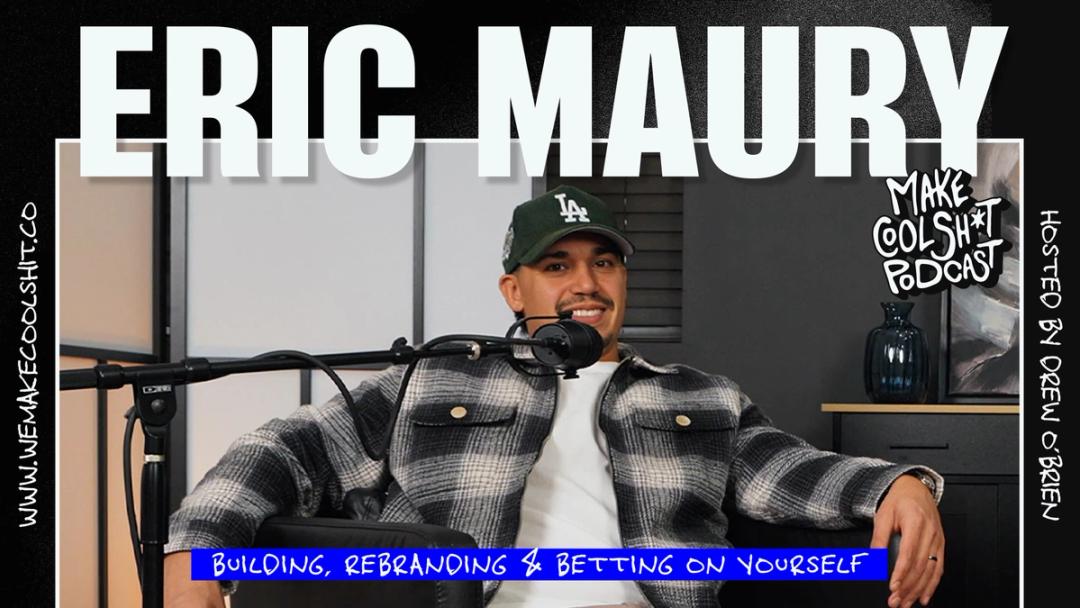
What's up, everybody. Welcome to the "Make Cool Shit" podcast. I'm here sitting down with Eric Mori, friend and client. He is the owner of Marcel in Montclair, he is the owner of Aligned Creative, and he is the owner of Drip Coffee, which is how we first started working together, but we've known each other for a very long time. Very long time. Now, we went to the same high school. I'm class of '06. Shout out, Fair Island High School. You are '07? '07. Okay. Now, we don't come from a town of a lot of business owners, right? There's a few, but it's selective. Yeah, I would say. We don't come from a small business or an entrepreneurship background. For sure. Right? So there's not as many people in our town with business owners. If I had to look at the stats, we're probably pretty low. Yeah, like a handful. Yeah. So we first met and started working together, officially, with Drip Coffee. Yeah. We did a bunch of, uh, we did a logo packet. Still to this day, actually, that's the new logo we started rolling with. Once we started drifting into catering, we started rolling with that cursive one that looks real elegant. So just to be clear, you hired us to do a graphic package, and then you changed that to your whole brand? 100%. That's the key to business, is find efficiencies. Yeah. He got a full brand at a very, very cheap price. Find efficiencies. So you were working in the advertising industry.
Yes. Right? And why did you decide to start Drip Coffee, which started off as a coffee cart? Is that fair to say? Uh, yeah. Yeah, it did start off as a coffee cart. The long and the short of it is, advertising kind of sucks. So, you know, after I got burned out, it was just a grind. You're kind of plugging in. It just made so much sense that, why am I making millions of dollars for these million-dollar brands when I can just kind of apply the same thing as a small business? Why not just turn this around and just do this for myself? And that's kind of where it all started. I had been investing in real estate for quite a bit of time before I launched Drip Coffee, and I was just kind of trying to solve, how do I—real estate's a good game, but it's a long game, right? Like, it is great for generating wealth over 30, 40, 50 years, but if you're looking for cash flow, it's very hard unless you have significant capital to really get the cash flow you'd be looking at to step out, do your own thing, or you have to be really active in it, start flipping. So I started with Drip just because I was like, how do I start something small, try to put the pieces in place, build a system around it, and see if I can just get a little bit of cash flow from that? It started as, like, a really simple idea, a really simple business. Where'd you get the idea from? Like, why a coffee cart?
Because in theory, you weren't working in coffee. At all. You weren't doing anything in the food and hospitality space. At all. At that point. So why specifically a coffee cart? I thought it would be a simple business. And the key is, I thought. I thought it would be a simple business. You know, when I set out, I thought, like, oh, it'll be pretty chill. I can, uh, smoke pot in the morning, go make, you know, become a barista for the day, and I'll just be hanging around, making some coffees, and then as I kind of build the business, I'll put a manager in place and all this stuff. And then what I came to find out relatively quickly after launching it was I'd have to become, like, a master mechanic, a plumber, an electrician. I'd have to be getting my hands dirty on the generator every single other day. I'd do everything but making coffee or smoking pot in the morning because I'd be so drenched and it'd be 5:00 a.m. So that's kind of where it started. That's how it all kind of build, but one thing led to another, and it just kind of ramped up. Like, I think we got the blessing of launching during COVID. So the idea kind of formulated beforehand. The world shuts down. I was already planning on building this mobile coffee shop. I thought it would lean more towards where I kind of am now, which is, like, selling to businesses, bringing it to businesses. When the world shut down, I had
to pivot. I was like, well, everyone's inside. Everyone's kind of, like, ripping to get outside. Why not just bring this to residential building? So I started to talk to a bunch of residential buildings in Jersey City, started pulling up, parking outside for the day. One thing led to another. As the world opened up, I just started getting more and more calls about, like, hey, can you do this? We want to do an employee appreciation. We want to do a school outing. And then all of a sudden, I saw this big opportunity. Like, really, the way to make money here is the catering angle. It's not really just pulling up and selling, you know, a $5 cup of coffee. Now, it's amazing that you said that because you started out to do, like, this in your mind, secretly, like, yeah, this is bullshit. Like, this is gonna be easy. Yeah. Right? And all of a sudden, you have 17 jobs, and you're also a full-time salesman. Yeah. Right? Because you can't build a business on people just calling you. You need to go out and get clients. 100%. Right? So now Drip started. That's how we met professionally, obviously. We know the personal side. But why in the world did you decide to buy a restaurant? It was really, again, going back to efficiencies, right? Like, our biggest holdup was we didn't have a point of operation. So I started looking at that challenge, that obstacle, as, like, there's multiple ways to go around. You can open up a coffee shop, and that comes with an inherent
risk. Maybe you succeed, maybe you don't, but coffee shops are a dime a dozen. It really depends on, and then going back to the idea of, like, real estate capital, it depends on your location so much. So you gotta really go in with some heavy pockets to get great real estate, to do the full build, and then maybe, maybe not. There's maybe, it's a coin flip. You need 10 things to go your way before you even start. It's a coin flip. And you gotta do the grind of, like, probably a full year, 18 months of just getting your name out, getting the word out. So for me, I was looking at it and I go, you know, I think it's also, like, the confidence of having come through advertising, building brands for other brands. I never really thought of it like, I need to have my fingerprints all over this thing. I'm so used to building brands for other people or, you know, kind of exploring and pushing other people's visions. I should mention, like, I come from the copy side. So that's why we work together and we work really well together. You come in from the art side. We just kind of pair together. So for me, it was like, how can I expedite this process? How can I get where I'm trying to go quicker? And that's when I started looking at purchasing a restaurant or something in the food services business that I could twist into my vision, which is a bigger catering platform and create efficiencies with the team, the products. And ultimately, that's what happened with Marcel,
but it just took a really long time to find and secure that opportunity. Now, cut to my scene, where I'm sitting down with the previous owner of Marcel. His name's Menny. Great guy. Shout out, Menny. Shout out, Menny. And he's in our office and we're talking. He's like, yeah, I'm going to sell the business. And on a whim, I'm just like, okay, who are you selling it to? Maybe I'll know him. He goes, oh, he's some guy from Fair Island, which is the town that we grew up in. I'm like, wait a second. So now in my head, I'm like, I guaranteed I'm going to know this person, or I know somebody that knows this person. And he's like, oh, it's this guy, Eric Mori. Yeah. And while I was talking to Menny, I texted him, I'm like, yeah, dude, you just bought Marcel. So now, for people that aren't in the Montclair, New Jersey area, they call it, what do they call it? Like, the sixth suburb of New York City. It's a very affluent area. It's very expensive. It's a beautiful town. It's where I'm moving back to. It's where you want to raise your kid. It's like, it's like out of a movie, right? So it comes with high rents, right? There's a lot of businesses in Montclair that turn over very quickly. For sure. You might see a business on the street that he's on, which is Valley Road, be there for three months, five months, six months, 18 months, right? I've lived in Montclair for five years now, Bloomfield, five years. I've seen 50 businesses leave a five-mile radius of where you are, right?
So you bought a already successful business, and you said earlier, I've always built brands for other people. And why did you decide to then work with us and say, hey, I want to put my own stamp on this business? Because most people, when they buy a successful business, like an NBA franchise, you get a new, you get a new owner, you get a new branding. Yep. For sure. Right? Some people do it for the wrong reasons, just to put their stamp on it, right? But why did you decide to take Marcel from where it was at? And from a visual perspective, not necessarily a food perspective, but from a branding perspective, we flipped it upside down. Flipped it upside down completely. Not intentionally, but it just happened to be that way. And funny enough, the reason why I wound up doing it is because we got on a phone, like, shortly after, you're like, dude, you're buying Marcel? I'm like, how the hell did you find out? And of course, Chef knows everybody, so it's a small world. And I was like, dude, I don't know, man. I really don't know. You know, part of me's like, I want to rebrand. I think it'll be fun. The other part of me's like, dude, just don't break the machine. Don't change anything. If it ain't broke, don't fix it. Yeah. Like, you risk so much more. We have a steady clientele. Don't want to scare them away with a new brand coming off really aggressive as this new owner. Like, just hold tight. And me and you were talking, and you
were like, Eric, like, just walk into the place. There's three brands inside of there already. Menny had done this rebrand, like, multiple times, but, like, halfway through. It's like, you're not really, I don't think people are really going to notice the way you think they're going to notice. If anything, they're going to perceive it as a benefit. And if you do it right and you put your heart into it, like, it should be fine. And I kept going back and forth, back and forth, and I'm like, I'm talking to advisors. I'm talking to people in the industry. I'm talking to friends about this, and everyone's got a different answer, a different perspective. And at the end of the day, it just netted out where, like, if I'm going to fail, fuck it. I want to fail on my own terms. It's that simple. It's like any business, there's always a coin flip. You can feel as confident as you want going into something. There is no guarantee at the other end of it, you're going to reach success. So if you're going to fail, fail on your own terms. Do it your way and see what happens. You can always pivot. You can always make do. To go out there and try to build something that I'm not passionate about just felt like the wrong approach. Just really felt like the wrong approach. At the end of the day, you wanted to be authentically yourself. And I think what's important is Eric and his team, they didn't come in and completely change the menu, right? I'm sure there were some small
tweaks. I'm not talking about the design. I'm talking about the food aspect, right? Dialed in. Marcel has had great food. It has great food now, right? So as a business owner, you're like, okay, let's take this amazing food that's already here that Chef Menny kind of curated, and let's just add lighter food on top of it. It was 100% that. And I told Chef when we were in the negotiation, there's nothing I can add in the kitchen. I'm buying the product, and I'm buying the team, and I'm buying the system. I can't add, my wife doesn't even let me in the kitchen. Like, it's that bad, dude. I fuck up eggs. Like, it is that bad. I'm not adding anything to that side. But what I can do is I can add my own touch of where I see the heart of this business, you know, and trying to get at it. We did, like, an exploratory, like, whether we were looking at, like, all the Mediterranean brands that could potentially be competitors, all the way dialed into, like, where are our three biggest competitors? And they all happen to be on our block. I'm not going to give them any clout, but yeah, where are they? How are we looking at them? How do we differentiate? So we did all of that, and that's where I saw myself adding value to the business. And then after we built out the brand, we had fun with the logo. I mean, I think the brand went from somewhere that felt a little safe to somewhere that is completely different from our competitors, from, I'm talking the color palette
to the logo. It now feels like a very fun brand, you know? Like, we've got this, like, squiggle, ownable pattern. The logo feels very Mediterranean and edgy, kind of. We've, like, kind of brought in this, like, streetwear aesthetic into both the space, but also, like, the clothing that we're wearing. And it's funny enough that the shirts that we did, we did these beige shirts. I'm not wearing it. We did a pink shirt. The beige shirt, we've already sold out of medium and large twice. So people are going in there. They're liking where we're pushing it, and they're telling us it with their dollars. They're telling us it by purchasing and supporting. You know, it seems like such a small thing, and it is a small thing, but for me personally, it tells me I'm going in the right direction. Keep pushing in this direction. Now, it is a small thing in terms of, like, revenue. Yeah, you guys made two grand off of t-shirt sales, right? Probably at most. But through those t-shirt sales, you really have a walking billboard everywhere those people go, right? So yes, apparel is not going to be the driver of your business, right? That's not going to 10X your company. For sure. Right? But one thing that I want to make note is in our process, when we were rebranding you, you looked at the data. The brand for Marcel, if you can see here, it's pink. That's pretty uncommon in restaurants in the area that we live in. 100%. But you looked at the data. You looked at the Instagram followers.
You looked at all of your customers, and you realized, if I remember, it was, like, 65-35 or 70-30 women to men. Yeah. Is that fair to say? 100%. You got to dig into the analytics, right? So we started looking at, like, and it was both the data, but also my subjective experience. You know, I would sit in there for hours and just be present. And you can clearly see who's coming through the door, right? And at the end of the day, our target audience is 30 to 40-year-old women, majority of them, upper Montclair. And then also, we have a large segment of their daughters, right? So high school, college. We had a brand that was already geared towards women, but on the back end, the brand wasn't speaking to women. We just amplified it on the front end. We amplified it a little bit. We amplified it a little. And to your point about the shirts, the money that comes in from the shirts is completely irrelevant. It's the continuation of your brand. It is a brand, an enduring brand. It's an extension. Every single time you wear it, it's an extension. Exactly. Using that same thinking, it's like, the shirts were important to me. The choices of the things that we carry on our shelves was super important because I'm also a big proponent of the things you carry on your shelves say more about your brand than you say about them. So for us, we started to integrate, yes, we have some Israeli products. We've got a good diversity of them, but we've
also got some products we make in-house. We've got some products that are trendier, funner, whether it's like the Grazza olive oil, things that you would just speak to that audience that they're already kind of gravitating towards. Those products speak about who you are as a brand. I think it's really important that you have to curate that. You have to create the experience you want for people when they enter into your space, and it has to be active. All these items that you're talking about are very important when you go to rebrand anything, whether you're a company from scratch or if you're rebranding a current business that was already successful. I feel like a lot of people or a lot of business owners, they'll just rebrand because they want to fix a problem, or they get a new owner and they just want to do it from an egotistical standpoint, right? A good brand is built on stats and a reason why, right? You need to solve a problem with branding. You now have a new brand. Most of your branding on the inside of the restaurant is done. Maybe you're 70% there, right? We're 70% there. 65, 70% there, but every single day, we're trying to keep pushing forward. So as someone who's worked in advertising, who's worked on building brands, right, I get all the time from people, like, if we're sending out a $100,000 proposal, they'll say, all right, how can you measure the ROI in a brand? So now you have your new brand. Now, obviously, it's too soon to look at actual numbers, but if someone would ask you, hey, how can you put
ROI on creativity, or how can you put ROI on a brand refresh? You got to measure the objective. For us, when I came in, and going back to my catering background, our objective was, can we ramp up catering? So when we did the menu rebuild, and for any restaurant or food service business, spend a lot of time on your menu because the menu architecture is vital to your business. Everything from how the dollars show up visually, like, if you look at our menus, we don't have a dollar sign that goes into the psychology of when you remove the dollar sign, you remove resistance to the number next to it, to your placement, making sure that, you know, your highest grossing items are closer to the top. You're driving the action you want people to do in any type of way, shape, or form. So for me, when I was measuring the brand ROI, you're right, you can't directly tie it to any one thing, but I knew the initiatives I wanted to get, right? I knew I wanted to drive some revenue. I knew I wanted to drive catering. So in a very short amount of time, less than six months, at this point, maybe more than six months, but not much, we've been driving catering like crazy. And it's not just with ad dollars. We spend very minimally on our Google ads. It is word of mouth. It is people now gravitating to this new brand, grabbing this new pink catering menu, seeing, and having that front and center has made a huge difference to the point where last weekend, we did a 200-person catering gala, fully catered, five courses.
Just today, we did a 150-person business event that I was just pulling from all breakfast. So those are the things I'm looking at. You know, when I look at brand, and now I'm trying to tackle the interior, right? And I say I'm 65% there because I'm still working on the interior. The other aspect, and it goes for food, it goes probably for any business, but every seat should have a dollar associated with it, right? So right now, when you walk in, we have this nice L bar, and it kind of, it does one thing really well. It hides everything that's going on behind the bar, but it's unusable space. And in my mind, that could be four to five bar seats. So I'm going to spend tens of thousands of dollars to redo our bar because every single one of those seats on a Saturday has a dollar mark. And those tens of thousands of dollars, you might be able to make up in a weekend. If I add two seats, I'm adding tens of thousands of dollars into the business. If I add five seats, you know, multiply it. Yeah. That could add a quarter of a million dollars at the end of the year. Because the beautiful part about Marcel, and I always preface, I take no credit for the success of this business. I just came in. It's a credit to the team. It's a credit to the chef. It's a credit to the community that's been built around it. Everyone is fantastic. But what I will say is we're packed out Saturday and Sunday
to the point where we turn people away because we just don't have chairs. We don't have seats. So those seats on a Saturday and Sunday, if I can add six to eight seats, you're right, I can make up the cost of that in a month for sure. In a month for sure. And we're looking at, like, doing some pretty substantial stuff, and I don't want to give it away, but, like, we have unusable space on the bar. We have unusable space in the window, which is nice. You can set up a cute little, but I could also make that a lounge seating, and I could add four more seats in the window, and it's a really cool place to sit. So we're exploring all these opportunities, all these ideas. That will be another thing we go back to and say, like, what's the ROI on this? Because if anything, your interior, it's all about, it should be all one fluid experience. So the ROI you have on your any interior renovation should also be considered in the ROI of a strong brand. And that goes for any business. It doesn't have to be a restaurant. If you have a retail store, if you have an apparel company, whatever it is, right? You want the website to feel just as great as the retail store, right? You want every single aspect of your brand, whatever it is that you're talking about, you want it to be, you want it to evoke an emotion. And I think that's where a lot of restaurateurs get lost is they don't see a value in their website development.
They don't see a value in their CRM. They don't see the net benefit of it. People are coming in. People are eating. The food is what's important. I agree with you. The food is very important. The product is very important, but the feeling it elicits when you walk in is also very important. And for us, like the catering, why we've been able to ramp up catering in a short amount of time is because I took a digital approach. When I started Drip and I pushed it towards catering, I said, I'm going to use the best practices of e-com to sell my catering, which is very unusual in the space, but it's paid dividends, right? So that's what I do for other small businesses. When we talk about Align Creative, is I help them dial in their CRM. I help them dial in their sales funnel so that they can automatically generate catering leads. It's not easy, but it's simple. What is Align Creative? Align Creative is, so I've been working in advertising as a copywriter, creative director for about, you know, over 10 years. I started branching out, freelancing at the same time that I started Drip so that I could have more control of my schedule. And just one thing has snowballed into another. And I started taking on clients, helping them dial in this exact method of kind of colloquial term I throw around is like performance branding, but it's really just like dialing in from your, whether it's Google or Meta ads, through your sales funnel to the point of making the sale, making sure on the back end that you're fully dialed in so that not only you
can get leads, you can nurture leads, and you can convert leads with as little to as no effort as possible. Like for me, for Drip, we do a couple hundred thousand dollars a year in revenue, and I take sales calls. I take 15 minutes' worth of sales calls, and that's my responsibility for. I've input a manager in place for that. You have all your systems. I have an admin working for me in the Philippines. I have our CRM is dialed in. All of our, you know, touch bases. When someone comes into my system, they're going to get an immediate follow-up within three minutes. It's got a personality. It feels like the brand. It's fun. My admin's going to nurture that client until they are booking or saying no. I think that's really important. A lot of people shy away from this. You should hear no. Like, don't be afraid to hear no. It is a great thing. That means, okay, we're done with this one. We can move on to the next. But a lot of people are like, oh, I don't want to be a pest. I don't. No, go for the no. Sometimes you'll get a yes. That's great for business, but a lot of people shy away before they ever get there. Sometimes you need five no's in order to hear yes. Of course. But if you're not chasing the no, you're not chasing anything. Correct. If you're afraid of, like, I've reached out to them two, three times of silence, make them say no to you. They're not going to be afraid to.
When they're done, they're going to say no. But if they reached out to you, it's for a reason. They're interested. And then ask two more times. Yes. Right? I say all the time, three no's, like from a sales perspective, okay, that's it. Yeah. Right? But if you just say no one time and whatever, like, you know, if I, hey, if I said to you, hey, our services are XYZ, it's cost this much money, no. Okay. So now I just never talk to you again? Or do I set up an email and I hit you up three days later? Exactly. Hey, I just want to let you know that I just want to restart our conversation. Maybe we didn't talk about these couple of things. I always look at it as an opportunity to pitch another service. And for me, like for my sales funnel, my goal is to get you on the phone because I know once I have you on the phone, I can listen to you. I can make a real human interaction. I can make a real human connection. I can listen to what you're trying to solve for, and then I can pitch you my services. And that's sales, by the way. That is the core of the sale. It doesn't matter how you want to phrase it. You are there to solve a problem, whether it's branding, whether it's backend, whether it's your doctor. It doesn't matter. You're there to solve a problem from a sales perspective. You have to go into every sale listening. My grandfather used to say this. You got two ears, you got one mouth. You should listen twice as much as
you speak. I think that is like at the core and heart of sales. You got to listen to these people. They're going to tell you what their problem is. Now it's your opportunity to say, this is a service I have for you that's perfect for you. And that's literally language I use every single morning when I'm on these calls. All right, well, I got a hundred people, but we're not looking to do anything outside. It's cold. You know, we're thinking about pastries. We're thinking about this, but we definitely want coffee because, like, who wants a box of Joe? Perfect. I got something exactly for you. Our bar is set up. We own a sister bakery and kitchen. What kind of pastries were you thinking? Like, ask questions. Get to learn the person. Try to solve their problem. Be real direct with it. And then it doesn't even become a sale. It becomes a conversation that just happens to involve a financial transaction at the end. Exactly. And if they say no to you, you also know on the back of your head what they're looking for, and you can pitch other services that might help them. Oh, okay. Maybe you're not into the coffee catering thing, but listen, we do just like hot food catering. If you guys are ever doing lunch, let me send you out a box of pastries just to try. Drop you off a couple of menus. No commitment. Just have some. Like, you know what I mean? Like, you start to pepper. You start to, the more goodwill you do for your clients and your customers, the more it comes back to you.
I'm a big proponent of that. It's karma. That's absolutely. It's just business karma. Yeah, business karma, you know? Like, and right now, like, that's part of our initiative. That's part of how we've been dialing up and driving sales is I reach out to people, big businesses around the area, and I go, can I drop you off a box of pastries? Shooter's got to shoot. Shooter's got to shoot, man. Absolutely. And it works. It definitely works. So you've worked on the front end, the back end, in every aspect of building brands, your own, clients. When you hear the word brand, what does that mean to you? I think brand is a feeling. I think brand is a feeling. It's the thing that when I interact with your product or service, what do I walk away with? What is that feeling I walk away with? Am I empowered? Am I satisfied? Am I resentful? Your brand is a double-edged sword. It's your job to cultivate it so that you leave with a positive experience. But at the very same time, there are brands that turn people away and they leave just, I'm never going to interact with this brand. I'm never going to pick up this product. I'm never going to purchase from this person. Which happens often in the food and hospitality space. 100%. You get one chance at it. And that's what, like, especially when people come to me and they're upset, which is inevitable when you're upset with something, my only thought in my head is, how can I have this so that you leave still
with a positive experience? How can I set this off so I can make this right for you? Because I know that every single person who interacts with my brand becomes a brand, and for lack of a better term, a brand ambassador. And how they're going to talk about your brand is just as important as you making the sale. So for me, brand is completely a feeling. It's the feeling that you're trying to invoke and everything around that. And that's why I think taglines are so important. And of course, a copywriter who thinks taglines are important, go figure, right? Shocker. You know, taglines are getting at the core of what that feeling you want your brand to elicit. So for instance, an example, Marcel, it's savor life. And for us, we went back and forth on, like, dialing in the manifesto. And it's like, it's a restaurant. Like, why do you care about a manifesto? Because the manifesto is everything I want you to walk away with, right? It's not just a restaurant. It's not just a restaurant. It's everything. It's the experience, right? And for us, like, savor life, it means like getting together with the people you love, with friends, with family, with coworkers, and enjoying being present in a moment. And so much of what we're building is about that. Because I really do believe that the dinner table, the table itself is like the last place that we truly feel present. Everything is attacking your attention. Everything. Your phone's constantly in your hand. Your computer is your emails, this, that, and
the other. When we sit down with food amongst the people we love, there's nothing better. That's the moments that you can still appreciate it, right? Your phone's away. You're there for the conversation. You're there to just like see how someone's doing. That's important in this world. And I think it's becoming, people are striving for less and less for some reason. Everyone's just like, the robots are going to take over sooner or later, but until then, dude, I think we got to like really lean into humanity. Lean into each other. That's important because, for example, the other day I went to Marcel, I went with my wife and my daughter, and we sat down and I was on my phone and my wife was like, what are you doing? We're here with Sophia. We're here, like, be present. And she was 100% correct. 100%. Now, she knows if I had an emergency or something that really needed to happen, yeah, I need to be on my phone. But she was like, hey, like, let's be here. Right? But to your point, there isn't a lot of spaces out there that really allows you to have that openness about being present. Because when you're just on the couch with your partner and your family or whatever, you should also be present. I want to be very clear. You should also be very much present around your family. But when you go to a space and you're there and you're spending money and you're having an experience, right? Outside of taking the good pictures of the shashuka or whatever is on the menu, which you have to do and make sure you
tag Marcel Bakery Kitchen. Tag us every time. But being in a restaurant is one of the few places that you can actually have that experience. So I mentioned my daughter. I'm somewhat of a new dad. You are a new dad as well. How has being a father changed your perspective? Yeah, that's interesting. It gives you something to work for, grind towards. A lot of times I'm thinking about lately is like, you know, with men in general, right? Like. Get ready to cut this. No, no, no, no. Keep it rolling for sure. Because I think our, you know, we've kind of lost the traditional roles, right? I think fathers and men are being asked to do a lot more, but the reality is, like, our kids want their mothers, and there's biological reasons for that. And for me, with my son, it's become really something I think about a lot where it's like, the best way I can raise my son is to be the man I want him to grow up to be. So if he sees me grinding, if he sees me working my ass off and he still sees me finding the time to be present, to be with my family, to show up when I need to show up, and it's not, it's for everyone, right? Like, you know, McConaughey always talks about, you got to feed these wolves, right? You got all these wolves, you know, kind of vying for you, but you got your family, you got your friends, you've got your work, you've got your passions, you've got to show up for all of them. And when you're a parent, your time
becomes less and less and less. Your free time becomes less and less and less. What free time? Yeah, exactly. So you got to make every single minute count. I think with being a parent, a new parent, for me, it's like making sure that I show up in a way that when my kid is conscious and, you know, really like able to perceive what's going on, he can look back when he's 20 and go, yeah, my dad was a really hard worker. My dad really showed up for his family. My dad, you know, he cared about people. He went out of his way to care for people. You know, those are the things. I just want to be the man that he can, like, kind of aspire to. His north star. Yeah, that's pretty on point. We don't have to cut that. That was good. We can leave that in. I thought he was going in a different direction. So as a father, you mentioned that, like, hey, your time kind of dwindles a bit, which is true. So my favorite thing that I see on social media is like work-life balance. Do you have a work-life balance? No. I mean, there is a balance, but like the scales like this. No, you just try to find, you try to find, show up for the things you need to show up for, right? Like there are weeks when if you, funny enough, it goes like, you can look at it for sales too. You can look at it for a lot of things, right? You can even look at your, like your kid's milestones or development or weight,
right? The more you try to focus on the day and let's just use a kid's growing, right? You want to, you're tracking their weight. So from week, from month five to month six, they got to get, you know, you can track it by the day and you're going to cause yourself a lot of gray hairs, but really you should be tracking it over the weeks and the months. And I look at work-life balance in the same way. Like there are going to be weeks where I'm going to have to be laser-focused on work. There are going to be months where I'm going to have to just like lock in and be laser-focused. But if I'm locked in for the whole month or the whole, I've got to also, on the flip side, find a week to lock in for my family. Find a week to lock in. Find a day to lock in for my friends and make sure that I prioritize it. Because if you don't, and it's the same thing with your calendar, if you don't prioritize owning your calendar, someone else will own it for you. You got to clip that one because that one's a fucking bar. What is your creative superpower? Ah, shit. My creative superpower is probably that I overthink. I like to sit in these worlds. That's a superpower. That is my superpower for sure. Your superpower is that you're an overthinker. Explain. You know, sometimes a negative can be a positive. I also can acknowledge that I'm an overthinker. So it helps me be very honest
with myself. And, you know, going back to like my wife, she also knows I'm an overthinker. So when I am able to open up with her, when we're sitting on the couch, when we're talking about things and I can open up to her, she can, I listen to her and she'll be like, Eric, you need to just do X, Y, and Z. And me knowing that I'm an overthinker, I'm like, she's right. She's right. But for me, I, in my mind, I will work around problems a lot of different ways. You got to trust your gut at some point. I'm also a big believer in like alchemy, right? Like the doors you're supposed to walk through will open for you organically. Your job isn't to figure out what door to walk through. But you have to be ready to walk through that door though. You got to be ready and you just got to walk through it. You got to just keep going. You're never going to know what's on the other side of it. And like it goes back to what we were saying about business, right? Like you start a business, you start an endeavor. I've started multiple and they're coin flips, right? But you know that this door is open. Let me walk through it and let me see what's on the other end. At the very least, you're going to grow as an individual, as a person. And I think business-wise, you're always going to fall into, you will always be limited by who you are as a person, your own personal limitations. So like for me, you know, I have a short temper.
So it's really important that I work on my patience. And it's, that is like. No, I'm laughing not at you. I'm laughing because you're talking through me. Yeah, right? Like, but like that's a lot of men, right? Like short temper. If you have a short temper with your staff, with your team, you're going to turn people away. We all can work on our patience, right? And it's like find, being humble, being able to think and observe yourself and say, where am I deficient? If you find those on a personal level, you'll find where you're deficient at a business level. So your job is become a better person, work through those problems, work through those deficiencies, and business will follow. Money will follow. Yeah, I just pointed out Richie because I told him the other day, you know, he's a new team member and he's surprised how open I am. I talk about financials, I talk about everything, I talk about my family. He's like, wow, I wasn't necessarily expecting to have these types of conversations. And I was like, well, if you don't know what's going on with me, if I'm leading this charge and you have no idea what's going on with me, my family, the business, what it costs to, what it costs our clients to work at Make Well Shit, all this stuff, then how are you going to learn? Yeah, for sure. Right? And at the same time, if I come into the office and I'm a dick, that's not a great place for him to work at too, right? So your patience, who you are as a human being also trickles and translates
into the business because if you're an asshole, all your staff's going to think you're an asshole. And it's not going to be a coincidence if you have three servers that quit in one week because someone at the office is an asshole. And if, same thing, like if you are greedy, if it doesn't trickle down to them, if they're. It's so easy to turn people away. And you could turn a lot of really good people away. Everyone's trying to survive. I think it takes, like you have to be, you have to be humble, you have to be empathetic. Everyone's going through something, you know, try to be a human. But I think being open is, yeah, I think you're right. You know, like you got to be open. You got to create an atmosphere where good people want to stay. And that's really hard. It's not, it's not easy. It's hard. No. It's culture. That's thrown around in the big business world, right? Like you got to create a culture, which is an overused word, right? But it's true, right? You really need to curate whatever that means to you, right? We have a small business. You have a small business, right? It's, you spend more time with your staff than you might with your son and your wife that week. For sure. That's just a reality. For sure. I don't love that, but that is what happens on a day-to-day basis. So if you're mean to your employees, even if you don't even realize you're being mean, just because the Nicks lost and you had, you know, the over, you know
what I mean? And the next morning you come to the office and you're like, you know, in a pissy mood. Yeah. That's going to translate to them, to the customers. And guess what? In an unintentional way, that also ties into your brand. 100%. So earlier I asked you, what was your biggest superpower? What's your biggest flaw? My biggest flaw is I'm impatient. And it goes right back to me as a human. I'm impatient. My business is I want to see, I want to see movement and action. And at my core, I'm a builder. I think my flaws are, I can look at calm as a lack of traction when really some days, things being calm is a good thing. So for me, it's just always grounding myself in. That's something I struggle with as well. You know. If nothing's going wrong, it's almost like, when's the other shoe going to drop? Let's shake some shit up. Yeah, yeah, yeah, yeah. Time to redesign the website. You know, let's call Drew and redo the menu. No, but it's true, man. You know, my biggest flaw is business and person, you can't separate the two worlds. So I'm impatient and it's one of the things that I'm constantly working on. Be patient. Especially in 2025. There used to be no such thing as a personal brand. I've talked about it, I think on every podcast we've had on here so far. Your personal brand is your business now. 100%. But a decade ago, five years ago, that wasn't the case, right? That's why I have a podcast now.
I don't, I didn't want to start a podcast per se, but I need to get myself out there. I need to get the business out there. 100%. Your grandfather dropped a bar earlier, two ears, one mouth. Yep. What is the best piece of business advice you've ever received? The best piece of business advice I ever received was just keep it simple, stupid. I was literally going to say the KISS method. Yeah. Keep it simple is really the best way to look at business. Like don't overcomplicate things. Sometimes it's just about what is your product? What are people saying? Like listening, again, going back to listening, it's so important because people will tell you what they don't like about your stuff. And you can, you know, you can like, you know, puff up your chest and your hubris can tell you, no, my shit's perfect. Or you can say, all right, listen, maybe there's something right about this. How do I solve this? How do I fix this? How do I address this? How do I push for a better product, a better service, whatever it is? But business at its fundamental is simple. It's trying to turn one dollar into two. So the less you overcomplicate it. Another bar that I get, or I should say another thing that I tell myself on a daily basis is if you aren't humble, you're about to be. Yeah. That's good. I like that. Or no, the correct verbiage is if you haven't been humbled, you're about to be.
You will be humbled for sure. Keep that one in. So we've talked about personal development, professional development. What has been your fuck it moment? Meaning, what's one risk that you took that kind of changed everything for you? Oh, 100%. This is easy. I was working at Hill Holiday. My mom was really sick at this point. I was really burned out. I was burned out in life. What year is this? This is 2020, 2019. I'm really burned out in life. What happened in that time? You talking about like COVID? Okay. Yeah, it's a little like pandemic drop. This is right before the pandemic. I'm just super burned out and I'm like advertising, I can't, advertising's not going to be me forever. Also advertising agencies. I could probably spend a whole podcast shitting on advertising agencies as a business model. Let's cut that because you're in an advertising agency. But I mean like the. No, don't cut it because we don't have the regular model that everyone else is in. Yeah. Like the, well, I like your model because it's a brand and you're like, you're churning things out. The advertising agencies of the Sachis and the Publicis and the Havases, where they're, come to us, we do everything and anything and we'll bill you by the hour and we're at your behest. There are, they, going back to culture, they chew you up and they spit you out. They don't care that they can churn you out, churn employees out every 18 months. And that's why it's constantly a revolving door.
Because they know that someone wants to move to New York City and work in an advertising agency anyway. It's cool. It's fun. It's like, it's like anytime a professional sports team wants to hire someone, they pay them half of what they're worth because they know if someone wants to go be the head of film at the New York Knicks, they'll. They'll take it. They'll be tens of thousands of people that will apply for it. So I was super burned out. I was doing a bunch of real estate at the time and I just couldn't, I was like, I need to find a solve that gets me out of advertising. Not something that I can, you know, invest in over the next 30 years of my career because I'm like, I'm also just in entrepreneurial spirits, which just doesn't work. So I started telling people like, I'm just going to launch this coffee shop. I think I'm just going to build a mobile coffee shop and I'm just, fuck it. I'm just going to do it. And my wife's like, at the time girlfriend, she's like, please don't do this. I'm very serious about you. Please don't do this. I'm like, my dad's like, Eric, I hated my fucking job for 40 years. Get over it. Like, what are you talking about? And my mom having the perspective, I think only of a sick person can is like, listen, she's like, I worked and I hated my job for 30 something years. And I always had the back of my mind that when I retired, I would do the thing that I loved. And she's like, I'm never going to get to there.
What was the thing that she loved? She was a really good interior designer. She always had a side hustle. She did a bunch of interior design. She built this like curtain business out of nothing and she was a hustler. But, you know, she wound up getting cancer and she never wound up living that dream. So she's like, Eric, if this is the way you want to go, just do it. And she was the only person that told me to do it. Everyone else is like, my friends, my family, don't do it. You're an idiot. What are you, you're going to open a coffee? You know about coffee, you've never been a barista before. My mom told me do it. Fuck it, I'll do it. So that's when I jumped out. I said, I'm going to go freelance. At least freelance, I can work part-time, 30 hours, 25 hours. I can grab contracts. I can go off contract, four months, learn the business, get involved. And then when I come back to it, I can make my money and, you know, make ends meet. And that was the driving force. And I've never looked back. And still to this day, the things I build, I always think about that. Like this is for her, right? I'm just keep building it for her. That's incredible. The most important thing that I heard about that outside of your mom was everyone was telling you no. Everyone said no. And a lot of people told me no when I wanted to
start my business in 2017 too, right? There were some people that supported me, like my wife unconditionally supported me, my family did, but everyone else, all the dumbasses we went to high school with, you know, they're like, what do you know about starting a business? And guess what? I knew absolutely nothing about starting a business. And you know what? You're never going to know anything before you start a business. You got to do it. Yeah. You've got to have lived experience. I don't even care how many books you read, how deep in, like it does not matter. Until you're actually boots on the ground, you're not going to know shit about shit. So just do it, see what happens. You fail, so what? Dust yourself off, go do the next thing. Yeah, because think about it, what's the worst that could happen? It didn't work out and then, okay, you go back and work at Havas or wherever you were at before. Square one. Yeah. Yeah. Not so bad. It's funny because all the Instagram commenters and everybody that likes to talk about other people's businesses, they actually have no fucking idea how hard it is to even run small businesses at our scale. 100%. Right? Never mind running, being a massive CEO of a huge corporation or something like that. So what's one thing that you think most people don't understand or can't even comprehend or maybe don't have any idea of what it's like to run a business? I think most people get into business thinking they're going to do the thing that they set out to do. If you're a builder, you think you're going to
build. If you are a baker, you think you're going to bake. If you're a graphic designer, you think you're going to do a podcast. Yes, exactly. Exactly. But the reality is, is at a certain level, whatever you're doing, if you're good at it, you're not going to touch that thing. You're going to have to manage people who touch the thing. Business is people. How do I manage people? How do I build systems around people? How do I empower people? Owner versus operator. 100%. You know, the operators will always struggle because they'll just, they'll be too in the weeds of things and not have the perspective of pulling away and being able to see where you're going, right? Like the captain of a boat doesn't stand on the stern in the front. The steering wheel's all the way in the back. You've got to be able to look and navigate and see how the winds are whipping and how the waves are forming to be able to have a clear direction of where you're going. It's people. You're moving human capital. You're building systems. You're not doing set work. And that's why it was like, when I set out to be a barista, I thought I was going to be a barista and I probably spent like 12 hours behind the bar. You know, I wound up taking care of all the problems. I think that's another thing is like when you're a business owner, small business owners, your role is to jump in front of the problem all the time. You're looking for the problem to jump in front of it.
I tell people, because catering, I'm setting up a cafe in a new space every single time I roll out. And I tell them, your role is not to deal with an angry client or to deal, your role is to send angry clients to me and I will deal with them. Your role is to, when you hit a problem, you call me, I will figure out a solution while you continue to work on the thing you're doing. So yeah, professional firefighter, that's it. One very important question that I've asked on the pod to date is, how do you deal with imposter syndrome? How do I deal with imposter syndrome? I realize that it doesn't really matter. What you think about who you are doesn't really matter. The most important thing is you put your two foot, you put your one foot in front of the other, keep walking, keep going, like I said, keep going through those doors. You can't, I'm a big proponent of you can only control the things you can't control. I can't control how someone else looks at me. I can't control the way things are going to break at the end of the day, but what I can control is my effort, my actions, and how I move forward. You know, everyone. Yeah, but how did you come to that? How did I come to that? I don't know. I'm a bit of a stoic. I don't know if that's come through. I try not to get too swarmed up in my emotions and like all of the, being able to acknowledge the fact that I'm an overthinker. I know I'm an overthinker. You have some self-awareness, which I think
is important. I have a lot of self-awareness. So I think imposter syndrome, everyone has it. I know you said that, you know, I think, I think you've, I've listened to both podcasts at this point. I've heard you say it, you know, everyone suffers from imposter syndrome. It's impossible to get in front of it. You just got to keep going, man. You just got to keep walking forward. If you fail, there's always a chance to course correct. What's something that most people always get wrong about you? Although I am very beautiful, I'm not a male model. So I think that's, that's definitely. I'm sure you do get that a lot. That's what I've heard. Yeah, the other day someone was like, Leo! And I was like, no, no, no, Eric, Eric, what's one thing someone gets wrong about me? I don't know, man. I try not to think about other people, what they think about me, but I think people could see the way I move. I move with conviction and I think I try to move with confidence. And I think some people can look at that like, he's arrogant or he's probably an asshole. And the reality is I'm actually like a very reflective guy and I just know that where I want to go. So I'm very pointed in the things I want to go. I don't try to like sugarcoat shit. So sometimes the things I say can be abrasive. I never mean harm. I never mean to like offend anyone, but I'm going to tell you how it
is. I'm going to tell you what's on my mind. And it's not a judgment on you. It's a, we're trying to build something together. We've got to get, you know, I think conflict is actually good in a business. You should have some conflict because that helps you grind down to the middle, right? Like that's the whole, not to get into politics, but the whole purpose of two-party system is that you grind down and whittle to the middle. And conflict helps with that. That's why they open up the Senate floor to debate. So we can have conflict and we can find out and say, this is actually the best way forward. I think people are so averse to that nowadays. I think people are very scared. Like I don't want to hurt someone's feelings. I'm just going to tell you how I feel. I'm going to tell you exactly how I see it. You tell me and we'll figure out like. Have a conversation. We'll have a conversation. We'll have a conversation. Why are we so afraid to talk to people anymore? So I think that's kind of, I would say maybe that's probably a good answer. I feel like a lot of business owners get that same cliche where it's like, oh, they're assholes, right? When in reality, we're just, we don't have, we don't have time to do half the shit that we would like to do, right? So we have to be very precise with our time. Absolutely. I get that. Especially when I have clients outside the New York area.
Oh yeah. They'll like, even when I hop on a call, they're like a little bit like taken back, but I'm just like, I'm just talking to you how I'm talking to you, like right here, right now, right? Like I'm not, but they're like, yo man, you're like, you're talking fast, you're coming in hot. Yes. And I'm just like, it's Tuesday. You know what I mean? I've experienced that a lot over the years, especially in advertising when I have clients in like the Midwest or I'd have clients on the West Coast and I'm just like fast, like let's get this thing done. Yeah. Like what are we doing here? Let's go. I'll just jump out and throw my opinion out there. Like I'll throw my perspective and like, oh, he came in a little hot. Like, don't be so sensitive. No, I agree. What's next for Eric? What's next for Marcel? What's next for Drip? What's next for Align Creative? Yeah. What's next for Drip and Marcel is to keep growing together. Marcel, I mean, I didn't buy it just to have one Marcel. You know, the going back to keeping it simple, we have a single-minded focus right now. It's to take Marcel from one to two. So all of my energy and efforts are right now to build the systems in place so that we can get there and looking and trying to figure out like where is that next one? Where's that next one going to be? And strategically, how are we going to get it, right? In a perfect world, where is the next location for all of our
New Jersey listeners? Ridgewood would be beautiful. It's very similar socioeconomic standpoint to Montclair. It's got some location efficiencies where we're like 35 minutes away from each other. Ridgewood, Glenrock would be great. Also maybe Monmouth County. I live in Monmouth County from a catering perspective, not to give away the secret sauce, but Netflix is going down there. They're going to be a big driver of success. You know, it's just strategically positioning ourselves both where our community is, while not being too far away where we can create some efficiencies. Yeah, you can't have one location in LA and then one location here. Exactly. Like even if we were trying to go into like New York City or, you know, listen, Jersey City, Hoboken would be cool. You got to deal with a lot of big fish, right? So I want to make sure when we do go into Jersey City, when we do go into Hoboken, everything's dialed in. Our operation's perfectly dialed in. Our system's dialed in. We're ready to compete with the best. You need to be more established at that point. You got to be a little bit more established. What's next of line? I'm still taking clients very selectively, helping mostly hospitality dial in and gain more catering clients. But my experience is really in the health and wellness space besides hospitality. So I am working with a couple health and wellness clients as well, but it's still the same approach. Same concept. Dialing in your sales funnel so that you can take leads from the top of the funnel, bring them all the way through with as little effort on
the owner's end as possible. So building out these systems for them. And what's next for Eric? I don't know. I might go get lunch. I think that's probably, that's probably it. I think I know a place. Where can the audience find you? The audience can find me on Instagram at DrLabamba. Not board certified, just to be clear. They can also find me on Instagram through Marcel Kitchen, Drip Coffee Catering, Align Creative. All right, well, man, well, I appreciate you coming down. It was a blast. That's a wrap. Make Cool Shit podcast. If you guys like it, share it, promote it, hit all the buttons. You can find us on Instagram at @wemakecoolshit. You can find us on OnlyFans at. Listen, you know where you can find us. Have a good day. Peace.