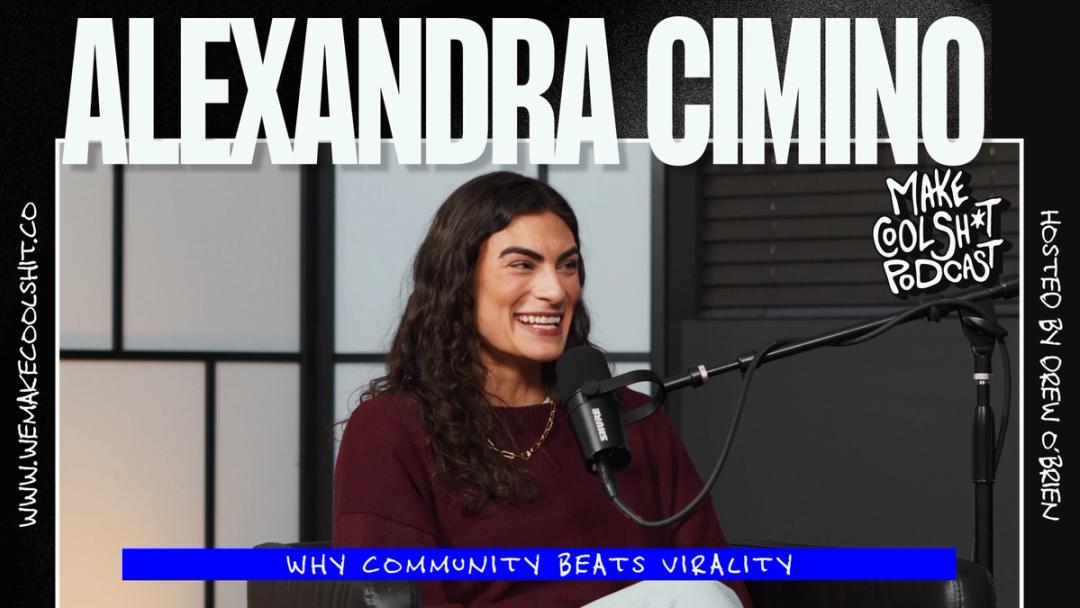
Alright, everybody, welcome to this week's episode of the Make Cool Shit Podcast. Today I'm sitting down with Al Samino. She is a social media agency owner, she's an amazing singer and recording artist, and she makes the best sourdough bread you'll ever fucking taste. Welcome—welcome to the Make Cool Shit Podcast, Alexandra. Thanks, Drew. I'm pumped to be here, chat with you about all things social. We'll get right into it. We are cousins? I know, I was thinking about that. Yeah, cousins in marriage. You are my wife's first cousin. Correct. Right? We've known each other for a decade. Yep. Or maybe even more. Wow. Uh, 12 years, actually. Whenever you met your wife. It's probably around the time we met. Whoa, hopefully she doesn't listen to this episode because I don't remember when we met. Um, but you actually were the first employee of, at the time in 2017, Drew O'Brien Creative LLC. Wow. It wasn't even O'Brien Creative Group yet. It wasn't even O'Brien Creative Group. Wow. Yeah. Now, now you own your own agency. Correct. Right? Outside of being a singer and all the other artistics, baking, all that other stuff that you do, you run a full-fledged social media agency. Yes. Why? Because I can't stand social media. And listen, all joking aside, organic or even paid social media, it is a churn. Yeah. It's a lot. It's a lot of moving parts. Yeah. You need to be priced accordingly. You need to make sure that the time that you're putting in is comparable to
the revenue that you're receiving. Yeah. And also, it's not the easiest thing to scale unless you already have an agency that has multiple, multiple employees. Yep. So why did you decide to leave the most amazing company you've ever worked at in 2017? By the way, the office, do you remember our office? I don't know that I actually ever went to your office. You know what? You were before the office. Because I was totally—I was living in DC at the time. Yes. You were before the office. Okay. And by the way, the office was like the size of this television. Wow. Like, it was—it was a shoebox. Then we had—I had Allison. Yeah. Um, my sister-in-law. Right, she was after me. Was after you. So my first two employees were family. Yeah. Which is uncommon, but you guys were great. Yeah, yeah. So I no longer run social media clients at the moment at Make Cool Shit. When you were working with us, we had anywhere between like 5 to 12 people that we were running at that time. Mm-hmm. Why don't we do it anymore? Unless it's at like a 5, 6K a month range to just to start. Yeah. It's not really worth it for us, right? The juice isn't worth the squeeze. Totally. So there's a million social media agencies out there. Yep. Right? A, what makes you different? And B, why did you decide to continue that social media career even after we originally started working together? Yeah. Wow, this is bringing me all the way back.
So you were also the first, like, company that I actually ever, like, worked for. Because I, at college, I was working—well, I guess I was working for a startup that I started with friends. Frodo? Frodo. We could talk about that. Is that still a company? No, no. Nope. It was good, though. Frodo was fun. But that's what got me started in social. Okay. I was doing social for Frodo. And then I wanted extra cash, and this opportunity came. You offered me a job, and I was like, "Oh, cool, I could freelance and do social media." And then, I mean, honestly, I never intended to continue in social, but opportunities just kept coming. I started to build my own clientele after working with you. And it was just something that kind of came naturally to me. I loved working for myself. I loved, like, it's funny, thinking back to the starting, like, moments of this. I loved, like, the time freedom that I had. I loved, like, not working for someone else. Um, I don't know that I would say I have much time freedom anymore. I was—I was trying not to laugh because, you know, the whole entrepreneur thing is like, "Oh, start a business so that you can make your own schedule." And not working—you work 24/7. I work so much now. But it's—it's re—it's so rewarding to, like, do it for yourself, I think. Um, but yeah, I mean, I—again, I never intended to stay in social, but I—I've—I've built the business. I've been doing it for, I guess, what, 7, 8 years now, since 2017. That's when you started, right?
That's when we started? Yeah. Yeah. Um, I think the thing that has kept me is I've—I've loved the people that I've gotten to work with. Which is important because regardless of the size of business, you can run into shitty clients. And, oh, I have. Yeah. We all have. We all have, right? We don't need to call them out here on the podcast. But—and listen, sometimes it's also not just the client. Yeah. Right? There's a lot of times where I've, in hindsight, looked back and been like, "Yeah, I didn't handle that the right way." Oh, totally. For sure. Yeah, yeah. I mean, it's a learning curve. I learn every time—to this day, I'm still learning with each new client that I have how I can better tailor my services to what I know I'm good at and what people need. Also, like, what's my limit? Where are my boundaries? Like, I'm still figuring all that out as I go. What are you good at? Or. And—and why do you think the organic, not on the social media side, the—the word-of-mouth referrals come to you? Because we were talking earlier off camera, your website stinks. Terrible. You haven't put any focus on the business externally. Mm-hmm. But that's because the work that you do brings people to you. Yeah. Right? Why do you think you keep getting organic referrals? And why do you think that you have a need to update your website?
Because every business owner, you always forget to update your website, ours included. Even though we're building a new one as we speak, yeah, I could have like 10 new projects on our site right now. Yeah. But we're focused on the work. Mm-hmm. But that's not what it really should be. But why do you think you're continuously staying in business. Yeah. Without spending $1 in ad spend? Man, that's a good question. I mean, I care a lot about my clients and about the people that I work with. Um, I have, like, real relationships with them, so it's—and it doesn't super—doesn't feel super transactional. Um, I—yeah, I, like, genuinely enjoy the people. And I think that's like—that goes far, right? Like, obviously they want to see results. They're investing in social media. They want to see, you know, community growing online, and they want to see that convert to sales or whatever it is that they're trying to sell for their business. But also, like, I enjoy working with the person. And I—I think that that kind of goes far. I mean, yes, I'm an agency, but you're not just getting, like, assigned to an account manager and you're never going to talk to me. Like, you're dealing with me. You know? It's a—it's a one-on-one situation. Yeah. I mean, I—I hire help when I need it. So I'm definitely like a small scale. Like, I work with medium to small-sized businesses. I have—I've had some corporate, like, accounts that I've worked with before, but it's—it is very personal. And I think people like that. They like that it's personal. Who is your target customer? Because you just said you work with small to medium-sized
businesses. Yeah. Right? If your website was redone, there should be a sentence on the beginning of your website that says, like, who you are and what you do. Yeah. I think I do have small to medium-sized businesses on there, if I'm not mistaken. I think it's been—I'm not even joking—like four years since I've updated my website. The last time I looked at your website was probably seven years ago, and I don't think it's changed since the last time I looked at your website. I don't think so. Um, but yeah, I would say small to medium-sized businesses. A lot of them—some of them are local, some of them are not. But, like, we work remote regardless. Like, I'm always—you know, we're doing everything pretty digitally. Um. So a client comes to you, what do you actually do? You focus on paid, organic? We do all organic. So my goal is always to figure out, like, you know, what is your business goal and how can social support that? So. Which is important rather than just posting to post. No. Oh my gosh, that's the worst. Just posting to post, that goes nowhere. You're spending money hiring me, and I want it to be worth it, right? The thing too, I try to set the expectation. Like, I'm not guaranteeing that you're going to go viral or that you're going to get 10K followers or 100K followers, wherever they're at. I do not guarantee or promise that because social is a beast that is sometimes very unpredictable. Yeah. It changes daily, weekly. Changes all the time. And that's like the battle, right?
Like, what is the algorithm doing? My goal with social is I try to figure out how can you build a community online? Because social media was made originally to be social, right? And we as humans often forget that the people—like, when we see, you know, 10K views on a video, that means there's 10,000 people that are viewing that. You have 100 comments on a video. Those are 100 people that have commented on it. We, like, lose this sense of human connection on—on our phones because we're staring at a screen. Um, so my goal is to keep social social. And I'm not always all about the numbers. Of course, that—that means something. There is definitely, like, importance to the metrics. But how are you, like, converting the community that you're building online to be actual customers? Um, and I found that that has made a big impact. And it's like, I always say consistency over time makes the biggest difference. Like, it's great to go viral because you can get, like, a boatload of, you know, followers overnight or something like that. But the—the method and the bread and butter is consistency over time, being genuine, and connecting with actual people. That's kind of what my strategy is when I approach social. I think that's important, right? Because, you know, especially small businesses, not the medium-sized. And by the way, technically speaking, a small business can still do a million, $2 million a year, right? So medium-sized business could be a $5 to $10 million business. But the point is, hitting on the community aspect, I think, is extremely important. Because whether you're—I know you have the Philly Marathon as a client, right?
Um, the running community is huge. Yeah. I forgot to mention, Alexandra is also an Absurd Athlete Division I scholarship, Maryland. Uh, I don't exactly know her bio other than, uh, if you follow her on Strava, she's a fucking beast. Um. Currently injured, but we'll get back to that. Currently injured, currently injured. You follow her story, she's like, you know, like, doing a—throwing a rock up a hill or some shit like that. But, um, you mentioned the community aspect, right? And I think it is important to build that core community. Because whether it's an apparel brand, whether it's a running community, whether it's a restaurant, whatever it is, right? If you're not able to tap into that community. Yep. Then a—then going viral doesn't matter. 100%. Going viral once might get you 500 to 3,000 followers. Oh, yeah. Yep. Right? But that doesn't mean money. Yep. I think a lot of people sometimes correlate viral and views with revenue. Mm-hmm. And they're not one and the same. No. You also mentioned something that I think almost every single person forgets when it comes to social media, myself included. Mm-hmm. I think at the time of this episode, we have like 35,000 followers on—on Instagram. Yeah. And in my head, I'm like. You need more. I—we need to be at 100. Yeah. And then I said something to my brother the other day, and Connor was like, "Dude, you—that's more than Madison Square Garden." Put those people in a stadium. I always say that. And. Think of the number. And I—I literally just got chills just.
Yeah. Like, just saying it out loud. So like, if you really think about—so some people can make a million dollars with 1,000 followers. It's about how engaged your audience is. It's about the community. Yes. And the audience. I, you know, they're—they're the same word in this scenario, right? Yeah. But like, so on the other end of the stick is, I make a lot of money with the followers. Mm-hmm. Right? I make sure I monetize. Mm-hmm. My following because that's what businesses should do. Yep. I can't tell you how many people have half a million followers, a million followers. They don't do nothing with it. And they're fucking broke. Yes. Yeah. Right? Some of them are very smart, and they monetize it, and they're extremely wealthy. Yeah. Due to it, right? But I—how many people's, uh, uh, uh, Porsches are rented? Mm-hmm. Or—or the house that they're staying in, in LA on this—on this reel that they posted. Yeah. Is their cousin's house. Yeah. Right? So, you know, people don't build that community. Mm-hmm. Right? And usually, sometimes they're just a very good-looking guy or a very good-looking girl. Yeah. And then that's how they get followers. Capitalize on their, yeah. Oh, hey, you know, um, use code, um, 20% off, whatever, whatever. Right. On this bullshit water brand. Yeah. Right? But they're not building a community. They're just using their looks or their, um, they're just using their likeness for the wrong reason. Yeah. So I think it's super important that social media focuses on that community and that actual audience because you are nothing online without it.
Yeah. Yeah. 100%. The other thing too, like, yes, we want to make money, right? We want to increase our revenue. Everyone does. But are you, like, selling your soul for the sake of your bottom line? Like, at the end of the day. To answer your question, most companies, yes. Yes. Yes, they are. At the end of the day, are you going to go to sleep at night and, like, rest well knowing that, like, you're being—you have integrity and you're not being, like, a total fraud online and literally selling anything and everything just to make a dollar? Like, I—I—there's two things that can be true, right? Like, yes, we want to make money. We need money in this, like, world to live. Having—we all know that money is wonderful. Money makes life a lot better. People need to eat, yeah. Yeah. Yeah. But I think there's like a threshold of, like, what you're willing to do to make money. And, like, I don't think I would work well with a client that's like, "I want to monetize absolutely everything. All I want is to make money." To me, like, where's your impact? I want to see you make an impact. I want to see you actually offering something to a human that's going to improve their lives in some way. That's—that you can make money on that. You can make a lot of money on that. Think of all. You'd make more money on that. Right. Exactly. And it's these, like, short, like, term fixes of, like, "Let's just, like, get rich quick." I'm not—I just, like, I can't do that.
You know? Like, I'm not about that. I—I wouldn't be able to—to work with someone like that. Normally, I would say to a potential client, "Hey, you need to structure your website and position yourself and strategically get yourself out there. You need to have a target demographic as a company, not as you." Mm-hmm. "Who you are, uh, who are you targeting, how do you look, how do you sound," all of that. Mm-hmm. However. Mm-hmm. You don't have all of that because your website isn't great. Yeah. And you are getting—which—which is a good and a bad thing, right? But you are getting everybody coming to you organically. Mm-hmm. The website, if it's done correctly, that is filter A. Right. Right? Or—or that is the first filter. Right. Yeah. Right? So the make-cool-shit website, like, you either fucking hate us. Right. Or you fucking love us. The name itself. Right. And the name itself, that's all strategic, right? Totally. I love that. So we do have a filter. Mm-hmm. Right? But you don't necessarily have that filter. Mm-hmm. So let's just say people come to you. Mm-hmm. They want to work with you. Mm-hmm. Through the organic word of mouth. Mm-hmm. Through your great work. Mm-hmm. How do you say, "Hey, I'm going to work with John or Jane Doe"? Mm-hmm. Or, "Hey, I'm going to pass"? Yeah. To be honest, I don't think I've actually had the experience where I've had to turn someone down that I didn't want to work with.
Not even budget-wise? Um. Because that's. Yes. That's—that's the second filtration. Yes. That there—yeah. One time, I worked with someone that just wasn't willing to pay. They wanted to pay you $50 a month to. Yeah. And I was like, "It's just not going to work." Yeah. Yeah. So—but that was one time. So, like, maybe I'm lucky in that, you know, that I haven't had that experience. There was one client that I worked with that was—it was just a—they were just a headache. It wasn't that, like, the product was bad or anything like that. Um, the person I worked with, we just didn't get along. There was a lot of micromanaging, lack of trust in my expertise, and, like, started taking up just so much of my time. Paid me great. Was, like, one of the highest-paying clients I've ever worked with. And after four months, I was like, "I am not continuing this relationship." Because of the mental toll and the frustration, it just, like, wasn't worth it. Yeah. I—I—but I think it's important to say no. Yeah. Right? It took me a really long time in business to say no to a client. Mm-hmm. Even if they had all the money. Mm-hmm. Right? If I—if my bullshit radar would go up. Yeah. So episode two, we had my buddy Ryan Mack on the show, and he said something that, like, really hit me to my core. And now that I have a daughter. Mm-hmm. Right? He's like, "I don't accept clients if I can't trust them with
my child for the weekend." Oh, wow. That's good. Yeah. And no one's ever put it through that lens for me before. Now, I'm not saying that's how I necessarily look at it, but. Mm-hmm. The way he said it, I was like, "Wow." Like, he's just looking at it totally different. Yeah. He's looking at the class of the individual. Mm-hmm. Not necessarily of the establishment. Yep. If you will. Yep. So you mentioned earlier that it was a toll, this one client. It's time-consuming. Mm-hmm. Isn't all organic social media absurdly time-consuming? Do you have a personal life? How do you handle multiple, multiple clients? For example, one of the reasons why I killed social media, uh, for the—for the most part, running it for clients on the make-cool-shit side of the business is we had multiple, multiple restaurants. Mm-hmm. I'm not in your restaurant at 10:00 p.m. Because there's something going on that should be on social media. Mm-hmm. Yes. But if you're paying us, back in the day, $1,000 a month to do this. Mm-hmm. Yeah. Like, you're not—that's not enough money for me to hire a staff member and just sit and live in your restaurant for—for as long as you're open. Yeah. Right? So how do you handle all the incoming requests and all the organic, uh, uh, content that needs to go out for all of your clients in—now, you're not the only employee in your company. Mm-hmm. I know you have employees, but how do you structure your time? Yeah. That's a good, good question.
Um, well, I. I don't. Yeah. I—I don't. And I'm also—I'm in a season of scaling and growing right now, which is wonderful and exciting, and I'm so grateful for the business that's coming in. But there's growing pains. So I'm—I am in the process of kind of reestablishing those systems and figuring out what's, like, really scalable right now. I would say the past, like, three years, I've kind of been, like, status quo, and it's worked, and it's been great, and I've had a good, like, work-life balance, you know? And the winters, I would, like, take a month and, like, go ski, which has been so fun. I'm in grind mode right now. Um, but to answer your question about, like, managing all these requests that come in from clients, I set expectations upfront. You're paying for X amount of posts to go out on your social. We're going to get them in a content calendar. We're going to plan them together. Figuring out, you know, what the content strategy is. Is it a reel? Is it a carousel? Is it a—all of those things. Um, I'm not—I make it very clear. I'm not going to be, like, available at—at 10:00 p.m. on a Friday night to be posting something on your stories. If you want to do that, you're more than welcome to. And they should. They should. Yeah. Yeah. Like, I make it clear I'm not doing an entire account takeover for you. Like, that's just not what this is. We're going to create, like, a really solid organic social strategy and plan the content out. Um, I'm like, it depends on the client. Some of them, I'm like, absolutely
trust you to post the thing. You have an eye. You know your voice. But some. Some other clients do that. Some clients, I'm like. Oh, okay. "Why did you do that?" Because that was terrible. So there's a nuance to that also. You mentioned earlier that you've been going on status quo. Mm-hmm. So I've known you for years. Mm-hmm. Right? We've already established that. And you haven't ever said the word scale to me before. Mm-hmm. Right? Mm-hmm. We were recently talking when we went in to go cut down our Christmas trees together. Mm-hmm. That you wanted to scale. Mm-hmm. And almost like a weird proud father in me, I was like, "Oh, wow. Okay. Like, she's trying to take this shit seriously." Yeah. Right? Now, I know your family's going to listen to this episode because they support you in every single thing that you do. So you could correct me if I'm wrong, but you do not come from an entrepreneurship background. As far as I know, zero people in your family work for themselves. Yeah. Everybody has a 9:00 to 5:00 job or have—has had it and, um, are not brand and business owners. Mm-hmm. So you didn't grow up with that mindset. Nope. Right? And now, at whatever age you are, you know, my mom told me never to ask a woman her age. I'm 30. You're 30. Um, why now? Right? Yeah. And because you've also been running the business for years. Yes. And you've been paying yourself, and you've lived a good life, and you've taken
a month off to go skiing. Yeah. But why is it time to lock the fuck in? Yeah. Well, I think opportunities kept presenting themselves to me. And I have, in the past, been like, "Okay, let's—you know, I'm at capacity, so, like, let's do it in three months when, like, a contract ends" or something like that. I've always had, like, a flow kind of in and out. I've had a couple solid clients that I've been with for, like, seven, five years, which has been so awesome to have some sense of stability being, you know, self-employed. Um, but I had a couple opportunities come to me recently, and instead of saying no, I was like, "I'm going to say yes, and I'm going to figure it out." Like, that's. Welcome. That's kind of where I'm at. And I have to say, Andrew, it's so true what you said. I have not seen entrepreneurship in my family or, like, seen it modeled truly anywhere other than you. So, like, you've definitely been a big inspo to me. I think even when I first, like, graduated college and I was working at a startup that my friends and I started, and I was like, "Oh, he's—he's self-employed. Like, he's doing this himself. Like, he started his own business. This is, like, an actual, like, route I can take. I don't have to take the traditional, like, route of going to work for another company." And I just loved it. It was very, like, fulfilling to, like, work for something that I created myself and then, like, to see it actually last for the
past seven, eight years. Again, it's been pretty status quo, which, again, has been such a blessing. But I'm just, like, ready. I saw that—I saw someone talking about this. Like, "Don't create another job for yourself," which is what I have done. So I'm ready to, like, be actually a business owner in the work that I'm doing. So there's transition that has to happen with that. And I'm—I'm learning all that right now. I'm in the—I'm in the weeds. You're going to be in the weeds for the rest of your life. Yeah. Thank you for the compliment. Thank you. I was trying not to cry out of—out of, uh, uh—I have emotions now that I'm a dad, so. Yeah. Uh, but—but thank you. Yeah. So similar with me, though. My parents, uh, my dad, my uncle, and my grandfather, they owned a bar called The Three O's Pub in Queens. Outside of that. Mm-hmm. My family does also not come from an entrepreneurship. Mm-hmm. And they sold the bar when I was, like, seven or eight. Mm-hmm. So, like, I was young. I don't have core memories of the bar. Mm-hmm. Right? So I didn't grow up in an entrepreneurship mindset either. And I started my company because I got laid off from my dream job. Oh, yeah. Right? So it wasn't necessarily that, like, I decided to take this leap. And similar to yourself, I was status quo. Mm-hmm. From, like, 2017 to, like, 2020. Mm-hmm. I was like, "Okay, I'm making six figures a year." Right.
I live in a condo in Montclair that your mom sold us. Oh, my goodness. Um, yeah. Right? See how it all comes together? So I didn't want to, like, take a—take the next step. Yeah. Yeah. Right? Then I started meeting the right people. Mm-hmm. I started meeting my business partners at the time. I started getting in the right rooms. Mm-hmm. And then I realized—and this is just me—everyone comes to this on their own, and everyone has their own opinion. I was like, "My status quo is pathetic." Mm-hmm. Mm-hmm. In terms of what I now want. Okay. Yeah. Right? So there's always, like, that next level. Yeah. Right? I don't ever think I'll be 100% satisfied. Mm-hmm. Mm-hmm. On where I'm at. And I'm okay with that. Mm-hmm. And I've accepted that. Yeah. However, there's always room to grow. And yeah, sure, you sometimes you want to take a step back and be like. Mm-hmm. "Hey, look where we are." Yeah. Like, the Madison Square Garden thing we were talking about earlier. Yeah. Right? Like. Yes. I forget about those types of things. Yeah. But I never had that mindset. Mm-hmm. Or frequency of, like, "Hey, I'm trying to really build something." Mm-hmm. Right? Now that you're entering that new mindset, how are you setting yourself up now to scale? Mm-hmm. Are you bringing in new employees? Mm-hmm. Are you accepting contracts and figuring it the fuck out after? Yeah. By the way, if you—what you say yes or no, that's what everybody does
anyway. Yeah. Right? Yeah. So I tell people all the time, if someone called me and they needed a $10 million brand refresh tomorrow, the answer's yes. Yeah. I'll figure it out. Yeah. And I'll bring in 10 more people tomorrow. Yeah. Right? Like, and I know I will. And, like, but the difference in the past was—and this is where I believe you will get—in the past, that was a lie I said to myself. Mm-hmm. Mm-hmm. Or that was, like, something I said in theory. Mm-hmm. Versus now, if that happened today. Yeah. It would happen tomorrow. Yeah. Right? Like, it's not a question. Yep. It's just of not if, but when. Yep. Right? So tell me how you're going to look towards scaling. Mm-hmm. In the next 6, 12 months. Yeah. I hired a business consultant, which has been wonderful. Which is not me. It's not me. Not him. Coming through all of the operations of my business, internal and external. Right? So, like, how do I work? Like, what's my onboarding process for employees versus, like, when I take on a client? Like, from the, you know, top of funnel all the way down to, like, actually booking them as a client. You've been in a business operator, not an owner. Yeah. Those are two very different things. Yeah. And I mean, I am the one doing all of the social. You're an owner and operator as of this today. Correct. Yes. Um, so I have—I literally—when was this? This was Tuesday night. I got a call, someone looking to hire me to do social for them.
And I said, "Yeah, let's do it." Do I have the capacity right now? Absolutely not. Oh. So what did I do? I texted someone who I hired as an intern in the past, and I—I texted her literally this morning. I said, "Hey, are you free to hop on a call? I have social media work. This will be paid. Let's—let's chat." And she said, "Yep, I'm free at 1:00 today." So after this podcast, I'm going to hop on a call with her, see if I can hire her. Because, like you said, let's figure it out, you know? Um, I'm looking to outsource different aspects of the business so that I'm not the one apps—like, doing everything. Um, so those are the things I'm doing right now to scale. I'm sure there's going to be more things revealed, you know, bottlenecks or. 100%. Things that I'm blind to that I'm not seeing, which is why I hired the business consultant as well, to kind of help me pull out, you know, and, like, figure out what can I automate? How do I optimize? Are—are there things that I'm doing that I'm just completely wasting my time that don't actually, like. Yes. That—that are not returning. Yes. You know, investment of my time. Half your day. Yeah, exactly. So—and then, like, you know, even things like block scheduling so I'm not task-switching all the time. Because yes, I have my social clients, but I also work part-time for my church, which is—I love, and I love my church, but that takes up time too. Right? And, like, I'm not technically working on the business when I'm
doing those things. What—what do you do for your church? I'm the music ministry and communications coordinator. So I help plan the Sunday service for the music portion of it, figuring out what songs we're singing, which volunteers are going to be on the band that—that Sunday. Um, and then also helping with, like, communication. So the email newsletters that are going out. I do some minimal social for them, which might ramp up in the new year, uh, depending on budget stuff like that. But. But correct me if I'm wrong. This is essentially an unpaid in. Oh, no. I am paid by the church. Oh. It's a job. Gotcha. It's a job. Yeah. So I'm actually looking to take them on as a client in the new year. Sure. Which would be really, really cool. And I would love to do that. Um, but again, like, those are—that's—that takes up time, right? Like, out of my day. So figuring out how to optimize all of the different projects and things that I do, plus having a bit of a social life, you know? I love to bake bread. Her sourdough is incredible. I actually—I had a few loaves that went in this morning, but I—I tasked my mom to bake them for me because I had to come here, so. Speaking of, didn't you hire your mom? I. Or am I. No. We can announce it here. She is officially hired. Breaking news. My—I hired my mom. Um. What—what's your mom going to be doing for you? She's going to be doing all of the scheduling for my posts.
So a task that takes time. It's a little tedious, but I don't want to be copy-pasting, downloading, uploading, putting them into Metricool or Sprout Social. Yeah. And no disrespect to your mom. No. It's a mundane task. Yeah. That you can hire another human as a business owner. Yes. You—and by the way, I'm still an owner and operator. Okay. Yeah. Right? So my goal is to, by the end of 2026, is to be the owner. Let's go. Right? So I'm still designing and creating and doing everything. Now it's a double-edged sword. Mm-hmm. Because are people coming to Make Cool Shit for Make Cool Shit, or are people coming to Make Cool Shit for Drew O'Brien? Yes. Right? So I want them to come to Make Cool Shit because of Make Cool Shit. Now I have a team. I have designers. I have other people that work with us. Yeah. Um, work for us, but I'm the creative director. Yeah. So I have a question for you. Every project that comes in and out, do you have your eye on everything? Every single pixel—every single pixel, every single thing that's ever left the Make Cool Shit ecosystem. Yeah. Has had my eye on it in some way, shape, or form. Like, your designers are designing, and you give them edits or approval. You're like, "All right, this is good to go to sign." Correct. For example, Richie is a somewhat new employee. Mm-hmm. He doesn't send anything to any client that I haven't approved of already. Mm-hmm. And I have to be CC'd on
all the emails. Right. And now also, like, when you're having client meetings, are your designers in there with you, or are you relaying all the information to them? Depending on the schedule, yeah. Okay. I—ideally, I'd like for everybody to be in all the meetings. Yeah. But, like, my motion designer lives in Kazakhstan and Denmark, two separate ones. Oh, okay. Okay. So. I was like, how is he in two places? No, no. Okay. Yeah, yeah, yeah. Eden lives in Denmark, and Nur lives in Kazakhstan. Okay. But the point is, yeah, I'd like them in the meetings, but the reality is I could convey that information accordingly. Yeah. If. Because that takes time. That takes time. Right? So, like, that's all I'm like, now I'm, like, micro-analyzing all the things. Like, where am I spending my time? Right? Like, okay, I have these meetings with clients, and now I have to debrief and then, like, submit those tasks to whoever's going to be creating the content, you know, whatever it is. So, like, having them in the meetings, right, would be a little bit more. Exactly. Time-effective. But is it also, like, are they people that can be in the meeting? You know, like, there's. That's important because you don't want to bring the wrong person into a meeting. Right. Says something dumb, you lose the client. 100%. Right? Right. Now, people don't necessarily think about that going into a meeting, but those are things you really need to take into account. Mm-hmm. Now, I know my team can do that because we've done it already. Mm-hmm. But for example, for us, the next thing that I need to hire.
Mm-hmm. Personally for the business and arguably for my personal life is I need to hire an assistant slash, uh, uh, project manager. Yep. I need to hire a person to clean up my life. Yeah. To do that stuff. Yeah. Right? Because you. Yeah. You know my wife, and you know my personal life. I have a lot going on in the business. And then sometimes, wrongly so, my personal life schedule gets, um, thinned. Yes. Right? And then even in that thinned amount of time that I do have, things fall through the cracks because I'm running. Yep. Make Cool Shit and two other apparel brands as well. Yeah. Right? So it's like, okay, where's my personal life? How do I be a good father? How do I be a good business owner? How do I be a good person? Yep. How do I be a good husband? How do I be a good family member? Right. All these things. Yep. Yep. Right? So you don't have enough—everybody has the same amount of hours in the day. Mm-hmm. So as you grow as a business, and something that I'm learning on a day-to-day basis too, you need to bring in the right people. Uh-huh. Now, you are bringing in this girl that you have a call with in a couple hours from now. Mm-hmm. I think it's smart what you did because you used your network. Mm-hmm. Yeah. Rather than putting up something on social media and saying, "Hey, I need a social media manager." Mm-hmm. "$25 an hour," whatever the—whatever it is. Mm-hmm. You're going to get strangers. Mm-hmm. It's always great, in my opinion, to pull
from your own network. Yeah. And be able to hire people that you know that could be in the room. Yeah. That could do the job. Totally. Yeah. Because that also saves you time. Yes. Interviewing 100 people. Yeah. For the position. Right. I mean, that's been, I think, my next biggest hurdle is, like, the talent, right? Like, hiring good talent. It matters who you have on your team, you know? Like, I know how it feels to, like, there's some clients that I have that I collaborate with other, like, people on the marketing team, right? And I love working with them. It's a joy to work with them. I trust them. They're hard workers. They're smart. They're creative. And those are the kind of people that I want to have on my team that I can trust, you know? Not that I have to hold their hand through everything because then what's the point of paying them an hour? Then—then at that point, you're doing the job. No, I don't want to do that. To—to. Yeah. On that note, the right talent, one person can do the job of three people. 1,000%. Right? And I'm not saying that because we want to pay one person less money for three jobs or whatever, but you can't—talent is hard to find. Yeah. And once you lock in talent. Yeah. Then you can train everything else. Yeah. Right? Like, I was, uh, our designer that we just hired, his name's Richie. Mm-hmm. He has talent. Mm-hmm. I could train him on everything else. Mm-hmm. But I can't train him on talent. Yeah. Right?
So—or and also, you can't train people on work ethic. Right? Yes. And on—on the flip side. Mm-hmm. I would almost sometimes have a talentless person. Mm-hmm. That is ready to run through a fucking brick wall and will do whatever's asked. Yes. Yeah. Competency is a human trait that I value so much. Competency and integrity, I think, are two things. If you have that, I trust you to figure it out if you don't know it, and also to do the best job that you can. Because if you have competency and integrity, like, that is what I'm looking for. In. The two Cs. Not just—yeah, two Cs. Not just in business, but in life as well. Like, that's the people that I like to be around, people that are competent and have integrity. How has your personal life flowed into your business life? Right? Because as someone who knows you. Mm-hmm. For years, you've become more spiritual. Mm-hmm. In the last year—couple last few years. Yeah. You've taken on more things. Mm-hmm. And, uh, uh, in your personal life. Mm-hmm. And coincidentally, you are now looking to build your actual business. Mm-hmm. So am I wrong that in some way, shape, or form, all of these aspects are connected? Uh, I mean, 1,000%. I think so. Yeah. Um, I think, like, it—it's—it's difficult to manage having a personal life, but I know for my own soul that I need my community. I need to be spending time with people away from the computer and my phone for my own sanity. So—but there's a double-edged sword too because I like to be
really diligent and have integrity with my clients. Again, that's what I'm talking about. Right? And I—I would say my faith plays a big part into that. I'm not trying to just, like, get people to pay me money to, like, do a job. Like, I want to do a good job for them, you know? If they're investing dollars into me, a dollar matters. I know how I feel about when my money goes out of my pocket. I want to see, like, quality work. So—and I would, like, truly, like, the foundation of that is my faith. I feel like if I didn't have that, then it would be—I would—I would have, like, a tendency to want to be like, "Well, like, I can make more money," you know? Like, there's. You'd be like me. No, you have integrity, Drew. Um, yeah. And I think—I mean, I believe in God. I think that he has blessed me with, like, good clients. Like, all these things I'm talking about, work that keeps coming, which, like, I'm not seeking it. It's just coming to me. And I truly see it as a blessing. And, like, I express gratitude for that. And I think that's, like, rewarded, you know? But yeah, it's—it's—it is interesting. I think I work hard when I work, and when I'm with my people, I'm with my people. Like, that's it. And if there are phases in life, there are seasons where my social life is not as existent, and that's just a season, I make sure that that's not forever because I will suffer. And if I suffer, then the business is going to suffer.
So there has to be a balance, and there's ebbs and flows to when the busy seasons come and when they—when they go. There always needs to be a balance. Right? And the work-life balance is different for everybody. True that. Yeah. Right? Um, my work-life balance is different than your work-life balance, and yours is different than the person next to you. Mm-hmm. Right? If you don't have your personal life together. Mm-hmm. Then your business doesn't matter. Yeah. Right? That's something that I've noticed recently, whether it's my business partners, whether it's my partner, whether it's, um, even on social media. Right? Mm-hmm. Like, sometimes the most random memes or—or posts will hit me. Right? Like, I saw something the other day in terms of fatherhood. It was like, "Don't forget, uh, I know that you want to give your child the best life, but don't forget to give them the best day." Yeah. I saw that. And that, like. Yeah. That, like, stabbed me through my heart. And then I was like, "Okay, how does that translate into my business?" Mm-hmm. Right? So now I do try to do that with my daughter every day. Mm-hmm. Right? But now in the business, so if I come into work pissed off. That's going to show. Then the four people that are in the office, like, they don't want to talk to me. 1,000%. That's also—both of our work is in the creative space. Mm-hmm. So it's like, if you're pissed off all the time. Yeah. And you're coming in because you had a fight with your—with your partner or your mom or whatever, and then it's going to affect your work.
Yeah. So people don't realize that the personal side, uh, 9:00 to 5:00 salary-paid workers are a little bit different. Mm-hmm. Because it's, like, a different, um. Clock in, clock out. Clock in, clock out. Yeah. Right? My wife, Gabby, she clocks in, clocks out. And I have nothing against that. Yeah. There's more people. There's millions of people. There's a lot of beauty to it. That do it. There's a lot of beauty to it. 4:00 p.m., her laptop closes, and she's like, "I'm good." That's nice. Yeah. Yeah. 4:00 p.m., my laptop opens for shift two. Yeah. Right. Right? So—and—and I'm not judging her or anyone else, but that's just—it's just a different mindset. But when you are 24/7. Mm-hmm. 365 on the business, if you are struggling personally. Mm-hmm. Whether it's mentally, physically, emotionally, it drastically bleeds into the business. 100%. Yeah. Yep. Is that something that you've experienced? Yeah. I mean, ooh, 2020 was a rough year. That happened. What happened in 2020? I lost almost all of my clients. I was just going through a terrible time in my life. And I, like. Outside of the pandemic. Outside of the pandemic. Yeah. It was just a rough time. But you know what? It's shaped me to where I am right now. A lot of factors that have made me who I am today. So, like, grateful for the struggle. Right? Part of me is, like, I didn't want to go through it, but I
wouldn't be here without that. So, like, I'm grateful for that. But I lost almost all my clients because I was struggling so much in my personal life. Right? Did you lose them because of the pandemic, or you lost them because of what was going on in your personal life? Combination. Okay. Combination of both, for sure. But that's a good example of. Yeah. The outside world. Yeah. Whether—whether that's God, whether that's. Yep. The—the ecosystem, whatever. Mm-hmm. Whatever that means to you. Mm-hmm. Right? You know, no one predicted the pandemic. Yeah. Yeah. Right? So everybody had to deal with the pandemic. Mm-hmm. You just also happened to be going through some issues in your personal life. Yeah. So those two things combined. Mm-hmm. You couldn't plan for. No. And all of a sudden, you have no clients. Yeah. So what'd you do? I got a message on LinkedIn. I never checked my LinkedIn. I hadn't checked in, like, six months. I don't even think I'm connected to you on LinkedIn. I—you might not be. And I got a message from a very well-known company. I can't say who it is, but you would know it. You—I think you do know it. I've told you before. I do know it. Yeah. And they messaged me. I was broke as anything. I gave them a proposal for three times my normal, like, rate for social, and
they accepted without blinking. And, like. Because you could have been another three. Yeah. Right? I was like, "Dang it. I should have gone higher." To me, that was such a blessing. And that was truly the catalyst that helped me, like, get out of that situation, come back home, get back into social because I was like, "Oh, this is something I can actually continue to do. This could be, like, something that's stable for me." And I've been with that client ever since, and it's been amazing. Um, so that—I mean, that was so outside of my control. I did absolutely nothing for that to happen. That's where I'm like, "This is—I don't know what's going on," you know? Like. It's meant to be, maybe. Yeah. Like, I truly, like, felt like that was, like, a blessing from God that just completely fell in my lap. It was a—a catalyst for—for moving forward in social. You're on your phone a lot. Yeah. You literally run social media. Yeah. What is the worst trend that you see right now on social media? Oh, it's. And I'm not necessarily talking about a trend that's, like, "Oh, the John Hamm meme." Uh, like, we were—we were talking about that earlier. The John Hamm, uh, is that in your algorithm? Is it the guy that's, like, dancing? Yeah. Yeah. Yeah. Exactly. Where it's like, "Oh, I have a beautiful wife, beautiful business." Yeah. Beautiful daughter. Yeah. What else do I need? Yeah. And then cut to John Hamm. Yeah. Yeah. Yeah. Um, that's a—that's a—that's literally a trend.
I know. That's like a—that's a social media trend. Yes. Right. But what I should say is, what's the biggest red flag that you see on social media when it comes to businesses? Yeah. Let's forget the personal brands. Mm-hmm. Fakeness. What does that mean to you? I just sniff it out. Like, when people are, like, very obviously trying to sell you something and, like, put on this fake persona and, like, it's just so ingenuine. And I mean, I don't know who that's working on because I'm immediately scroll. I don't want to see it. I don't want to hear it. And I know that there are definitely other people that I—I'm so against just, like, the fakeness. So you could tell when a brand is being disingenuous. Yeah. And not being authentic to themselves. Like, you could—you—you could tell them. You could sniff it out immediately. Yeah. Like, just be real. What—I mean, sure, tell me what you're selling, but, like, be real about it. Why do you want to sell me this? Like, why do you believe in this? Like, what has it done for you? Like, talk about that. Like, "Hey, we're here today, and I " you know, it's like, "I can't. I just can't do that." The social media influencer sell. Yeah. Yeah. Uh, yeah. Even, like, the paid social stuff, like, pe—you know, they're—it's a sponsored post. They're getting paid to say it. Like, be real about that. Like. So you—you're—you're more attracted to brands that tell a story, maybe?
Is it kind of, like, what I'm reading between the lines? I—I love storytelling. Storytelling is a great way to bring someone along the journey and actually convert them into a customer. Because going back to what you said earlier, storytelling drives the community. 100%. Right? So. How can we relate? Yeah. A good example is, I never heard of Bandit Running five years ago. Yeah. Yeah. I don't even know if they were a company. Uh-huh. Right? Now, granted, I was training for the marathon, but you've—you've been in the running space your whole life. Mm-hmm. I haven't been. Mm-hmm. Right? So a company like that built a foundation, built a core. Mm-hmm. Right? What are some other brands out there on social media that you believe are telling a story and running their social media the right way outside of the social media clientele? Yeah. That's a good question. Brand-wise, I'm thinking more some, like, influencers that I know. Shout them out. My friend Matt Zalaya, he's a—he's a fitness influencer. But he—I love the way that he brings you along his, like, training journey. And he shares all the ups and downs to it. He just did, like, 100 miles in the mountains of Colorado at Leadville 100. Jesus. It's an insane race, but he really captures, like, the highs and lows through it. And he brings you along, you know? Um, and I know him personally, so, like, he's an awesome dude. So he's the same online as he is offline. And that's another thing that, like, I love to see.
Um, so I think he's doing an awesome job with his—his socials. What's your favorite thing about social media? Oh, the people. The amount of, like, people that I have met online and then actually gotten to meet them in person, and they've become legitimate friends. Like, that's the whole point. To me, that is truly the whole point. Take your relationships offline, get them into the real world. And, like, now I want to engage with their content even more. I know them personally, even if I've only met them just once. Like, I know who you are. You're not just this person, pixels on my screen. So I want to—I want to give you flowers. I want to support you. I'm going to comment on all your stuff. To me, that's how you build the community. Like, meet people. Yeah. And I think when it comes to social media, it does get a lot of negative. Mm-hmm. Connotations and a lot of negative attention. Right? But there's also people in England that follow us. Uh, I—I, you know, here at Make Well Shit that I talk to more than I talk to my own friends. Like. Yeah. There's a way for you to reach people out there that you couldn't reach before. 1,000%. In—in the most positive way. Right? Yeah. There's also other business owners and other entrepreneurs that I see on social media that support me, and I was a complete stranger. Mm-hmm. Right? And then some of the guys that I went to high school with, I've known my whole life, haven't bought a fucking thing from you.
100%. Right? So, like, it's funny. It's like, you know, sometimes your best friends aren't your clients, and then an absolute stranger on social media. Like. They're going to support you. There's people that like, comment, and support me on every single post that I do on my personal page and my business page. Yes. And—and my apparel brand. Like, there's some people that are just ride or die. Yeah. And that is the beautiful aspect of social media. Yeah. There's haters. There's assholes on social media. Mm-hmm. There's people that mock us all the time. Mm-hmm. We get all the time, "Oh, you guys are so cool at Make Well Shit. Like, your work sucks." Right? Now, those haters are hitting me up from their mother's basement. Mm-hmm. So I—I don't really—I don't really take them too seriously. Yeah. But I look at social media as a very, very powerful tool. Yeah. For fun and also for business. Right? Mm-hmm. There's absolute strangers. Yeah. From other countries who have followed me. Yeah. And paid us tens of thousands of dollars. Right? Not to only bring it back to business and revenue, but that is also monetizing. Mm-hmm. Your social media pages. Yeah. When you hear the word "brand," what does that mean to you? To me, brand is your identity. So when you think of, like, your id—how are you identified? Right? It's, like, how you look physically. Right? What your brand looks like. What's the feel? What kind of conversations are you going to be having? What's, like, the soul behind your company? Your brand is—I mean, it's obviously, like, the
front, you know, facing thing of—of your business. Um, but I think it's—yeah, it's how you are identified in this world. Right? I mean, there's so many brands that we know of. When we—when we think about them, like, I don't know. I just think about McDonald's. They have such. One of the biggest brands in history. Literally. Yeah. Yeah. Like, they have such an identity. There's, like, so many things that co—like, Ronald McDonald, Playful. They own the color red and yellow. I mean. They own it. It's iconic. Right? So to me, your brand is your identity. And that should go back and, like, align with all of your, like, the soul of your business. The purpose, integrity, vision, mission of your business should reflect in your brand, which is your identity. I just realized, is the name of your company called Soul Media because of what you just said? Or this is how you're now going to revamp your website? No. It's—there's a little bit of—there's multiple things for Soul Media. Soul meaning, like, social media, soul media, like, the play on words. Soul in Spanish is sun, so, like, to be a light on social media. And then also, like, the soul, having some, like, heart, integrity, and soul in social media. I think that's important. And I think you should redo your website, and you should probably call maybe us. And—and we could help you out. I need help. Yeah. Listen, I'd like to end this with, are your DMs open? DMs are open. In your personal life? No, I'm kidding. You—you don't actually have to answer. Are you taking on new clients?
I'm—I'm taking on new clients. Your DMs are open. The DMs are open. Professionally. Professionally. Personally too, maybe, but. DMs are open. If you need social media help, hit me up. Um, I want to work with you if you have a—a passion for what you sell in your business and see how I can help you out to share that on social media. If someone would like to reach out to you, where can they find you? They can find me on Instagram at alexandrasimino_. That's A-L-E-X-A-N-D-R-A-S-I-M-I-N-O_. And DM me. That's it? No website? No? Website is soul-media. It's so embarrassing. But you can—you can go to my website, my email. Should I share my email address? No. Email is alexandra@soul-media.com. S-O-L dash media dot com. That's a wrap. Thank you, everybody. If you've learned anything from this, like it, share it, subscribe. Do—do all the buttons. And we will link up with you guys next week. Cool.